In March, 2007, Warner Bros. released a $65 million movie with no real marquee draw, adapted from a Frank Miller comic most people have never read, shot almost entirely against bluescreen on a Montreal soundstage. Sixty days, in sequence, with basically nothing physically there except the actors. The director had one feature to his name, a Dawn of the Dead remake. Warner’s distribution president, Dan Fellman, said the studio was expecting somewhere between $35 and $40 million on opening weekend, which is the sort of number you say out loud when you want to be pleasantly surprised. It made $70.9 million, the biggest March opening on record to that point, and turned Gerard Butler into a bankable action star for the next two decades.
Videos by ComicBook.com
Much of that came down to a few seconds of film. A Persian messenger stands at the edge of a well, tells the king of Sparta that what he is doing is madness, and gets an answer that has since been remixed, parodied, printed on shirts, and quoted by people who haven’t even seen the movie. It is the rare movie line one stranger can start and another would chime in and finish. But what’s strange is the delivery everyone knows was not what Butler had been giving them for most of that day, and by his account he came very close to letting the quiet version stand.
Was “This Is Sparta” Really Supposed to be Whispered?
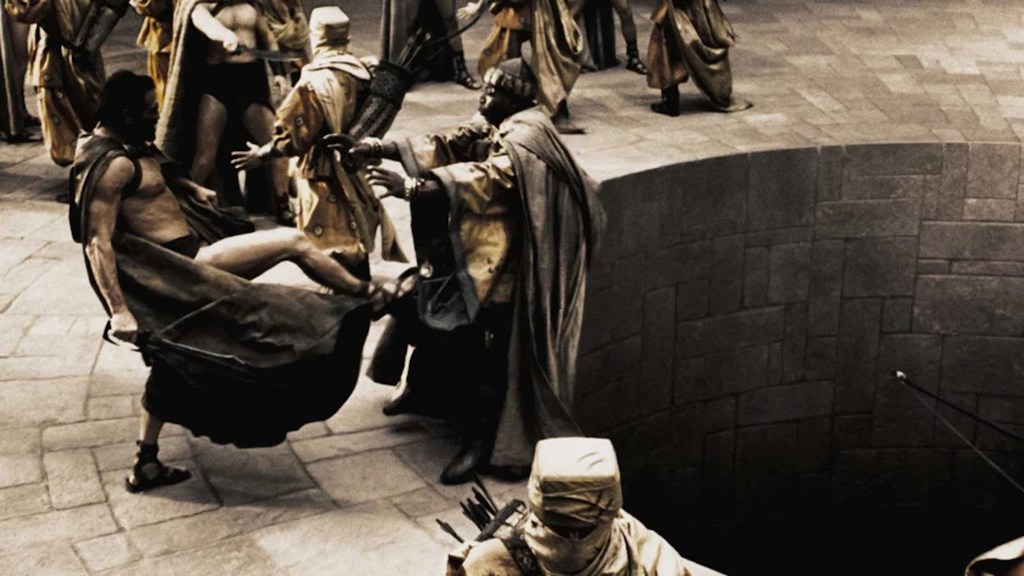
Butler told the story during interview for GQ in 2019, and his version is most likely better than one you have probably read. He had been playing Leonidas as a man who did not need to raise his voice, which is a defensive reading of a kind who has already decided how the conversation ends. “I had done quite a few takes,” he said, “and most of them were,” and here he dropped his voice super low, “this is Sparta.” Then something nagged at him. “It was part process and part insecurity, maybe, but I go, ‘Can I just try another one?” Snyder said yes. Butler screamed it, kicked Peter Mensah down the hall, and turned around to find his entire army of extras with their hands over their mouths trying not to laugh. By his account he walked straight over to the director and started apologizing. “That was too much, huh? That was too much.” He remembers Snyder telling him yeah, but it was awesome.
Now the version you have 99% read adds a detail nobody has confirmed, and that’s that the script told Butler to say the line calmly and he defined the direction. There’s not a script page, storyboard, or comment from Snyder or his co-writers who supports it. Butler describes his own instinct, which he then overruled, and that is honestly the better story anyway. Nobody was ever standing above him insisting on restraint. He had a reading of the character he liked, and only found out it had landed after everyone finished laughing at him. The most quoted line of his career exists because he second-guessed himself on the first day and asked for one more.
Did Frank Miller Write the Line, or Did Herodotus?
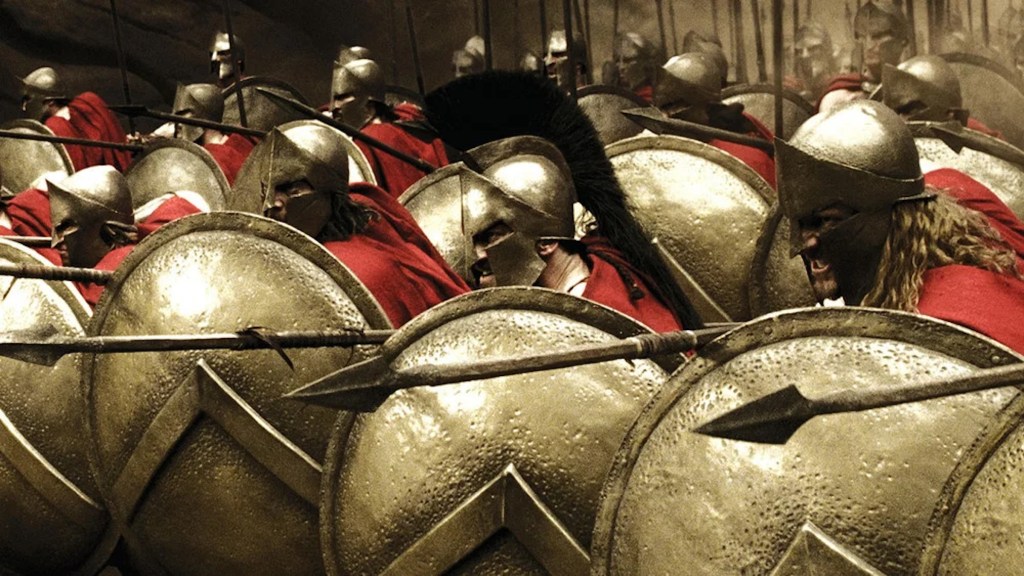
So, who wrote the famous line, Miller or Herodotus? Both, sort of, and neither the way you would guess. The bones of the scene come from Herodotus, who wrote that Persian heralds demanding earth and water as a symbol of submission were thrown down a well by the Spartans and told to collect it themselves. The messy detail is that Herodotus put that incident about a decade before Therapylae, under Darius rather than Xerxes, and Leonidas had absolutely nothing to do with it. Athens dropped the heralds sent there into a pit, because apparently this was just how Greek city-states handled Persian correspondence. The Spartans later felt bad enough about it to send to volunteers to Persia to he executed in atonement, and Xerxes refused to kill them. That must have been an awkward trip home, and it is the one part of the whole story nobody has ever put in a movie.
Miller and colorist Lynn Varley included the scene in the first issue of their 1998 Dark Horse series, and the line belongs solely to Miller. What he wrote plays flatter on the page than what ended up on screen, closer to a correction than a roar. Snyder, Kurt Johnstead, and Michael B. Gordon kept the words. Snyder famously photocopied Miller’s panels and used them as storyboards, which is how a comic published nine years earlier ended up dictating the framing of a blockbuster, and why the film looks less like an adaption than a tracing. The one thing those panels could not hand him was volume.
How Did One Scream Sell a $65 Million Gamble?
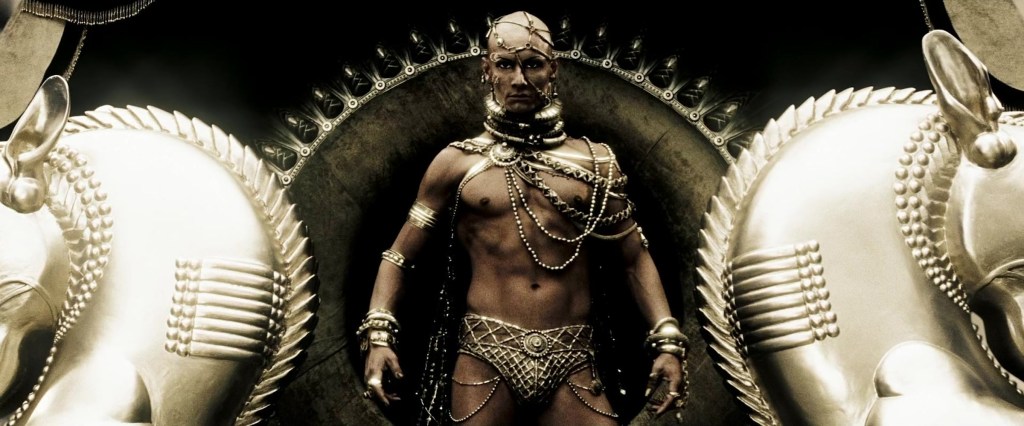
The marketing team understood what they had before audiences did. A teaser leaked out of San Diego Comic-Con in July 2006. The official trailer arrived that October scored to Nine Inch Nails, and Warner Bros. moved the release date up a week the same month. By February 2007, three weeks before anyone could buy a ticket, a user on YTMND had already posted a remix built around the line, and it went on to draw about 180,000 views and spawn an entire genre of copycats. The movie became a meme before it was a movie. By the time it opened on March 9, the line had already been doing promotional work for free across the early internet months, at a moment when studios had no idea how to manufacture that and would have paid enormous sums to learn.
Producer Mark Canton credited the MySpace campaign, saying, “MySpace had an enormous impact but to has transcended the limitations of the Internet or the graphic novel,” before adding, “Once you make a great movie, word can spread very quickly.” It was the third-biggest R-rated opening at the time and set an IMAX record at $3.6 million, for a movie whose memorable asset was a man shouting three words in a stone courtyard. Berlin had already delivered the verdict in miniature weeks earlier, booing at the press screening hours before a 1,700-seat crowd gave it a standing ovation. 300 finished with $468.9 million worldwide and a 61% on Rotten Tomatoes, which is roughly what happens when half the room thinks you are ridiculous and the other half is quoting you in the parking lot. It reshaped how Hollywood thought about comic book adaptations almost immediately.
Would Zack Snyder Have Reached the DCEU Without It?

Here the popular version of Snyder’s success story needs adjusting. Warner Bros. announced Snyder as the director of Watchmen in June 2006, nine months before 300 reached theaters. He already had the job, but 300 bought him permission to make it the way he wanted. Snyder said less than two weeks after 300 opened, when asked whether the sources helped. “It has in a lot of ways,” he said. “For me, Watchmen is a revolutionary piece of work… just the idea of an R-rated superhero movie is enough to send the studio into a tailspin.” He called Warner Bros. executive Jeff Robinov asking, “Is there anything else you want to do?” We really don’t want to do this.” This is about as close as a studio gets to saying please pick anything else.
Dave Gibbons, who drew the original comic, later said the studio let Snyder see his vision out because “he just came off the back of a huge success like 300, which made a lot of money for the studio.” The adaptation everyone called unfilmable went into production that September. The chain runs a little differently than the legend, then. A flop in March 2007 probably does not cost Snyder the Watchmen job outright, but it almost certainly cost him the R rating, the budget, and the running time nobody wanted to give him. Watchmen underperformed anyway in 2009, and he still landed on Christopher Nolan’s shortlist for Man of Steel the following year. The film became the foundation of the DCEU, and he has since said Watchmen is the movie he is proudest of.
With 300 turning 20 next March, Snyder premiered his long-gestating passion project The Last Photograph at TIFF this month and confirmed that a 300 prequel series is moving forward, calling it “a very rich universe” and saying he would love to direct episodes himself. The franchise is still growing, and none of it happens if a nervous actor on a Montreal soundstage decides the quiet take was good enough.
Did you know about how that iconic Gladiator line came to be? Let’s discuss in the comments.
More Movies
-
IMAGE COURTESY OF WARNER BROS.