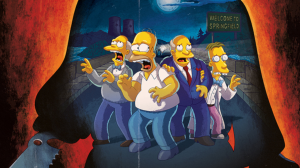
Television had spent fifteen years failing to make good on a season-ending cliffhanger before The Simpsons decided to try one anyway. The model everybody was working from was Dallas, which closed its 1980 season by shooting J.R. Ewing and then spending eight months withholding the answer to who did it, and when the answer finally came it was a piece of plot machinery rather than a punchline. Creator Matt Groening pitched his own version to writers Bill Oakley and Josh Weinstein on June 3, 1994, name-checking that exact cliffhanger, and the pitch the two of them came back with insisted on something the original had never bothered to attempt. They wanted a genuine solvable mystery, with small things planted throughout that pointed at the actual culprit, so that an audience could work at it across an entire summer and get there on its own. “Who Shot Mr. Burns? (Part One)” closed the sixth season on May 21, 1995. The answer arrived on September 17th, and the answer was a baby.
Videos by ComicBook.com
Maggie Simpson shot Mr. Burns. Not deliberately, at least not officially. Burns had spotted her sitting in the family car with a lollipop, decided on the spot that taking candy from a baby was worth his time, and lost his gun out of its holster during the struggle. It went off in her hands. He collapsed onto a sundial, and the dying gesture he made toward its letters, which read W and S from where the police were standing and M and S from where he was lying, is the entire solution sitting in plain view for four months. What the show delivered was a joke rather than a twist, and the case worth making is that the joke was the strongest option available to it. Every other ending the production seriously considered is on the record now, not one of them is funnier, and several would have cost the show something it could not afford to give up.
The Answer Was a Baby, and 31 Years On It Still Looks Like the Right Call

Part Two opened the seventh season on September 17, 1995, written by Oakley and Weinstein and directed by Wes Archer, and it drew 22.6 million viewers, the largest audience of that entire season. What those viewers got was a scene in which Burns wakes up, names Maggie, and immediately demands the infant be arrested, at which point Chief Wiggum explains that no jury in the world would convict a baby, before pausing to add the qualifier “except maybe Texas.” Marge then reassures the room that it must have been an accident, because Maggie is far too young to understand what she has done. The camera pushes in on Maggie. Her eyes shift. She works her pacifier in a rhythm that sounds a good deal like gunfire.
That final beat is the reason the ending works, and it was a late addition rather than the original plan. Showrunner David Mirkin has said the problem with an accidental shooting is that an accident is not a resolution, it is an anticlimax, and his solution was to leave the question of intent hanging by a thread. “What if Maggie did it on purpose?” he has recalled asking. “We’ll have her eyes dart at the end.” Oakley and Weinstein were uneasy about the idea at the time and were won over by that single piece of animation. It converts a mechanical accident into a character beat, and it lets the audience decide whether the youngest Simpson is a victim of circumstance or the only person in Springfield who actually finished the job.
Barney Gumble Was the Plan, Right Up Until Someone Pointed at the Family

The original culprit was Barney Gumble, and the writers had the aftermath worked out. Barney would go to prison, and the experience would reform him. Weinstein has described the pitch in exactly those terms, and the structural requirement he set for the whole story was that it had to be about Mr. Burns making six mortal enemies in twenty-two minutes. Earlier drafts were stranger still. The room considered making the shooter a complete stranger, which Weinstein compared to a Twin Peaks approach, a drifter who had only just arrived in town. Selma was on the list. By his account there were five further pages of suggestions, and Maggie was on one of them, buried among the rest.
What killed Barney was not a story problem but a maintenance problem. Sending him to prison would have changed the shape of the show, and The Simpsons in 1995 was not a series that let its consequences stick. Mirkin’s stated objection was precisely that, and his stated preference was for the culprit to be a member of the family, on the straightforward grounds that it would be funnier. Who actually said the name first is genuinely disputed, which is a small and honest complication. Mirkin has credited himself, saying “Maggie is a much funnier person” and “I suggested Maggie.” Oakley has credited producer James L. Brooks, remembering him landing on it with “What if it was Maggie?” Both accounts agree on the reasoning even where they disagree on the author.
The Clues Were Genuinely There, Down to Every Clock in the Episode

The fair-play promise in the original pitch was kept more rigorously than most viewers noticed. Oakley has explained that every clock visible in Part One was deliberately set to roughly three or nine o’clock, so that an audience would be trained to register a clock face in that position and, by extension, to read the sundial at the end the wrong way up. The sundial itself was the discovery that made the ending possible. Weinstein has described the moment the room realized Burns could point at the letters W and S, which flip into M and S, and that those initials covered a large portion of the cast. That is also why so many suspects share them, with Smithers, Skinner and Moe Szyslak all sitting neatly inside the same clue.
The rest sits in the open. Burns talks about taking candy from a baby before he is shot. Maggie is visible in the car with a green lollipop. His holster is plainly empty as he goes down. At the town meeting where the entire population turns on him, every armed adult in the room looks away at the crucial moment, and the only person still glaring at Burns is the infant. None of it is hidden and none of it is a cheat. The trick the episode plays is one of volume rather than concealment, burying the real evidence under a town’s worth of people who all have excellent reasons to want the man dead, and trusting that nobody will think to suspect the one character who has never said a word.
Keeping the answer from leaking took more work than planting it. Only animator David Silverman was let in on the solution at first, and Archer directed most of Part Two without knowing who had done it. The table read was halted before the third act so the voice cast would not learn it. Mirkin went further and recorded a set of false endings with Harry Shearer performing all of them alone, naming Barney, Moe, Apu, Santa’s Little Helper and Tito Puente as the shooter, so that any leak reaching the press would be worthless. One of those alternates was animated and did eventually air: the version in which Smithers is the culprit turned up that December, and Burns responds to the revelation by cutting his pay by five percent.
The Show Knew Exactly What Everyone Was Going to Call It

The most telling thing in Part Two takes about four seconds and happens before the story starts. Bart’s blackboard gag that week reads “I will not complain about the solution when I hear it.” Part One had opened with “This is not a clue… or is it?” Taken together, the two lines are the writers stating on the record that they knew the resolution was a joke, that a portion of the audience would feel cheated by it, and that they were going ahead regardless. It is hard to think of a cleaner pre-emptive defense, and it is the reason the cop-out complaint never really took hold. You cannot accuse a show of pulling a fast one when it opens by predicting the accusation.
The verdict since has been generous, and mostly on those grounds. The widely repeated critical read is that Maggie is the best answer the show could have arrived at, and the reasoning tends to land in the same place every time, which is that the comeuppance fits. Burns spends the two-parter blocking out the sun and stealing from an orphanage, and he is undone by the one resident of Springfield who cannot be prosecuted, cannot be reasoned with, and has no idea she is the villain of anyone’s story. A dramatic answer would have made Burns a victim. A comic one keeps him ridiculous, which is the only register the character has ever worked in.
The other half of the case is that nothing went wrong afterward. Nobody was written out of the show, nobody went to prison, and the status quo the series depended on came through the entire business untouched, which is exactly what the Barney version would have cost. That matters more than it sounds. A cliffhanger that resolves by permanently removing a character buys its payoff with something the show then has to keep paying for, and The Simpsons in 1995 was still built on the assumption that Springfield resets itself every week. The Maggie answer bought a real surprise and charged nothing for it, which is a rarer trick than it looks.
There would not be another two-part Simpsons episode for twenty-two years, and the one that eventually arrived ran across a single mid-season week rather than straddling a summer. The season-ending cliffhanger, the format the show borrowed and then improved on, has not been attempted a second time in more than three decades on air. That is either a sign the writers knew they had nowhere left to go with it or an acknowledgment that they had already produced the only version worth making. Either reading points at the same conclusion, which is that a series famous for repeating itself looked at the best cliffhanger on television, solved it with a baby and a pacifier, and then quietly closed the door behind it.
More TV Shows
-
20th Century Studios