Saturday Morning Television in the 1980s ran on a simple arrangement. Network had four hours to fill, advertisers had toys and cereal to sell, and children had no other option because the alternative was a farm report. Nobody in the arrangement was optimizing for quality. Shows were greenlit off a car range or an arcade cabinet, animated as cheaply as the schedule allowed, and cancelled after twelve weeks if the numbers came in soft. Kids watched them anyway, in enormous numbers, and remember them fondly forty years later. The economics only ran one way. A show existed to hold a child in place between commercial breaks, and everything else about it was negotiable. Animation houses worked to a fixed per-episode figure that allowed a set number of new drawings, which is why so much of this material moves the way it does, and why the same handful of shots keeps coming back around inside a single episode.
Videos by ComicBook.com
The four below were genuinely loved, and one of them was the most watched cartoon in the country. They are also, in ways that are specific rather than vague, very hard to sit through now. Not because of anything offensive, but because of recycled animation, plots that resolve themselves, and premises built to move merchandise rather than tell a story. The 1990s produced its own version of this problem, and the pattern is identical. Two of the four are free to stream, so half of this is checkable. The other two cannot be watched legally anywhere, which tells its own story. What follows is not a hit piece on anybody’s childhood. Each entry names the specific mechanical reason the show does not survive a rewatch, and in most cases the people making it were working under constraints that made any other outcome close to impossible. Two of the four are free to watch right now, so half of this is checkable in an afternoon.
4. Turbo Teen
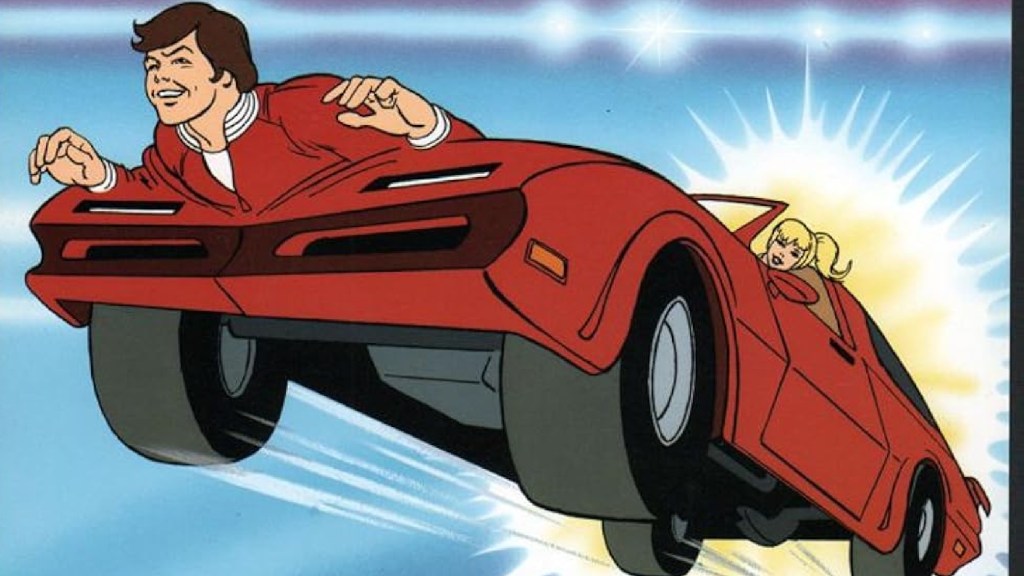
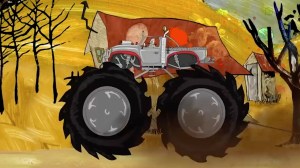
Start with the one nobody can name but everybody half-remembers. Turbo Teen ran on ABC from September to December 1984, thirteen episodes across twelve weeks, and its premise is that a teenager named Brett Matthews turns into a sports car when he gets too hot, and back into a boy when he cools down. That is the whole show. There is no reluctant-hero arc, no villain worth naming, just a weekly reason for a car chase.
What makes it unwatchable is not the concept, which is fine, but how the show renders it. The transformation sequences are played completely straight as body horror, with a human face stretching and flattening into a windshield, and then the episode cuts directly to a cheerful chase. Animation historian David Perlmutter called it perhaps the most absurd concept ever developed for television animation and criticized the production quality against the premise. Thirteen episodes is not enough time to develop anything, so the formula never varies once. Being honest: there is not ratings data for it all, and it survives now mostly as a transformation clip people share to unsettle each other. It is not streaming anywhere.
3. Shirt Tales (1982)

Shirt Tales began life as a Hallmark greeting card range designed by Janet Elizabeth Manco is 1980, and the cards were among Hallmark’s best sellers at the time. Hanna-Barbera turned them into an NBC Saturday morning show that premiered on September 18, 1982, ran into 1983, jumped networks to CBS for the 1984-85 season, and left television for good in March 1985. Twenty-three episodes across two seasons. Surviving a network is not nothing, and it had merchandise in t-shirts, plush and a Japanese licensing line.
The problem is backed into the origin. These are animals whose entire personalities are the slogans printed on their shirts, a premise engineered for a card rack rather than for stories, and the show never solves it. Cultural historian Jared Bahir Browsh attributes the show’s failure directly to what he calls the low-quality animation, the basic if not illogical storyline, which is about as blunt as an academic gets. The tell is what happened afterwards: the Hallmark card line faded shortly after the show left broadcast television, which suggests the cartoon was always the advertisement rather than the product. It is free on Tubi if you want to test that.
2. The Get Along Gang (1984)
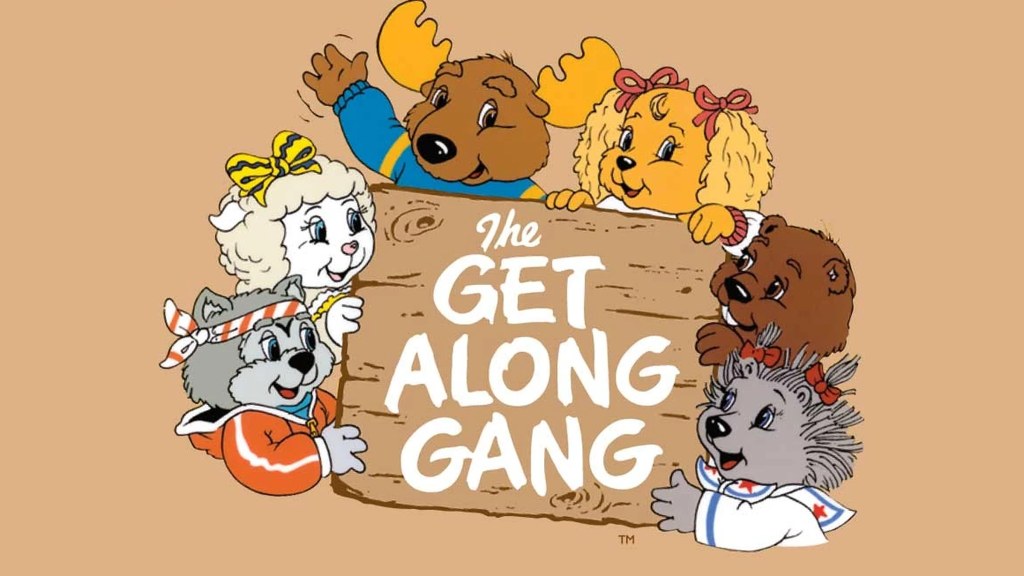
Same industry, different card company. The Get Along Gang was created in 1983 by six designers at American Greetings’ Those Characters From Cleveland division, the outfits that also produced Care Bears and Strawberry Shortcake, and those were not small properties. Care Bears is estimated at twelve billion dollars in lifetime sales, off an initial marketing spend of over a hundred million. Tomy made the action figures, Scholastic made the storybooks, and there is a detail that says everything: the Scholastic storybook line outlasted the cartoon.
The show premiered on CBS on September 15, 1984 and finished on December 8. Twelve weeks. Thirteen half-hours. What is left is wall-to-wall lesson delivery, and a specific criticism that has followed it: it enforces group conformity over individualism. You can watch it happening: the gang is alway right, and the character who disagrees is always the one who is a compliment built entirely out of qualifiers. It is not streaming anywhere, and unlike Turbo Teen nobody has made it a meme, so it is genuinely gone.
1. Pac-Man (1982)
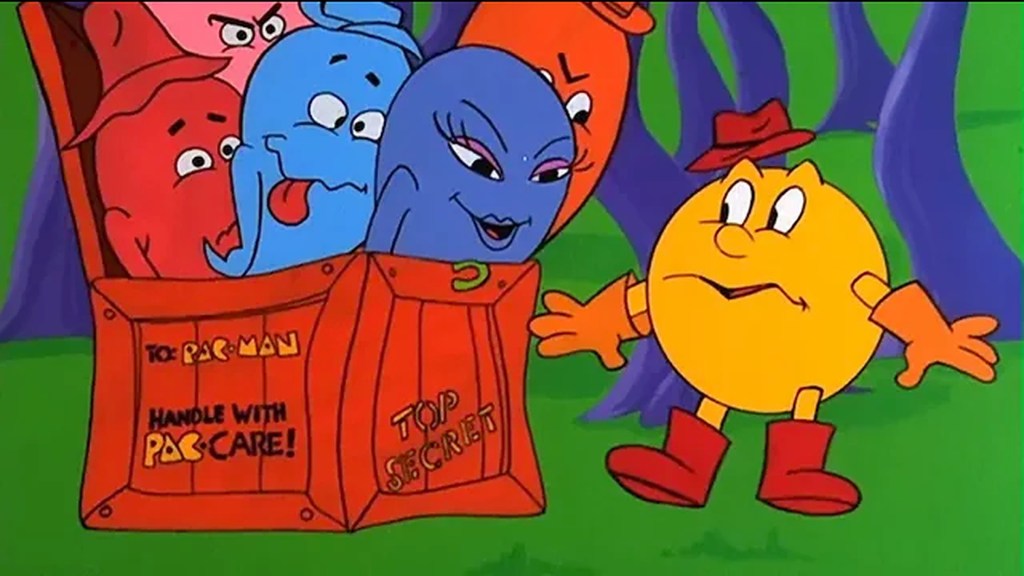
This one closes the list because the popularity is not in question. Pac-Man premiered and ABC on September 25, 1982 and was the highest-rated Saturday morning cartoon in the Untied States by the end of that year. Its debut drew more than 20 million children, plus adults. Forty-four episodes across two seasons, from Hanna-Barbera, riding the biggest arcade phenomenon of the era straight onto network television.
And it is a cartoon adapted from a game with no story, which solved that problem by running the game’s loop forty-four times. Nearly every episode is the Pac family against the Ghost Monsters, who take orders from Mezmaron, who wants the Power Pellet Forest. The Power Pellets are the deus ex machina in virtually every episode can generate real tension. Then it got worse: Standards and Practices decided the chomping scenes were too violent and had them toned down as the show went on, so a cartoon named after eating things gradually stopped showing anything being eaten. It is free on Tubi and running on MeTV Toons, so this is the easy one to verify.
–
Personally, I have some sympathy for all four of these, and the concession is that none of them was trying to be good. They were trying to be on at eight in the morning while a child ate cereal, and by that standard they worked perfectly. What gets me about Pac-Man specifically is the arc of it. The show was built on one image, yellow circle eating things, and then a network standards department decided the eating was too violent and took it away, and nobody stopped to ask what was left. That is most 1982 sentence I can think of.
The strange part is which ones survived. Pac-Man is free and easy to find, Shirt Tales is a click away, and the two shows built by greeting card companies to sell cards are the ones that vanished completely. Plenty of 1980s cartoons deserved better. These four got roughly what they were built for.
More TV Shows
-
20th Century Studios