
In 1977, filmmaker George Lucas, fresh off the success of his nostalgia-tinted American Graffiti, was positive he had a hit on his hands with his new film, an equally nostalgic throwback to the science fiction serials of the thirties and forties. Lucas shopped the merchandising rights to all the major toy industry players like Hasbro, Mego, and Mattel, and virtually of them passed. The exception was small, Ohio-based Kenner Toys, who decided that Lucas’s Star Wars was worth taking a chance on. Flipping through the production stills, concept art, and shooting script that Lucas’s representatives presented, the Kenner design team saw the potential for an incredible toyline. Star Wars was replete with exotic worlds, strange aliens and robots, and dazzling spacecraft. As their team set to work designing the Star Wars line, there was only one problem: the then-standard eight or twelve-inch scale used by manufacturers like Mego was just too big for in-scale playsets or vehicles. The solution? A brand new scale, just under four inches tall.
Videos by ComicBook.com
Or so Kenner likes to tell it. The truth was that while the Kenner Star Wars popularized the 3.75″ scale, it didn’t exactly invent it. That honor goes to Fisher-Price, whose Adventure People playsets made use of 3.75″ figures years before Kenner (in fact, some Adventure People figures were customized into the very first proof-of-concept mock-ups for the Kenner line). What set the Kenner line apart was its breadth: Kenner took full advantage of the reduced scale, and made playsets and vehicles representing virtually every scene in the film. These ranged from cardboard backdrops to replica spaceships to the most impressive of all: a towering, eighteen-inch high representation of the Death Star. Unsurpassed in almost fifty years of Star Wars action figures, this set was the first and to date only large-scale Death Star playset ever made, and it is still coveted by collectors as the centerpiece to the classic Kenner line. Mint in box, a complete (or near-complete, for reasons discussed below) sample can sell for thousands. A sample up for auction through Hakes next week has already realized a price of nearly $1k.
How Kenner’s Death Star Raised the Bar for Action Figure Playsets
Action figure playsets weren’t a new concept. Working off of the model created by Mattel with the houses and vehicles for their Barbie line of dolls, action figure manufacturers began offering playsets in the nineteen-sixties as a higher price-point, higher profit margin item that drove engagement with the line. Mego’s U.S.S. Enterprise or Batcave playsets are the best example of what these looked like. They were mostly cardboard, and were designed for 8″ scale figures, limiting their size. Mego’s 40″ high Wayne Foundation playset bucked this trend, but its massive footprint was to its detriment: retailers could stock fewer of the set, and few parents could justify the space it took up. As a result, sales were limited. With its 3.75″ scale figures, the Kenner Death Star could provide three (functionally four) levels of play while only coming in at a (comparatively) modest 20″ height.
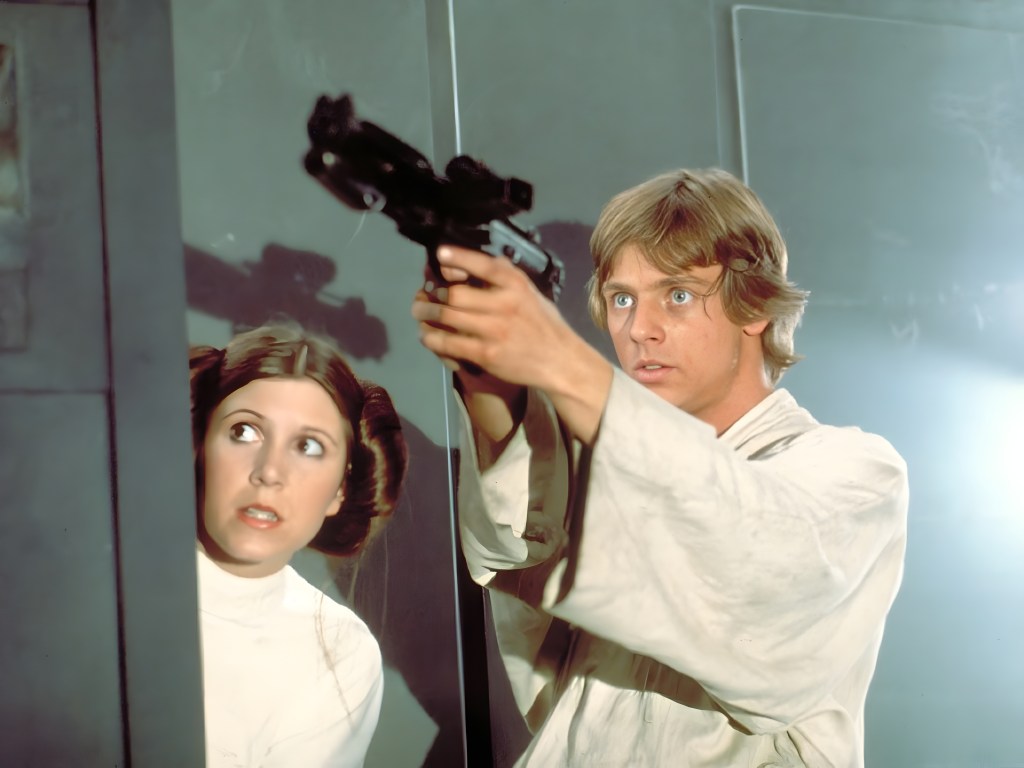
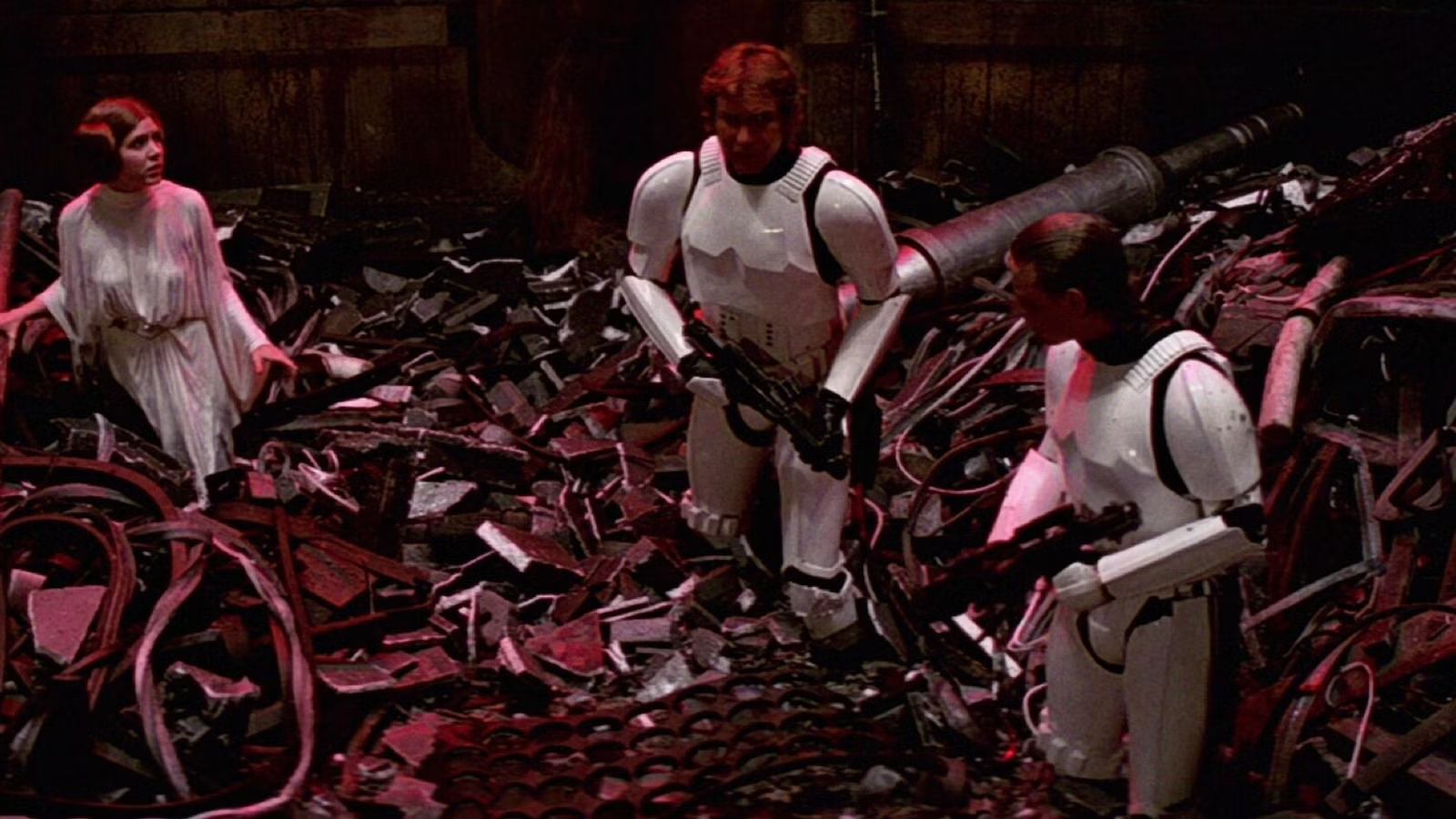
While the set takes necessary liberties with the space station’s layout, virtually every major set-piece from the film is represented. The bottom floor recreates the trash compactor scene, the trash represented by foam cubes, the “compacting” action by a push lever on the playset’s outside wall. Completing the scene, a hard rubber Dianoga (trash compactor monster, for the uninitiated) was included. As only the creature’s eye stalk is seen on-screen, the design is largely an extrapolation by Kenner’s Tim Effler. A trap-door on the floor above drops figures into the compactor. The high-ceiling middle floor offered the most room to play, occupied solely a computer panel, allowing kids to have a “boring conversation” of their own. On the box, Kenner also advertises that this area of the set can be used to stage Darth Vader and Obi-Wan Kenobi’s fateful duel. Overhead, a retracting platform creates a chasm for Luke and Leia to swing across with an included grapple-hook and rope. The top floor is the Death Star’s weapons deck, dominated by a massive, rotating laser cannon. A moving elevator space all four sections of the playset, and includes a narrow catwalk on its top floor for Obi-Wan Kenobi to span and shut off the Death Star’s tractor beam.
Retailing for $17.99, the Death Star playset was an instant hit with kids, and was under many a Christmas tree in 1978 and 1979. Its success inspired helped other manufacturers to shift to smaller-scale figures and larger-scale playsets in the decade that followed, leading to iconic sets like Castle Grayskull or the Cobra Terrordrome. In the United Kingdom, high shipping and manufacturing costs forfeited the gigantic plastic Death Star. Instead, Kenner’s U.K. partner, Palitoy, produced a mostly-cardboard set that could retail at a lower price-point. The Palitoy Death Star is preferred by some collectors, as its design is somewhat more faithful to the corridors and layout of its on-screen counterpart. The set would also be made available in Australia, New Zealand, France, and Canada. Canada makes an especially interesting case, as it was the only country where both Death Star sets were available.
Why One Major Design Decision Makes a Complete Kenner Death Star a Depreciating Asset
As is always the case with playsets, Kenner’s Death Star set includes small, easily lost pieces. Loose or opened samples on the secondary market are frequently missing the Dianoga, the rope and clip for the chasm, or the foam compactor trash. But even on mint-in-box samples, the compactor trash is a problem: the foam used disintegrates over time, and as time continues to march on, it becomes more and more difficult to locate a sample with the compactor trash intact. This also affects Kenner’s Dagobah playset, although this is less discussed, as the Dagobah set is significantly less collectible than the Death Star. Though exacerbated by oxidization, the trash continues to dry rot even sealed in the original bag, making its eventually disintegration inevitable. For the time being, Star Wars collectors will pay a premium to own one of the fewer and fewer sets with its original foam.
In its AFA (Action Figure Authority)-graded 80 Near-Mint condition, collectors bidding on the Hakes Auction are guaranteed a Death Star complete with all of its original pieces, including the trash compactor foam. That alone makes the set a brag-worthy centerpiece to any Kenner Star Wars collection, but for other collectors, the real prize is the unblemished packaging, looking fresh off a retail shelf in 1978. Evidenced by its revival in the still-running Hasbro “Vintage Collection,” Kenner’s packaging design for their Star Wars figures is truly beloved within the fandom, and many long-time collectors will tell you it has yet to be surpassed. With this in mind, it’s no wonder that Hakes expect a closing price at least double or triple the current $900 dollar bid on the Death Star: in nearly fifty years, it is still the definitive Star Wars playset for generations of fans and collectors.
More Collectibles
-
Image courtesy of Rankin/Bass Animated Entertainment -

Image Courtesy of Marvel Comics



Forum Conversation: Which Superman Costume Is Your Favorite?
Go to ForumAs of now the Kingdom Come suit
My main answer to this is that when Dan Mora draws Superman, it’s instantly my favorite. I think I prefer the modern suit best, which is just an updated take on the classic costume.
Now, two honorable mentions here if we are going a little more out there with the designs. First, Michael Turner’s Godfall suit is wild but actually rules. Second, I will always have a soft spot for the Electric Blue Superman suit. It just looks so flipping cool.
I actually like the New 52 costume a lot but Kingdom Come might be my absolute favorite. Alex Ross is just amazing.