Gene Roddenberry will always be best known for Star Trek, the franchise he created and wrote for. After starting his career as a freelancer who wrote scripts for other shows, he created and produced his first TV show, The Lieutenant, in 1963. However, it was in 1966 that he had his biggest success when the original Star Trek series premiered and aired for three seasons. When the show continued to grow in popularity thanks to syndication, he ended up producing and consulting on the feature films before helping to produce and consult on Star Trek: The Next Generation. That was the end of the road for him, though, because he stepped back due to health reasons, only consulting on the series until his death in 1991.
Videos by ComicBook.com
His death might be one of the reasons Roddenberry’s other sci-fi series remains mostly forgotten by his fans. Nine years after his death, a new series premiered, bearing his name. On October 2, 2000, Gene Roddenberry’s Andromeda premiered in syndication and went on to run for five seasons.
Gene Roddenberry’s Other Sci-Fi Series Was Also a Hit
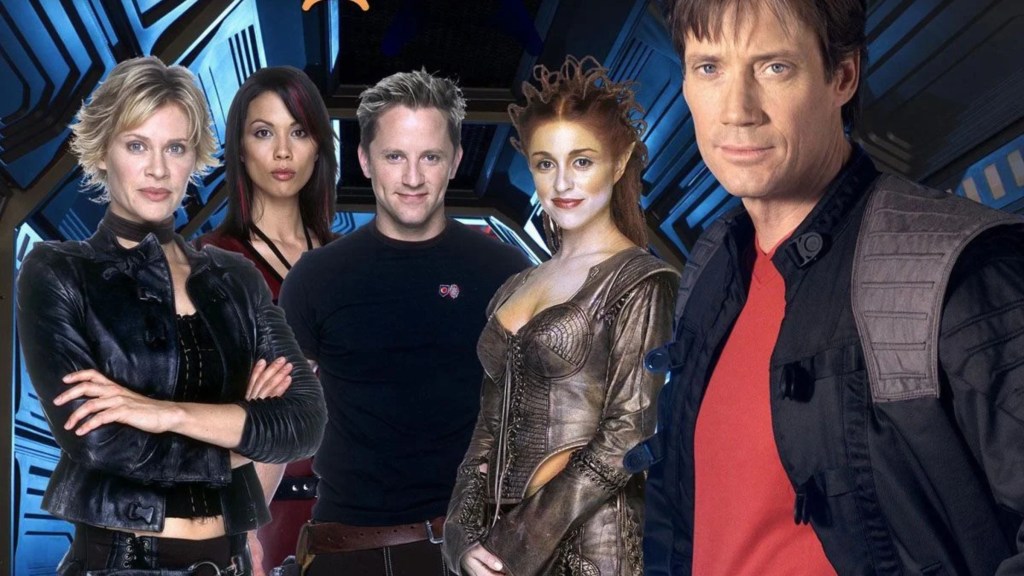
Andromeda was a television series concept that Gene Roddenberry came up with in the 1960s and 1970s. It was one of two TV shows Roddenberry conceived that were released after his death, with the other being Earth: Final Conflict. However, Roddenberry never got them made, and it wasn’t until after he died that they finally saw the light of day. Notably, the captain of the Andromeda Ascendant was named Dylan Hunt, a name that Roddenberry used in two other television pilots (Genesis II and Planet Earth), both of which shared a similar dystopian post-apocalyptic premise.
The story of Andromeda starts thousands of years in the future, when the Systems Commonwealth serves as a constitutional monarchy spanning the Milky Way, Triangulum, and Andromeda galaxies, with the capital near Andromeda’s core. As with the best sci-fi shows, there is an ongoing war, this time with the Magog, a parasitic humanoid species spreading across the galaxies. When the Commonwealth agreed to cede the world of the Nietzscheans to the Magog, the Nietzscheans attempted to usurp control, and that is where the series begins.
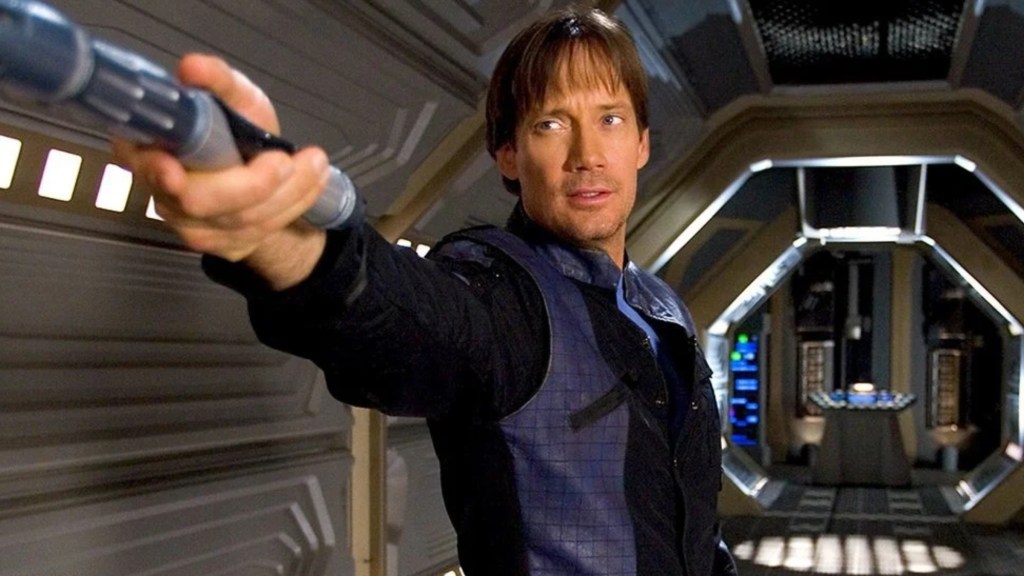
Kevin Sorbo, fresh off his role in Hercules: The Legendary Journeys, took on the lead role as Captain Dylan Hunt, putting a familiar face in front of audiences to bring in viewers to see the new series based on Roddenberry’s old ideas. The premiere episode sees Captain Hunt’s Nietzschean first officer, Gaheris Rhade, betray him, and in their fight, the Andromeda is caught in a black hole and frozen in time. The series picks up 303 years later when the ship is pulled from the event horizon. The Commonwealth has fallen, and Captain Hunt finds himself needing to fight for his ship again.
Joining Sorbo in the cast are Lisa Ryder, Keith Hamilton Cobb, Gordon Michael Woolvett, Laura Bertram, Brent Stait, Lexa Doig, Steve Bacic, and Brandy Ledford. While the cast was mostly led by Sorbo, the themes and sci-fi tropes on display here are what helped the series last for five seasons and 110 episodes. There is an AI named Rommie (short for Andromeda), portrayed by Doig, and the AI is as important a character as anyone on the ship. There is a new form of traveling faster than the speed of light called Slipstream, which is something an AI is incapable of navigating. There are also several star systems, races, and organizations that play into the same idea of political upheaval as Star Trek.
Andromeda Is Still Worth Watching Today
While Andromeda remains a lesser-known sci-fi series from the mind of Gene Roddenberry, it is still worth seeking out. In a similar move to the one that made Star Trek: The Next Generation a success, Andromeda aired its first episode in syndication in the United States in 2000, and Tribune Broadcasting signed on to carry the show through the first season, while adding a second-season renewal. It got two more seasons in 39 of the top 40 markets, and by its fourth season, it was in markets that represented 88% of the United States. It was a massive success. In 2004, the Sci-Fi Channel made a deal to air the series.
The first season received mixed to negative reviews from critics, but the show built up an audience that bought into its sci-fi themes and ideas. It doesn’t match up to Star Trek in any of its forms, but it does offer some nostalgia and an interesting premise, as long as audiences don’t take it too seriously. One thing that hurts the series is that it was released in an era that offered the exceptional Battlestar Galactica reboot, but for anyone wanting something lighter and more fun to watch, the first few seasons of Andromeda fit that description.
More TV Shows
-
Image Courtesy of Marvel -
Image Courtesy of Marvel -
Image Courtesy of Comedy Central -
Bass X Machina S1. Brian Tyree Henry as Bass Reeves in Bass X Machina S1. Cr. Courtesy of Netflix © 2026 -
Courtesy of Netflix