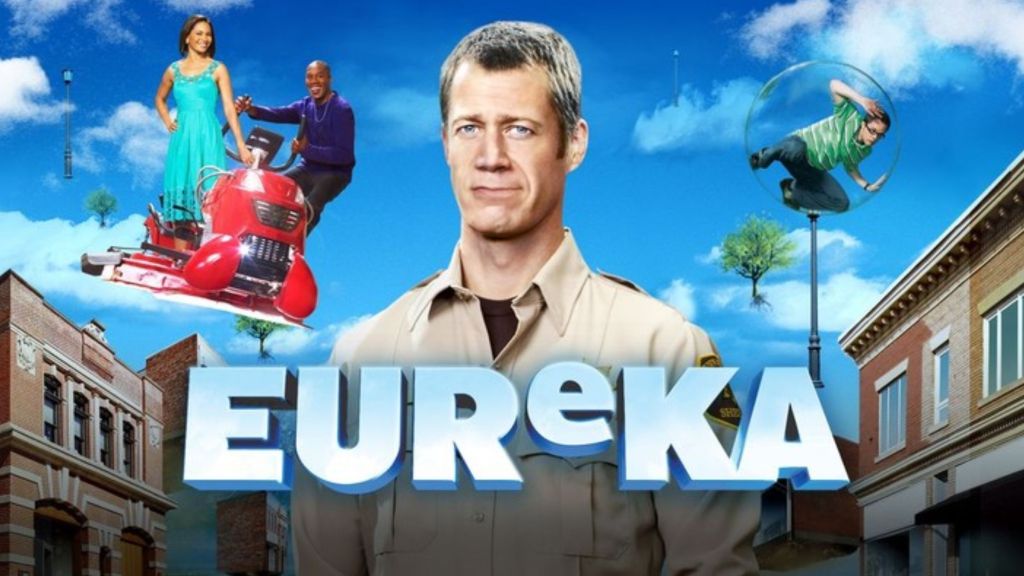
In the summer of 2006, the Sci-Fi Channel aired a pilot about a US Marshal whose car breaks down in a town where everyone is a certified genius and the household appliances are a public safety hazard. It pulled 4.2 million viewers and became the highest-rated series launch in the network’s history. Twenty years later it is not on Netflix, not on Max, not on Peacock. You cannot subscribe your way to it at all. And in August it started climbing the Apple TV Store charts anyway.
Videos by ComicBook.com
The show is Eureka, a Syfy series about a town where everyone is a genius, and the surge appears to be spillover from From, whose fans have spent the wait between seasons hunting for another series about an isolated community with a mystery at its center. They found one, and most of them have no idea what they are walking into.
Because in 2010, Syfy quietly let two of its shows share a world, put out a press release announcing it, and then never built on the idea again. Eureka was not a standalone quirky comedy that got cancelled and forgotten. It sat at the center of a shared television universe spanning three series, assembled on basic cable while Marvel was still finding out whether The Avengers would work. Nobody at Syfy ever gave it a name. That might be exactly why nobody remembers it.
Eureka Was Secretly the Center of a Syfy Shared Universe Nobody Branded

The connective tissue was two characters. Douglas Fargo, played by Neil Grayston, was Eureka‘s resident walking disaster. Claudia Donovan, played by Allison Scagliotti, was Warehouse 13‘s hacker. In August 2010 Syfy sent them across the divide in the same week. Fargo turned up in the Warehouse 13 episode “13.1” on a Tuesday to upgrade the building’s computer, promptly gave it a personality and got everyone locked inside. Three days later Claudia landed in Eureka in an episode called “Crossing Over,” where objects from 1947 started appearing around town.
They did it again a year later. Fargo fell into a coma inside a Warehouse 13-themed video game in the Season 3 premiere, and Claudia had to go in after him. What makes the whole thing stranger is that the overlap predated the plan: Joe Morton, Eureka‘s Henry Deacon, had already guested on Warehouse 13 back in 2009, a full year before either show formally acknowledged the other existed. None of this was a stunt week or a branded event. Syfy announced the first crossover through a development executive and then simply let the two shows share a world without ever telling the audience that was the strategy.
Then it stretched one show further. Lindsay Wagner played Dr. Vanessa Calder, a recurring Warehouse 13 physician, and in August 2011 she walked into the Alphas episode “Never Let Me Go” as the same character with the same CDC credentials. That is the whole link, and it is worth being precise about it, because plenty of write-ups get this wrong. No Alphas character ever appeared on Warehouse 13, and none ever appeared on Eureka. The connection runs one direction only. The Bionic Woman showed up in a third show and quietly annexed it.
Why Eureka’s Streaming Comeback Makes the Case for a Revival
What makes the cancellation sting is that it was never about the work. Executive producer Amy Berg tweeted in August 2011 that the show was the network’s “golden child in every way, except profit margins,” and put the decision on Comcast rather than Syfy, whose executives she said fought to keep it.
The math simply stopped working. Eureka shot in Vancouver with a large ensemble and effects in nearly every episode, and under NBCUniversal’s new ownership that budget could not survive the cuts it would have taken to turn a profit. The network initially ordered a short final season, then rescinded it, then granted a single additional episode so the writers could close the story deliberately rather than stop mid-sentence. Warehouse 13 got the same treatment two years later, its final season cut to six episodes.

The cast has scattered upward since. Salli Richardson-Whitfield directed her first episode of television on Eureka, and in 2024 she became the first Black woman ever nominated for the Emmy for drama directing. In 2026 she did something nobody had done before, earning two nominations in that category in the same year. She has written about the Eureka episode as the thing that started it, and that is the strongest argument for a revival anyone has made: the people who built this show are in more demand now than they were when it was cancelled for being too expensive.
The deeper irony is that the thing that killed it is the thing streaming now pays for. Eureka died because a large ensemble, a built-out town and weekly visual effects were unaffordable on a basic cable ad model. That is an ordinary Tuesday for a streamer. And the audience for a lightly serialized mystery-box show set in an isolated community is demonstrably right there, currently working its way through a twenty-year-old series it has to buy one episode at a time.
There is no revival in development, and any site telling you Syfy confirmed one for 2027 is making it up. What exists is a twenty-year-old show climbing a purchase chart with no streaming home, a shared universe that three series built and nobody ever marketed, and an ending that arrived early for accounting reasons. Somebody with a streaming budget should buy the rights and finish the job.
Tell us in the comments below whether you would take a Eureka revival, a Warehouse 13 one, or both.
More TV Shows
-

Courtesy of Paramount+ / Rotten Tomatoes -
Image Courtesy of DC Comics