
In the 1970s, Superman faced off against everyone from a rival publisher’s most popular hero to take-offs on summer blockbusters to Popeye the Sailor Man (well, he was technically “Captain Strong,” but everybody knew he was supposed to be Popeye). Eclipsing all of these storylines is Superman’s 1978 bout with Muhammad Ali, one of the strangest, coolest, and most iconic comic book battles of the Bronze Age. A giant-size special issue from an all-star creative team of Denny O’Neil and Neal Adams (whose work on Batman and Green Lantern are upheld as some of the best comics DC ever published), Superman vs. Muhammad Ali was a blockbuster, the painstaking result of more than a year’s development and delays. Though neither the first nor the last time the Man of Steel would cross paths with real-world icons, Superman vs. Muhammad Ali is the most fondly remembered among comic book readers, and was a point of pride for its creative team.
Videos by ComicBook.com
As a showcase of “the Greatest” in his prime and Superman depicted by two of DC’s greatest creative talents, the issue earns it reputation as an iconic snapshot of seventies pop culture. Almost fifty years after publication, Superman vs. Muhammad Ali is highly sought-after collectible, coveted by sports memorabilia collectors and comic book fans alike. The comic’s giant “treasury size” format makes it even rarer and more difficult to find in high-grade condition, contributing to its value. In any condition, the comic sells for a minimum of seventy-five dollars, though on average, a collector can expect to pay a couple hundred dollars. For a near-mint copy like this sample on auction through Heritage, a price-tag of at least a thousand dollars is likely to be the winning bid, with the price already up to nearly seven hundred dollars at the time of writing.
Superman vs. Muhammad Ali‘s Long Road to the Arena
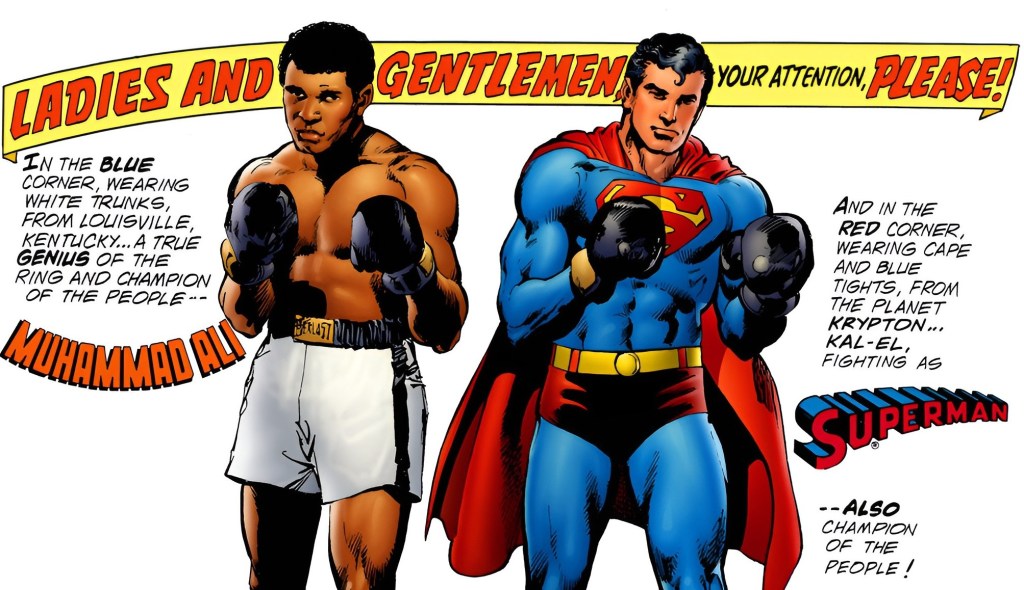
The concept for Superman vs. Muhammad Ali emerged from an off-the-cuff remark by DC Comics Editor-in-Chief Julius Schwartz, delivered during a meeting. As artist Neal Adams remembers it: “Julie said: ‘Why don’t we have Superman fight Muhammad Ali?’ We all said: ‘you’re crazy!’ but Julie felt that a real-life hero fighting a fantasy hero would be something special.” In this version of the story, (perhaps owing just a little to Schwartz’s position as Editor-in-Chief), the decision was made to go ahead with Schwartz’s idea, and Ali’s management was approached with the proposal. Other tellings have it that the idea originated with Ali’s manager, Don King, who then approached DC with the pitch. Either way, the end result was the same: DC partnered with Muhammad Ali and Don King in 1977 to publish the comic, with a planned release date later that year.
DC Comics legend Joe Kubert was initially assigned to the issue, but as Neal Adams recalls it, Kubert’s pencils were considered “crude” by Ali’s team. Feeling the artist wasn’t capturing Ali’s likeness correctly, they respectfully requested someone else complete the comic. Neal Adams was chosen, and took the assignment reverentially seriously as an admirer of both Ali’s boxing and his activism. Collaborating with Ali’s management and publicity caused several delays to publication, though Adams speaks well of both. Denny O’Neil departed from the comic during development (though he retains credit on the finished issue) due to scheduling conflicts. Adams felt that the delays were ultimately beneficial to the comic, enabling him to spend more time studying Ali’s person, integrating this into both his art and the script, which he took over writing after O’Neil’s departure.
Adams states that “Most of the speech patterns and the words and the phrases” used by Ali in the issue “were Muhammad Ali’s,” picked up while observing Ali in training at his “Fighter’s Heaven” training camp in Deer Lake, Pennsylvania. The delays created another interesting problem, however: in the time it took for the book to be published (finally arriving on stands in spring of 1978), Ali was dethroned as World Heavyweight Champion, losing a title bout against Leon Spinks in February 1978. It ultimately didn’t matter, as the comic was a massive success on publication, promoted heavily by Ali himself to the press and reprinted in numerous countries and languages. Apocryphally, Ali was incredibly proud of the comic, and was known to show his personal copy to guests when they visited his home.
Adams’ wrap-around cover places Superman and Muhammad Ali front and center, filling out the audience with a Sgt. Pepper-worthy array of DC Comics creators, real-world celebrities, and DC Comics characters. DC even included a numbered glossary helping readers identify the more than 170 people featured on the cover. Some personal favorites are Jimmy and Rosalynn Carter, the Metal Men, Ron Howard, and Frank Sinatra. As readers flipped open the blockbuster issue, there was only one question: who would win?
The Story & Legacy of Muhammad Ali vs. Superman
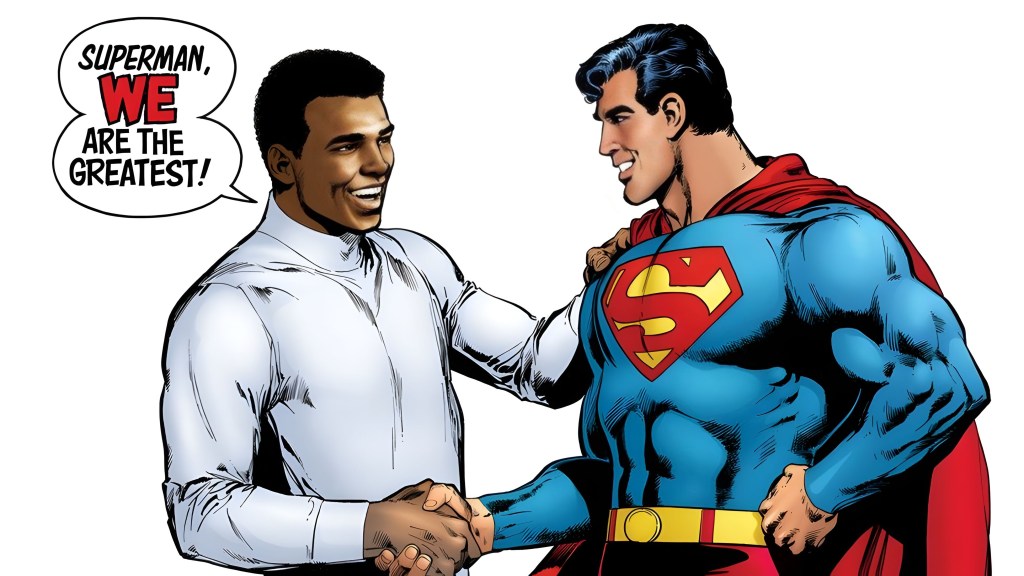
Although really just a flimsy pretense for its main event title bout, O’Neil and Adams crafted a superbly entertaining, seventies Godzilla film-esque alien invasion story to hang the comic’s narrative on. In it, an alien invader called Rat’Lar, who declares that Earth’s fate will be decided by a one-on-one battle between a champion of Earth and his own greatest warrior, Hun’Ya. When Superman and Muhammad Ali both step forward as Earth’s champion, Rat’Lar stages a preliminary round between the two to determine who will have the honor of representing Earth. To even the playing field, a battle-ground is chosen with a red sun, depriving Superman of his powers and leaving him with only his physical prowess against Ali’s. Naturally, Ali, the world’s greatest boxer (even if he wasn’t champion at the time), mops the proverbial floor with the Man of Steel, untrained in the art of boxing. Ali goes on to best Hun’Ya in single combat, while Superman defeats Rat’Lar’s orbital invasion force. Hun’Ya deposes Rat’Lar as his people’s leader and makes peace with the Earth. Superman and Ali shake hands, with Ali declaring that “Superman, WE are the greatest.”
Fifty years on, few who read Superman vs. Muhammad Ali in 1978 could give you even an abridged version of the above synopsis. Instead, they remember the weight and the power of that striking cover image, the impact of seeing a real-world champion face off against the world’s most iconic super-hero. “It meant so much to so many people,” Neal Adams told the BBC, “To this day, I have African Americans come up to me at comic book conventions with their old weathered copy of Superman vs Muhammad Ali for me to sign. It’s still extremely emotional.” Ali’s battle with Superman showed that training and dedication were worth more than super powers, and that graciousness and sportsmanship are worth even more. Reprinted several times by DC over the years, the comic’s impact remains undiminished by time, and fans of Superman and Ali alike continue to regard it as one of the most significant chapters in either’s career.
More Collectibles
-
Courtesy of Warner Bros. Pictures -
Image courtesy of Rocksteady Studios and WB Games -

Courtesy of The Walt Disney Company -

Courtesy of Warner Bros. Pictures

Forum Conversation: Which DC Superhero Has the Most Iconic Costume?
Go to ForumIt’s difficult not to go with Superman here. Batman is the most popular DC character, but Superman and Wonder Woman to me more represent the heart of DC Comics, and regardless of what era you’re from or your exposure to comics, the moment you see a picture of Superman’s costume, you know exactly who it is.
Ever since I saw Godspeed in the tv show The Flash on the CW, it has been my favorite costume. Reverse Flash comes in a good 2nd. Between the tv show, comics, and even animation. They’ve all been good. Ive loved the villians costumes over the superheros
I agree, Superman is probably one of the best examples of a costume being instantly recognizable no matter how much the design changes. Even small changes to the colors or style still make it obvious who the character is. I also really like some of the modern takes on his look, especially the Superman Blue Leather Jacket, which gives the classic character a more casual and contemporary feel.