
Known today as Xemnu the Titan, this obscure Marvel villain has a different motivation than most for his rivalry with the Incredible Hulk: he had the name first. Debuting two years prior to his green-skinned usurper, Xemnu was introduced by Stan Lee and Jack Kirby as “the Hulk” in Journey into Mystery #62. Four issues later, Xemnu would return in Journey into Mystery #66, still bearing the name. This phenomenon is referred to in comic book collecting as a “prototype character,” and is surprisingly common in the early years of Marvel Comics. Oftentimes, a “prototype character” was something akin to Xemnu, where a name would be used for a one-off (or two-off, as the case may be) character and then recycled; other times it was the origin of a design element recognizable to a later characters; other times still it was a character bearing a similar name and design to a later, better known character.
Videos by ComicBook.com
For the historically minded comic book collector, prototype character debuts can be a highly desirable key. While the “prototype” nature of many of these keys is the only thing that adds to their value, Xemnu comes with an important bonus: he’s remained a significant character in the Marvel Universe. Like Fin Fang Foom or Groot, Xemnu managed to transcend the pre-Heroic Age “Marvel Monsters” canon and cross over into the super-heroic Marvel Universe, facing off against the Hulk, the Defenders, and She-Hulk among others – as well as a surprisingly key role in cementing Groot as a canon character. Next week, Heritage is set to auction a rare copy of Xemnu’s Journey into Mystery #62 debut, prized among Marvel Comics of its era and genre for the character’s significance to the later Marvel Universe. Coming just before the beginnings of true comic book collecting, these early Marvel Monsters issues can be extremely challenging to collect: just a couple hundred graded samples of Journey into Mystery #62 exist on the CGC (Certified Guarantee Company’s) population report, literally about a tenth of the population of a major super-hero key like Fantastic Four #1 or Amazing Fantasy #15.
A Quick Look at Xemnu’s Marvel Comics History
Xemnu was a fairly typical antagonist of his era. In the years between the 1954 adoption of the Comics Code Authority and the revival of super-hero titles in the early sixties, much of Atlas / Marvel’s publishing output consisted of science fiction comics. These “monster of the month” anthology books featured alien conquerors, ancient monsters, and science-gone-mad, their story structure resembling the creature features that dominated drive-in theatres of the era. Journey Into Mystery #62’s “I Was a Slave of the Living Hulk!” is a fairly typical story in this vein: alien convict Xemnu crash-lands on Earth and is revived by hapless electrician Joe Harper. Using his vast psionic abilities, Xemnu intends to enslave the human race and force them to build him a spaceship to escape from the world and reconquer the stars. As thanks for reviving him, Xemnu keeps Joe under his own mental power, Joe turns this against Xemnu and sabotages the spaceship, trapping the alien in orbit around the sun.
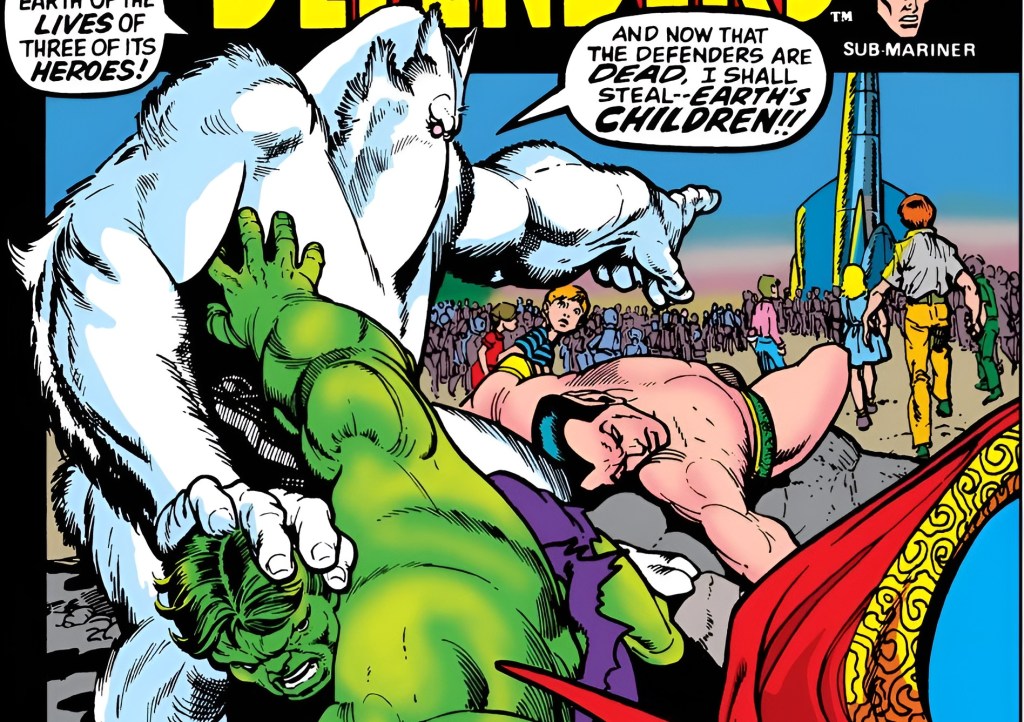
Xemnu uses his psionics to guide an asteroid into his ship, knocking it from orbit and sending it crashing back to Earth. There, he enslaves the town of Pineville and uses his thralls to build a “star reflector,” hoping to bombard himself with cosmic radiation to augment his powers. He’s defeated again by his would-be nemesis Joe Harper, who causes the reflector to backfire on Xemnu and scatter him into atoms. Xemnu would return to corporeal form a decade later in Marvel Feature #3, where he would use a television program called The Astro-Nuts to take over the minds of millions of children. This time, Xemnu was challenged not by an electrician, but by the Master of the Mystic Arts, the Sub-Mariner, and the Incredible Hulk. This issue marked the first time the Hulks would clash, and the first time Xemnu’s name, rather than the title of “the Hulk” is used to refer to the character. He battled the non-team again in Defenders #12, its plot similar to that of Journey into Mystery #66.
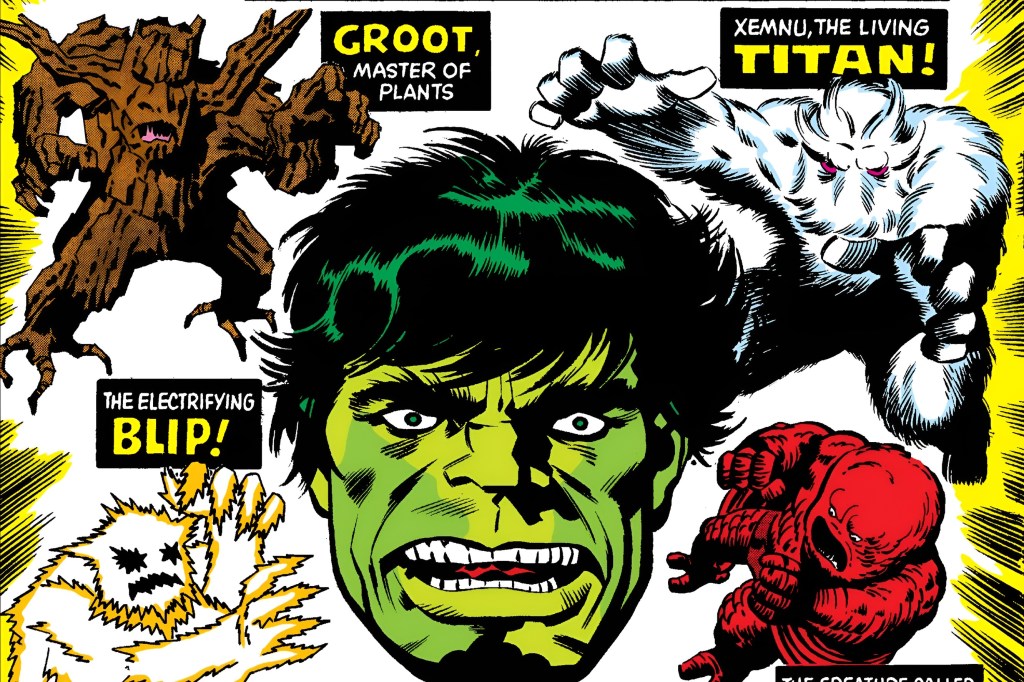
Xemnu’s most memorable battle with the Hulk came three years later in the blockbuster Incredible Hulk Annual #5. There, Xemnu stole files from the American government on alien visitors to the planet (neatly canonizing a flexible number of those early Marvel Monsters issues) and using them to construct duplicates of five such creatures. This included Groot in his second-ever appearance, instrumental in distinguishing Groot from the literal hundreds of characters like him introduced in these Marvel Monsters stories. Xemnu’s five constructs were set against the Hulk, with the Green Goliath facing off against them one-by-one before finally confronting Xemnu himself. The giant-sized annual is upheld by Bronze Age comic fans as one of the best action-oriented issue of its era. Xemnu’s final classic-era appearances were tongue-in-cheek storylines in Marvel Two-in-One #78 and a pair of Sensational She-Hulk two-parters.
In Marvel Two-in-One, the Thing and Wonder-Man thwart another attempt by Xemnu to conquer the world through television. In Sensational She-Hulk #6-7, Shulkie teams with U.S. Archer and Razorback (this run is noted — and beloved — for its emphasis on weird, teritary Marvel characters like these) to prevent Xemnu from transforming Earth’s unborn children into an army of his race. After temporarily transforming She-Hulk into the “Bride of Xemnu,” he is captured and defeated by alien teddy bear collector Big Enilwen, who mistakes him for a stuffed animal. John Byrne’s She-Hulk was many things, serious was not one of them. Xemnu escapes from Enilwen in She-Hulk #42, but She-Hulk’s friend and former Golden Age heroine Blonde Phantom, Louise Mason, makes short work of him, defeating the erstwhile conqueror with a wrench to the skull. In the thirty-five years since, Xemnu’s most notable appearance was a significant arc in Immortal Hulk, where he is recruited by Dario Agger and Roxxon as part of a plan to disgrace the Hulk’s public image. Hulk kills Xemnu in a confrontation at Roxxon’s headquarters, and as of writing, Marvel’s original Hulk has stayed dead.
Why Fans Are Fascinated By Prototypes Characters
For comic book fans and collectors, prototype characters represent the medium’s creative process in motion, and can be thought of kind of like evolutionary “missing links.” It’s the published version of a rough draft, created by the fast-pace and demanding deadlines of the comic book industry. For DC fans, the most notable are the several precursors to Supergirl, like the “Super-Girl” featured in Superman #123, an artificial being created by Jimmy Olsen wishing on a magic totem. In the Marvel Universe, this form of prototype character can be seen with “The Sorcerer” in Journey into Mystery #78 and the wizard Sazzik in Tales of Suspense #32; as well as the Iron Man-like “Metallo” in Tales of Suspense #16. The most controversial of these is Strange Tales #97, which features a kindly elderly couple named Uncle Ben and Aunt May, released some three months prior to Amazing Fantasy #15. Tales of Suspense #31 is an unusual case, as its “Monster in the Iron Mask” bears little resemblance to any Marvel character besides sporting a Jack Kirby-drawn mask identical to the design of Doctor Doom’s. Least direct are reused names like “the Hulk,” a phenomenon that recurred with “Magneto” in Strange Tales #84 and “Elektro” in Tales of Suspense #13.
Putting prototype characters aside, Marvel Monsters are passionately collected by a sub-set of comic book fans, prized for their rarity and uniqueness. This strange, brief era in the history of the Marvel Universe saw talents like Steve Ditko and Jack Kirby applying their creativity to an entirely different genre. The fascination that prototype characters therefore hold is in seeing how these one-off storylines and disposable “monster of the month” comics contributed to the creative foundation of the Marvel Comics universe. There are some collectors otherwise disinterested in this era and genre of Marvel who want just these books – “the Monster in the Iron Mask” commands a premium price sometimes in excess of $1k strictly because of its status as a “rough draft” of Doctor Doom. For collectors of Marvel Monsters at large, these issues are just as desirable, the historically-significant connective tissue that makes these comics more than just a footnote in Marvel’s publishing history. As a “prototype” of the Hulk who went on to become one of the real Hulk’s opponents, Xemnu represents this better than perhaps any other character.
Who’s your favorite Marvel Monster? Leave a comment below and join the conversation now in the ComicBook Forum!
More Collectibles
-
Image Courtesy The Pokémon Company






Forum Conversation: Favorite piece of Frank Frazetta Artwork
Go to ForumOh there are so many great pieces from Frank Frazetta! I’ve always loved Death Dealer and the Destroyer is another contender.
The Silver Warrior!
Also the Buck Rodger’s covers he did for Famous Funnies.