Batman is more than just a superhero. He’s a cultural touchstone that has completely transcended his origins as a comic book character. He’s one of the most recognizable and memorable figures in pop culture, to the point where there are more fans of him who don’t read comics than there are who do. Batman is a character that has touched millions of hearts around the world, defining what a hero should look like as he pursues a never-ending war to improve his home, even when it might not seem possible. Everyone has their own takes on the Dark Knight, and countless adaptations have introduced new fans to this icon.
Videos by ComicBook.com
I don’t think it’s crazy to say that the vast majority of fans started their Batman journey outside of comic books. Only a fraction of those fans actually make the jump to the comics that forged this character, and I was lucky enough to make that leap. Even when I did, I thought I knew who Batman was and how his stories went, based on what I’d seen so far, but what I found was that the comics weren’t just another group of stories. They were an entire new world full of history like I never imagined before. The comic that taught me that more than anything was none other than the storyline that celebrated fifty years of the Dark Knight, “Blind Justice.”
Bruce Wayne Is Batman to His Very Core
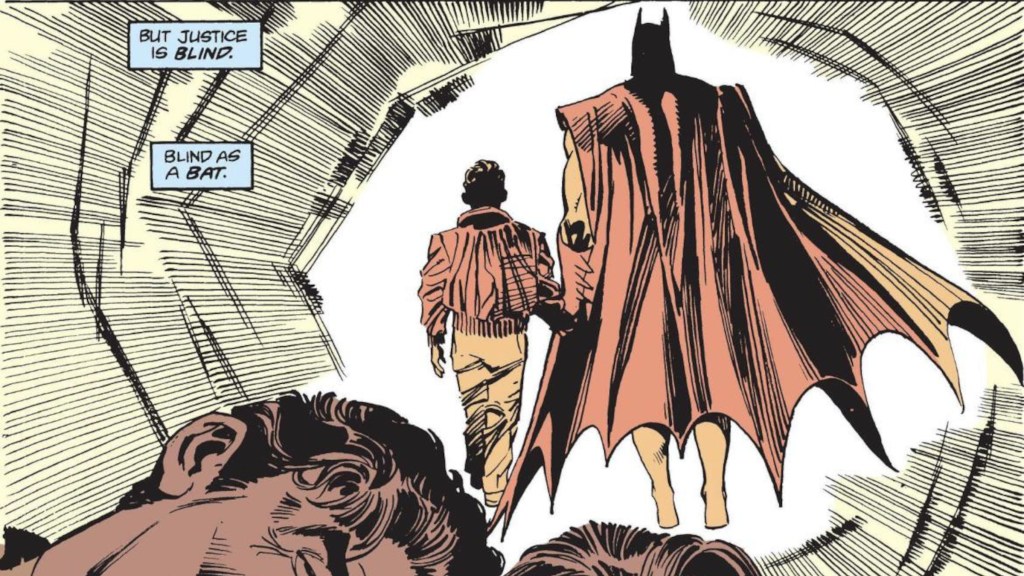
This three-part story saw Batman investigate a criminal ring where a man was using military technology to inhabit other people’s bodies. Bruce reunited his new girlfriend with her brother, one of those afflicted by the villain, but it placed him in harm’s way with said criminal, who used his massive influence to frame Bruce as a Communist traitor. With Bruce’s reputation in shambles, he was then shot, making him being Batman impossible until he healed. Thankfully, his new houseguest, Roy, volunteered to let Bruce control him with said recovered technology to continue to defend Gotham. In the end, Roy was killed because his body failed him, and Bruce couldn’t save him, leaving him alone once again.
This story, on the surface, is just another Batman tale, and that is true, but it’s also a wonderful celebration of what makes Batman tick. This is the storyline that introduces Henri Ducard as one of Bruce’s most iconic trainers, who gives his own perspective on Batman as a childish wish from a boy who never grew up. In the wake of these tragedies, Gordon even alludes to knowing Batman’s identity, telling Bruce that the Dark Knight has certainly earned the right to retire. The heart of this is, of course, Bruce grappling with these questions. He sees the pain that being Batman has caused him and the people he cares about, and genuinely wants to throw in the towel.
Yet, of course, he can’t. A nightmare haunts Bruce throughout this entire story, where he sees a demonic version of Batman being the one who shot his parents. He hates the idea that he has to throw his life away to be Batman, but also knows that Batman must exist. In his own words, he doesn’t deserve to be punished by being Batman after everything, but justice is blind. Bruce accepts his own suffering so that he can prevent other people from feeling the same. The final scene is a pure distillation of everything Batman is, being a scared boy who chooses to make himself suffer to save others. It was a phenomenal celebration of this part of Batman’s character. Yet, what really made this story matter to me wasn’t that, but something far simpler.
The First Step Towards a Massive World
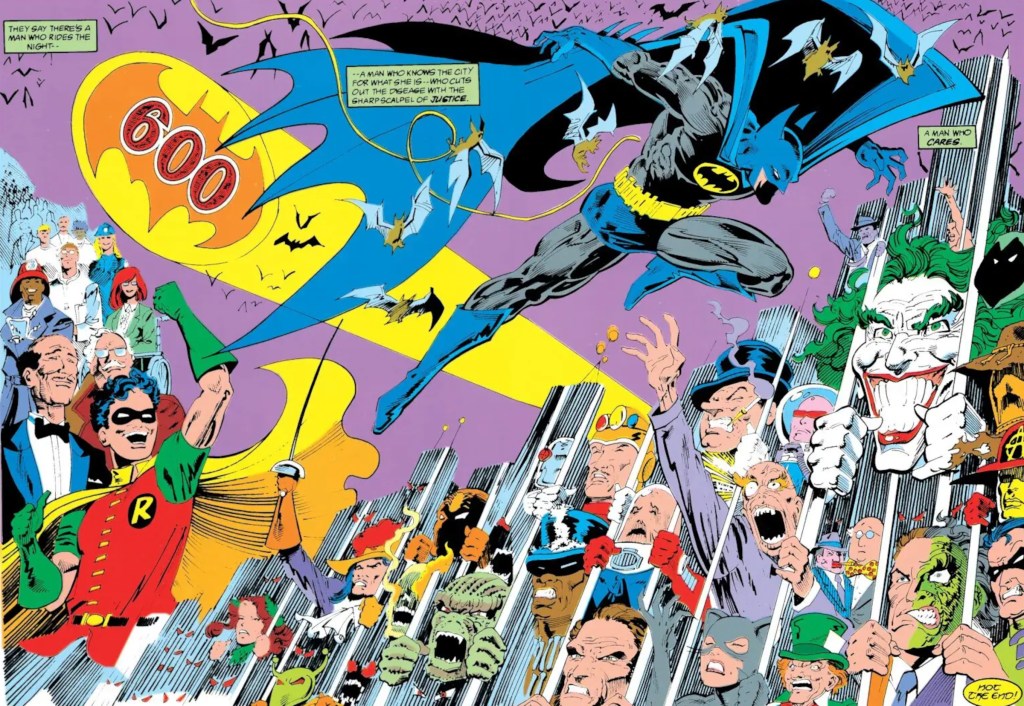
At the end of the day, this arc is just another Batman story. It’s a well-crafted one, for sure, but it doesn’t push any boundaries or do something that other comics haven’t explored. And do not, under any circumstances, take that as a negative. When I was still new to comic books, I picked this story on a whim, wanting to see what a random Batman issue could offer. I was blown away, not just by the story, but the fact that this story didn’t seem to be anything special. This was the fiftieth anniversary, sure, but you could remove that from the story, and it would still be a solid, wonderful little adventure for the Dark Knight. This made me realize that this level of quality and storytelling wasn’t unique to Batman’s major events or crossovers, but was just something present.
“Blind Justice” was a typical Batman adventure for the comics, and I was immediately hooked and wanted more. I had no shortage of options, either, because there were forty-nine years of stories before this adventure and still decades of comics after. This comic opened my eyes to the seemingly infinite world of Batman’s comic book adventures, and it was mind-blowing. That sense of wonder has stayed with me ever since, knowing that there were thousands of stories out there across decades, each with the potential to be something special, and I wouldn’t know it until I gave them a read.
Comic books are an intimidating hobby to get into. The sheer size of the backlog of issues turns off plenty of potential fans, but diving headfirst in and seeing what these stories were like was a transformative experience for me. It made me want to learn everything I could and consume every comic I could get my hands on, chasing that feeling of awe and needing to know more. I’m sure this is an experience that tons of other comic fans can relate to. Is the hobby confusing, even scary, at first? Sure, it absolutely can be. But taking that leap opens the door to an endless number of awesome stories, and I wouldn’t trade that feeling for the world. If you haven’t experienced that yet, I genuinely hope that you do.
What was the comic that made you realize how much the comic book world had to offer? Let us know in the comments below!
More Comics
-
Image Courtesy of DC Comics -
Image Courtesy of Marvel Comics -

Image Courtesy of DC Comics -
Image Courtesy of Warner Bros. -
Image Courtesy of DC Comics -
Image Courtesy of DC Comics