Marvel Comics has been around since 1939, one year after DC Comics brought the superhero to life with Superman. The DC Multiverse has went through numerous canon changes over the years, with Earths appearing and disappearing, origins being changed, and the entire history of the company’s characters changing completely. Marvel, on the other hand, has never needed a widescale continuity reboot, despite also having a multiverse. The Marvel Multiverse has become more popular than ever thanks to the MCU, with Marvel Studios bringing it to the big screen and making it the talk of the Internet for a time.
Videos by ComicBook.com
MCU fans who wanted to see the amazing depths of the Marvel Multiverse, though, are going to be sort of disappointed. While there are certainly some amazing alternate Marvel Universes out there, you’ve almost certainly heard of the best of them – Age of Apocalypse Earth, Days of Future Past Earth, the Earth X one (okay, there’s a good chance you’ve never heard of that one) – while the rest are mostly just fun What If… fodder. The Marvel Multiverse is really barely one that you can use; most alternate Marvel Earths are wrecked wastelands because of the heroes’ failures. The publisher needs to do something about this and they already have the perfect answer, a team that allows readers an in to the Marvel Multiverse – the Exiles.
We Need Better Marvel Multiverse Stories and the Exiles Can Give Them to Us
DC’s multiverse officially debuted in 1961’s The Flash #123, although technically, 1953’s Wonder Woman #59, which had the first DC parallel Earth, was first. Regardless of when it started, DC was the originator and they set the standard for what a multiversal world could be, crossing it over with the mainline universe in books like Justice League of America and using various anthologies, back-up stories, and full-length books to flesh them out. Each of these worlds felt vital and fans loved the adventures there. They had their own histories, their own heroes, their own continuity, making them unique chunks of DC goodness.
Marvel never really had much similar. Their multiverse started in 1971, with Avengers #86, introducing the Justice League pastiche the Squadron Sinister. Five years later, we’d get the first issue of What If…?; four years later we’d get the groundbreaking X-Men classic “Days of Future Past”, a story which introduced Marvel’s favorite kind of multiversal world – the dark alternate future. It would be Alan Moore who would established the Earth-numbering system in the ’80s Marvel UK book Captain Britain, and since then we’ve gotten numerous Marvel Earths, some blockbusters like “Age of Apocalypse” and some stinkers like “Age of Revelation”.
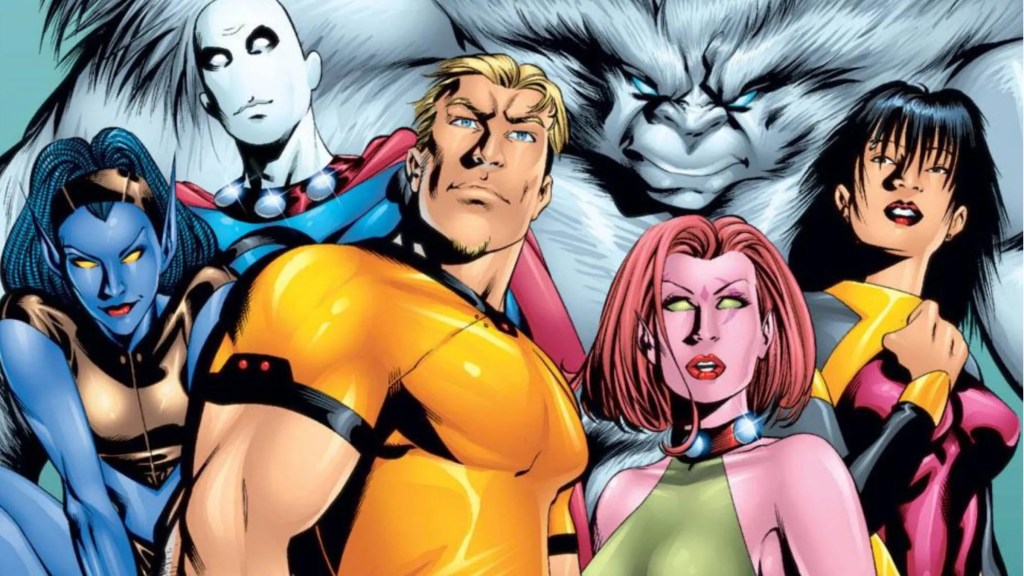
However, when it comes right down to it, Marvel’s multiverse never feels like a good setting. You can have cool stories but for the most part, most of these worlds are made to be a place where you can’t tell more than one story; how many alternate Earths only exist to show up the heroes’ failures? A new volume of Exiles can change that. The team first appeared in the early ’00s, from Judd Winick and Mike McKone. What If…? had failed in the mid ’90s, when the Marvel Alterniverse line floundered completely (‘member when Marvel split into five different lines?) and the team was a new way to do the same kind of stories. Exiles took characters from across the multiverse and sent them on missions to different Earths to solve a certain problem. It was the perfect way to do Marvel-style multiverse stories and the book’s first volume (basically anything written by Winick is good; the Chris Claremont stuff isn’t) was able to balance deft character work with creating cool alternate universes.
The Exiles only had a short period of popularity; every reboot of the team has failed in the years since. However, the Exiles, done right, are the perfect tool for exploring the Marvel Multiverse. Exiles (Vol. 1) had a lot of one and done stories, which isn’t something that we get much of nowadays. A new Exiles team could have the team spend more time on each Earth, building them up into interesting places we can return to.
There are numerous great multiversal characters we could get to fill out the team; the original Exiles had a Suicide Squad feel to it, because these characters could be killed. That adds something to the team that a lot of other Marvel groups don’t have: deaths that can be permanent. Imagine an Exiles series with six-issue storyarcs that dug into a new Earth, the team’s members doing their best to save it from whatever calamity endangers it, some of them failing and dying. Imagine Al Ewing writing that book. You could even do something completely unique in the current comic industry and have each arc done by a different creative team. It’s the perfect way to flesh out the Marvel Multiverse and bring back a classic team.
Marvel’s Multiverse Can Give the Company a Brighter Future

Marvel Comics could use some kind of shot in the arm, especially after the catastrophic ending of the second Ultimate Universe and the Absolute Universe continually shellacking them. Marvel Midnight is being positioned as their answer, but fan esteem in the project isn’t super high. No one really trusts Marvel with their multiverse anymore and that needs to change. My first introduction to the Marvel Multiverse was in the Alan Davis Excalibur comics with the Captain Britain Corps and it was so cool. I wanted more stuff like that, with What If…? scratching the itch, but rarely has the publisher been able to capture that kind of wild creativity on a regular basis.
The Exiles saved the Marvel Multiverse from obscurity in the ’00s. Without them, we would have just been getting dark alternate X-Men futures ad naseum (I mean, we still got a lot of X-Men stuff, but not all X-Men stuff). While they’ve been unable to succeed in recent years, the right creative team – and alternate Earths – could do wonders. The Marvel Multiverse can be a lot better and the Exiles could become the road there.
More Comics
-

Image Courtesy of Marvel Comics -
Image Courtesy of Marvel Comics -
Image Courtesy of Marvel Comics -

Image Courtesy of Marvel Comics -
Image Courtesy of Marvel Comics -
Image Courtesy of DC Comics -
Image Courtesy of DC Comics