The Lord of the Rings is, inarguably, the work that inspired, fueled, and in many ways created the genre that is fantasy literature. 72 years from the publication of The Fellowship of the Ring, creatures such as Elves and Dwarves, despite having existed for centuries if not millennia before the novel’s release, still take the forms given to them by Tolkien in the overwhelming majority of fantasy literature, movies, TV and even video games and comics— while creatures such as Orcs and Hobbits, Tolkien’s own creations, have comfortably entered the pop-culture and folkloric Canons alongside their profoundly ancient LOTR co-stars. However, while The Fellowship of the Ring would begin the profound transformation that Tolkien would work upon the field of fiction, it was not his first foray into it. 17 years earlier, The Hobbit— Tolkien’s first full-length novel and the first appearance of Middle-Earth in any published work — hit the presses.
Videos by ComicBook.com
Initially imagined by Tolkien as nothing more than a standalone book that happened to incorporate some of the larger worldbuilding the then-professor worked on in his personal time, The Hobbit stayed firmly within contemporary expectations of the fantasy genre, being aimed at a younger audience and centering a magical adventure with lovable characters, strange creatures and deadly perils while keeping an overall lighthearted tone (though Tolkien, in a hint at things to come, failed at maintaining this last aspect towards the book’s end).
Due to its original conception as a standalone novel and its more-or-less adherence to the fantasy tropes of the time, The Hobbit would go on to present a problem for Tolkien. As the book’s planned sequel, The Lord of the Rings, began to make its true nature known to its author as the sprawling, epic, and complex saga that would introduce the public to Tolkien’s decades of worldbuilding around Middle Earth and reinvent fantasy writing altogether, The comparatively short, light, genre-compliant Hobbit became more and more incompatible as a prequel.
To remedy this, Tolkien would— in a move that was no doubt painful for a man so focused on internally consistent lore and studious of historical text records as himself— go on to edit the text of The Hobbit to adjust for the most glaring areas of narrative and worldbuilding inconsistency, thus creating The Hobbit‘s Second Edition, which would be in published in 1951. This list explores changes made to The Hobbit that most readers younger than their 90s aren’t even aware happened, and why those changes were necessary— including the one edit that Tolkien made that let him accept the need to change anything at all.
7) How Bilbo Got The Ring
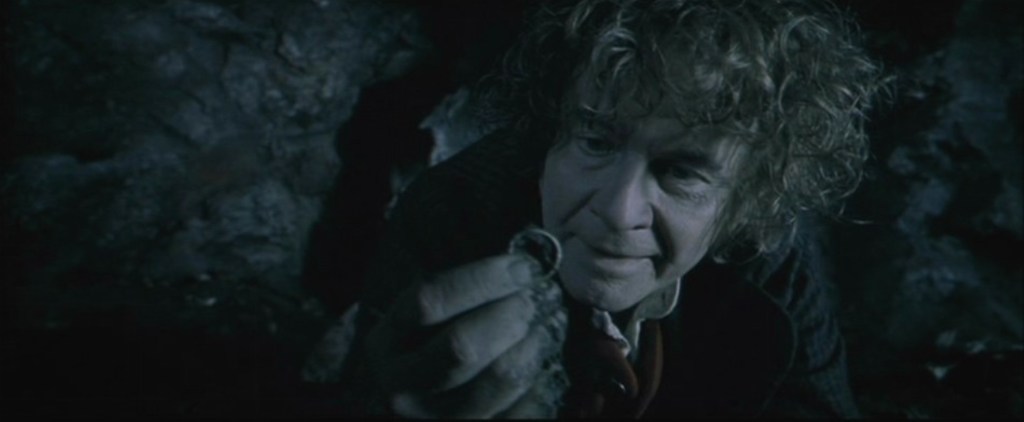
The scene in The Hobbit that most obviously contradicted Lord of the Rings‘ central premise— and, most likely, the passage that forced Tolkien to consider revisions in the first place— is of course Bilbo’s acquisition of the One Ring in the chapter “Riddles in the Dark”. In The Hobbit’s original iteration, the magical artifact is nothing of cosmic significance, being simply a magic ring with the power to turn its wearer invisible— one of several helpful and plot-relevant mystical items acquired by our hero Bilbo over the course of his adventure, right alongside the sword Sting and a chainmail vest that will appear in another entry on this list. Having no power or special property besides granting invisibility, the magical bauble was thus of fairly little value to its prior (and in this iteration, possibly original) owner Gollum.
To be clear, Gollum was barely less sinister in the original version, still being a creepy cave creature who really, really wanted to eat Bilbo but (thankfully for the Hobbit) wanted even more to play a game of riddles with him. However, in this version, Gollum’s constant muttering of “precious” is nothing but a verbal quirk, and his offer to Bilbo if he wins the Game of Riddles actually the ring itself— Gollum, here as in later revisions, is initially unaware that he has lost it or that Bilbo has already found it. Upon losing the game, Gollum heads back to his island amidst the underground waterways below the Misty Mountains to get the magical ring for Bilbo, only to find it gone.
Far from the feral rage and panic of the creature’s later versions, this Gollum simply apologizes to Bilbo for failing to uphold his end of their deal and shows the Hobbit the way out of the Misty Mountains as a reward for winning the Game of Riddles instead. In this version of the story, then, Bilbo’s “trick” on Gollum is that he cheated the creature into giving him two prizes— the ring and the way out— for one win. For obvious reasons, this series of events, were it to remain unaltered, would contradict the exact concept central to The Lord of the Rings— that the ring Bilbo got from Gollum is an object of nigh-indescribable evil, corrupting its owners and making them madly obsessed with it. As this contradiction undermined the very core of his story, Tolkien had no choice but to revise the scene.
The version appearing since The Hobbit‘s Second Edition forward is the one most readers and moviegoers will be familiar with, with everything going much the same except that Gollum’s initial offer for the Game of Riddles is to show Bilbo the way out should the Hobbit win. When Bilbo does manage to stump Gollum, the creature agrees to lead Bilbo to safety, but first goes to fetch his “Precious” ring with plans to betray Bilbo and eat him anyway. Finding the Ring missing, Gollum quickly deduces exactly what Bilbo has in his pockets and goes mad with rage, inadvertently leading the now-invisible hobbit to the exit in a mad pursuit where it’s not quite certain who’s chasing who.
Notably, once Bilbo reconvenes with the dwarves, Tolkien makes a point to keep Bilbo’s recounting of his encounter with Gollum accurate to the original version— recontextualizing the original version of the scene as a lie that Bilbo, already being subtly corrupted by The Ring’s influence, tells the party to make himself look better. The idea that the original version of “Riddles in the Dark” was a lie told by Bilbo due to the influence of The Ring is one that Tolkien took interest in beyond the bounds of the relevant chapter, and it will reappear later on this list.
6) The Tove Jansson Gollum Incident
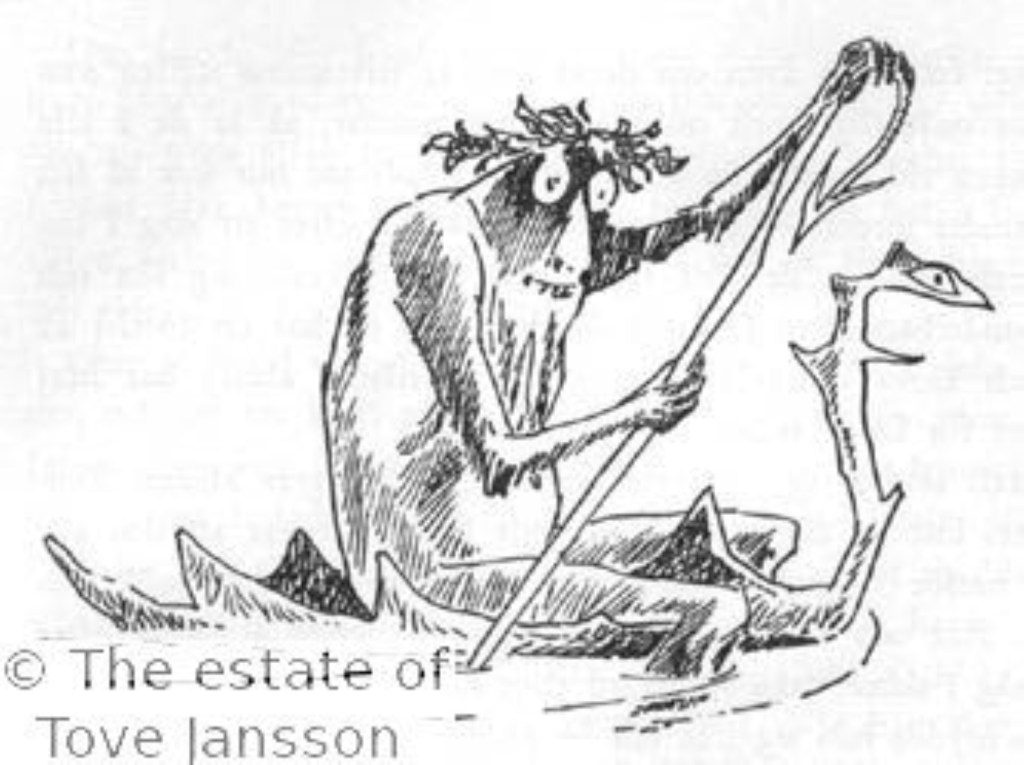
This would not be the end of problems, and revisions, for “Riddles In the Dark”, however. In a much less plot-centric, and actually rather charming and delightful in retrospect, turn of events, the chapter would once again become an issue for larger The Lord of the Rings canon in 1962 when The Hobbit‘s Swedish translation was released, featuring art by Moomins creator Tove Jansson. At the time, the text did not specify anything about Gollum’s appearance besides his “Round, pale eyes” and the fact that he dwelled within a series of subterranean lakes. This sparse description, when interpreted through Jansson’s soft-edged and folklore-inspired style, resulted in a Gollum that few fans today would recognize as something from The Lord of the Rings at all, unless we were to mistake him for an Ent or even for Old Man Willow. Jansson’s Gollum is a large and towering creature whose bright, round eyes peep out from a shaggy coat that could be moss, fur, or a combination— and, topping it all off, he appeared to wear a clown of leaves on his head.
The overall impression given was one of a dark and hungry nature spirit, or even deity, of some inconceivable age, who was to just as happy to provide wise and brave adventurers with gifts and aid as he was to eat those who proved themselves more foolish. While several prior illustrated Gollums had also strayed rather egregiously from the “corrupted hobbit” creature type that Tolkien was increasingly developing the character into, Jansson’s Gollum was so fundamentally off-theme that Tolkien felt the need to go back and, prior to the printing of The Hobbit’s 1966 printing, make further edits clarifying Gollum’s description from simply “Old Gollum [….] round pale eyes” to “Old Gollum, a small slimy creature […] round pale eyes in his thin face” to prevent any further confusion about the creature’s basic appearance.
5) Bilbo’s Mithril-Mail Coat
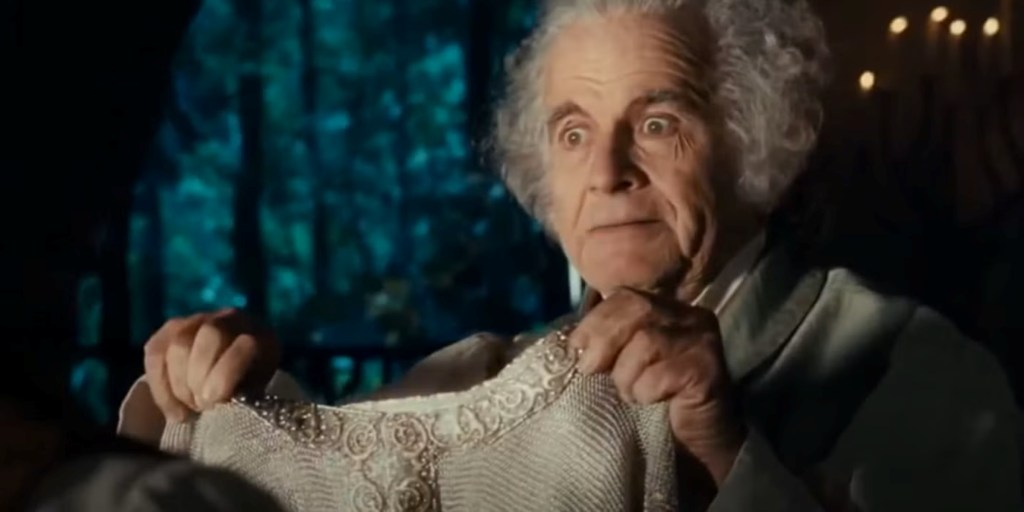
Gollum and his ring were not the only things in The Hobbit to gain increased significance, both to the main story and to the worldbuilding of Middle-Earth as a whole, as The Lord of the Rings developed. As mentioned above, the One Ring is one of a few items of seemingly otherworldly nature that Bilbo would acquire while on his adventure, one of the other items being a masterfully-crafted, luxurious chainmail vest. One of many cases of Tolkien transplanting concept from the real-life historical cultures he studied into Middle Earth, this garment is essentially a mail shirt— a shirt- or tunic-like garment of densely interlocked metal rings, often serving as a warrior’s main form of armor before the development of plate mail.
Given their ubiquity as the armor of warriors and heroes in the very stories that Tolkien drew inspiration from, it should not be surprising that Tolkien had Bilbo acquire something like mail shirt by the end of The Hobbit, having received it from Thorin after their defeat of the dragon Smaug. While the piece is initially described as a thing of rare quality based on craftsmanship alone— “It was of silvered steel and ornamented with pearls, and with it went a belt of pearls and crystals” —, Tolkien would go back and revise this before the publication The Hobbit‘s 1966 printing, specifying that the garment is made from Mithril, a rare, beautiful and extremely durable metal mined by the dwarves of Moria. It can only be assumed that since Frodo would inherit it mail-coat in The Fellowship of the Ring, Tolkien wanted Bilbo’s chainmail vest to have a more legendary nature to better fit among the more mythic and epic tone of The Lord of the rings.
4) The Hobbit Used to Have Many More, and Much More Random, Creatures
Just as Tolkien’s decision to use The Hobbit‘s sequel books to finally unleash his Middle Earth canon upon the world led to his having to revise, add to and clarify several passages of the Hobbit between editions to fit his complex and interconnected worldbuilding, so it also led to Tolkien cutting words and phrases from quite a few passages throughout the book. While each of these minor edits was doubtless necessary in some way to streamline the canonical connection between the Middle Earth of The Hobbit and that of The Lord of the Rings, there is a certain type of redaction that occurs multiple times across the book, and that speaks to an interesting aspect of Tolkien’s approach to building and defining his canon.
Throughout The Hobbit‘s pre-LOTR printings, there had been fairly nonstop references to various mythical creatures. This is to be expected, of course, in a story featuring many fantastical peoples and creatures including Hobbits, Dwarves, a Wizard, a Dragon, Trolls, Elves, Bear-Men, Giant Eagles, Goblins and Gollum, but newer readers may be unaware that there were once even more creatures alluded to in The Hobbit— creatures that, for one reason or another, Tolkien decided were not welcome within the canon of Middle Earth.
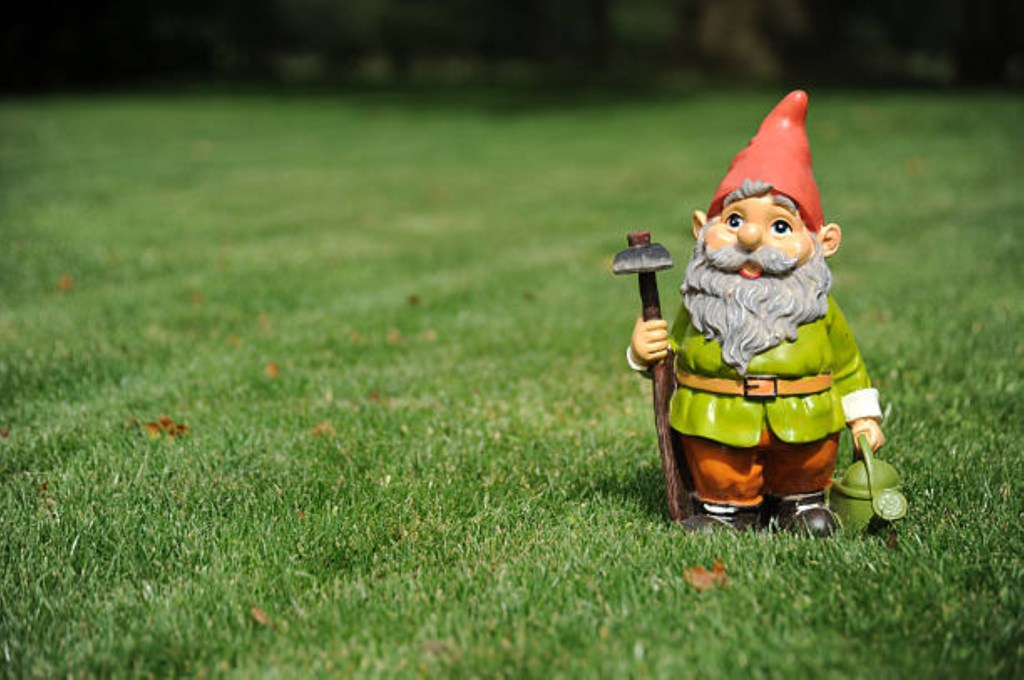
In some cases the reason for these creatures’ incompatibility is obvious— the original description of Hobbits read “They are (or were) small people, smaller than dwarves (and they have no beards) but very much larger than lilliputians.” Tolkien later edited this to remove the mention of the second species, and it’s fully understandable that he did not want creatures originating from 18th-century author Jonathan Swift’s Age-Of-Exploration Maritime-Political-Satire-Fantasy novel Gulliver’s Travels populating his epic early-medieval-mythic-fantasy universe. However, other removals are far more baffling, such as the repeated and tenacious work on Tolkien’s part to scrub all mention of Gnomes from the text of The Hobbit, which is all the more baffling given that the term Gnome is used interchangeably with other words for Elves in much of Tolkien’s earlier work before being suddenly and aggressively removed from canon partway through The Fellowship of the Ring‘s writing. It seems that Tolkien soured on the term after realizing that the perception of gnomes in popular culture was solidly stuck on little men in conical hats, and given the sense of dignity and awe that the author seeks to imbue his Elves with, we really can’t blame him for dropping it.
3) The Terrain Got Rougher Long Before They Reached Rivendell
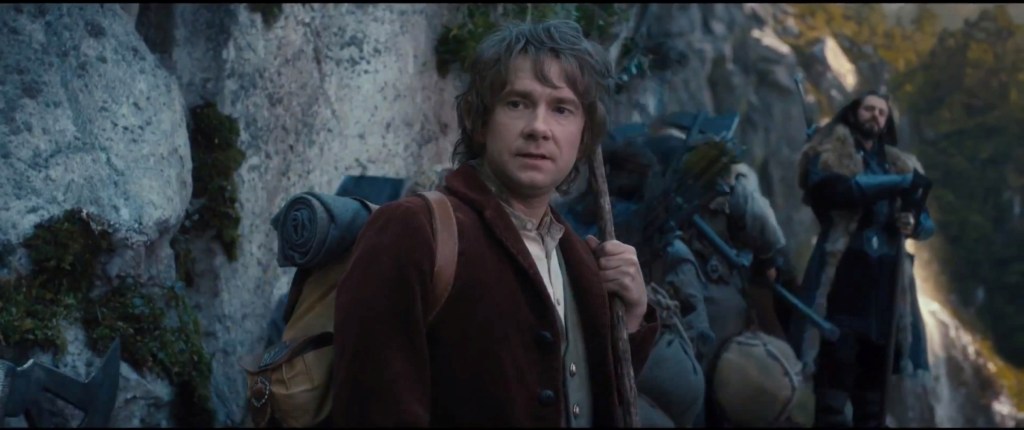
In at least one instance, even the weather and landscape of a certain portion of The Hobbit was altered after the fact by Tolkien, again to bring it more in line with the wider world of The Lord of the Rings. This makes sense given the part of the story in question — the travels of Bilbo, Gandalf and the Dwarves through the lands directly outside Hobbiton, leading up to their eventual encounter with the three trolls Tom, Bert, and William, is a clear predecessor to the journey of Merry, Pippin, Sam and Frodo through those same lands leading up to their similarly dicey encounter with the Barrow-Wight, followed soon after by the much more narratively-weighty battle with the Black Riders at Weathertop.
In light of this connection, it makes sense that, in the second printing run of The Hobbit to occur during the year 1966, Tolkien chose to make Bilbo’s own trek through these lands a bit more foreboding. “Inns were rare are not good” became “There were to people left, no inns,” “Hills in the distance rising higher and higher” became “Dreary hills, rising higher and higher, dark with tree,” and hilltop castles that “Looked as if they had not been built for any good purpose” became “Old castles with an evil look, as if they had been built by wicked people”. Even the weather was given the additional descriptor of “Gloomy.”
In a bit of a strange change for people raised entirely on the versions of The Hobbit that are fully part of the high-fantasy universe of Middle-Earth, the original version actually establishes the remoteness of the travels by saying that “Policemen never come so far”, which Tolkien had changed in the novel’s first 1966 printing to read “Travelers seldom come this way now” for obvious reasons. It should be noted, however, that the Shire and surrounding areas do have some sort of standing law enforcement in the form of the Sheriff, and that this position would actually go on to hold some narrative importance in The Scouring Of The Shire— The Return of the King‘s often-ignored final arc and the true final battle of the War of the Ring. This would not be the only time that Tolkien cut a concept from early on in The Hobbit, only to rework it for an instrumental role at the end of The Return of the King.
2) Sailing to the Other side
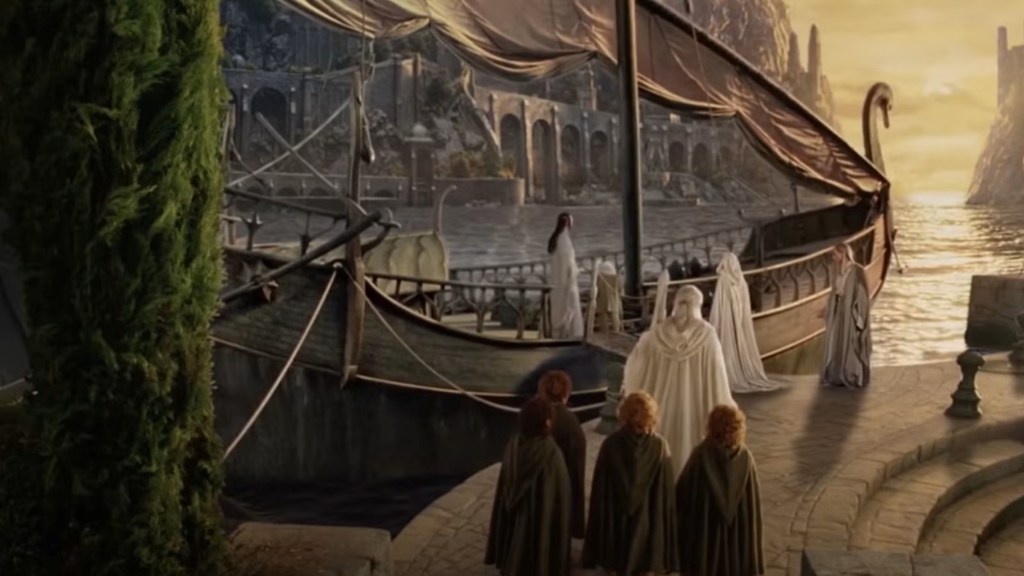
Extremely early on in the story of The Hobbit (or at least the book’s original iteration), Bilbo, suspicious of Gandalf’s wishes for him, speaks to the Wizard’s history of taking hobbits off on “Mad adventures, anything from climbing trees to stowing away aboard ships that sail to the Other Side.” The latter half of this sentiment, especially with its noticeable choices in capitalization, will immediately stand out to any fan of The Lord Of The Rings, as “ships that sail to the Other Side” seems be a very early, and strangely casually-spoken for its subject matter, reference to the journey taken by Bilbo, Frodo, Elrond, Galadriel and Gandalf at The Lord of the Rings‘ conclusion, across the sea to the mysterious Undying Lands.
It is unclear whether the Undying Lands are the “Other Side” referred to here, and the complete lack of reverence with which these ships and lands spoken of would make that honestly rather bizarre— unless of course this was yet another case of Hobbits hearing of Middle-Earth’s greatest wonders having almost absurdly mundane opinions of it all. Either way, seems likely that Tolkien edited the passage, replacing “…that sail to the Other Side” with “sailing to other shores”, not just to repair any dissonance in tone may have it created around Frodo and Bilbo’s own eventual journeys across the sea (which, in many ways, serves as a metaphor for death, a narrative tactic which the continued existence of this quote would have severely undermined) but to keep the entire concept obscure until its allotted time at the series’ end.
1) One Edit to Explain Them All
The final change that Tolkien made to The Hobbit was not within the story itself, but within the introduction— and it is this change that allows for all the alterations listed above to exist, in a manner that truly speaks to Tolkien’s genius. However, it takes some context to understand. J.R.R Tolkien, due to his background studying and interpreting early medieval texts and languages, preferred to frame his stories not as his own work, but as stories and documents written by the inhabitants of Middle Earth, that Tolkien (or occasionally an additional character, the pseudo-historical Anglo-Saxon sailor Ælfwine, who had brought these stories back from the elves and who Tolkien himself had in turn stumbled upon the works of), had translated into English in order to make them accessible to the people of this world.
All that complexity to say, Tolkien, when making the more major revisions to The Hobbit‘s 1951 Second Edition, explained the changes by adding a preface. This preface explained that the story— being of course only a translation of Bilbo’s own personal writings— and now contained a correction from the prior version, namely that the story Bilbo had told about his acquisition of The Ring was a lie made up by the hobbit, and that the text had (still in-universe) been corrected to relay the real story after the truth came out. Tolkien even includes clear and blatant foreshadowing of these edits within The Lord of The Rings itself— barely two chapters into The Fellowship of the Ring, Gandalf brings up Bilbo’s having lied about his encounter with Gollum, and asks Frodo if he knows the true story, which Frodo confirms that he does.
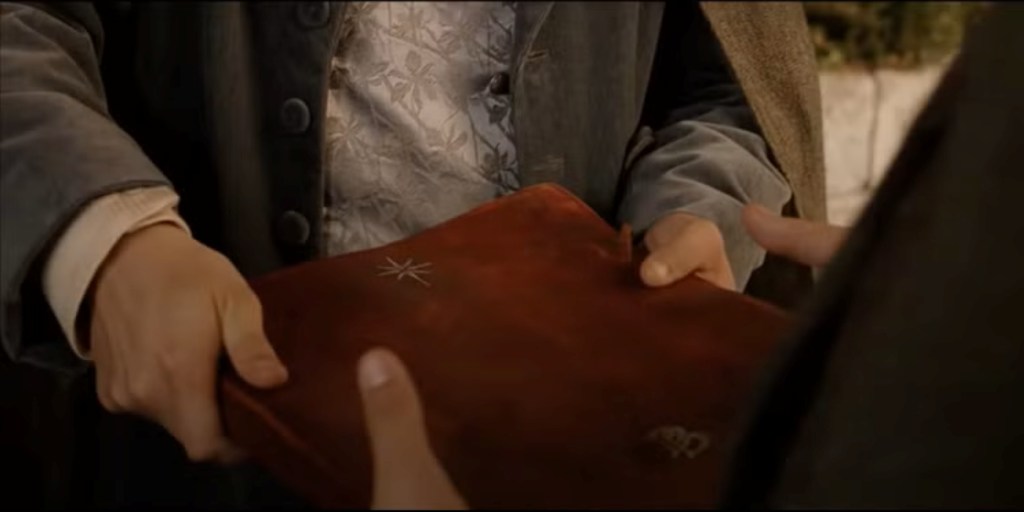
Later, during their farewell after the events of the War of the Ring, Bilbo gives Frodo the Red Book of Westmarch— the in-universe name for Bilbo’s record of his and Frodo’s adventures, i.e. the stories we know as The Hobbit and The Lord of The Rings— and we are told in the final chapters of The Return Of The King that Frodo continues Bilbo’s legacy of record-keeping during his own time as owner of Bag End. This transfer of the Red Book— the very text that Tolkien himself translated the story from, per his own framing narrative— into Frodo’s keeping for some time gave Tolkien a truly perfect opening to amend the story, especially given the nature of the edits needed.
This single interaction serves to neatly tie up two loose ends regarding The Hobbit’s revisions. Firstly, it informs returning readers (who, if they were reading The Fellowship Of The Ring upon its initial release in 1954 would most likely have grown up with The Hobbit’s first edition circa 1937) that a specific event they read about in The Hobbit did not, in fact, really happen, and thus they should not be surprised if the story they are about to read seems to conflict with what they knew of that event. Secondly, it combines with Frodo’s later ownership of the Red Book to give future readers, who will only be familiar with the revised edition of The Hobbit, context for the revisions mentioned in the book’s preface.
By developing a worldbuilding in which he himself is only a translator, and establishing a history of changing ownership for the imagined “original text”, Tolkien, although he likely did not think of it at the time, had granted himself the perfect means by which to re-enter and edit his work as needed with no damage to the internal consistency of his world. Convoluted? Yes. But without it, these edits would have remained permanent breaks in reader immersion for the world of Middle Earth.
More Movies
-
Image Courtesy of Lionsgate -
Courtesy of New Line Cinema -
Image Courtesy of DC Comics