As most moviegoers are probably aware, Edgar Wright’s adaptation of The Running Man is not the first time Stephen King’s dystopian thriller has been brought to the big screen. It was previously turned into a cult favorite 1980s Arnold Schwarzenegger vehicle — one that greatly deviated from the source material but was still a fun action romp built around its charismatic star. When working on his film, Wright made sure to pay homage to the original movie’s leading man. In an amusing Easter egg, Schwarzenegger’s face is displayed on $100 bills. Not only is this a tip of the hat to the ‘80s version of The Running Man, it also pays homage to another old-school sci-fi classic.
Videos by ComicBook.com
Speaking with CinemaBlend, Wright shed some light on The Running Man‘s Schwarzenegger Easter egg. He confirmed that in the movie’s universe, Schwarzenegger became President of the United States. “We decided that in slightly alternate 2025 is that they change the rules, and people not born in the United States can run for president,” Wright said. “So, the governor of California eventually became the president and in our version of events, And he’s Arnold. He’s not Ben Richards, he’s Arnold Schwarzenegger, the president.”
Wright continued, crediting Demolition Man with giving him the idea. “I have to give credit to Daniel Waters, the great writer who wrote Demolition Man because he made that joke first in Demolition Man. They make a brief mention of President Schwarzenegger. So, I wanted to continue that joke.”
Why The Running Man’s Arnold Schwarzenegger Joke Was Perfect
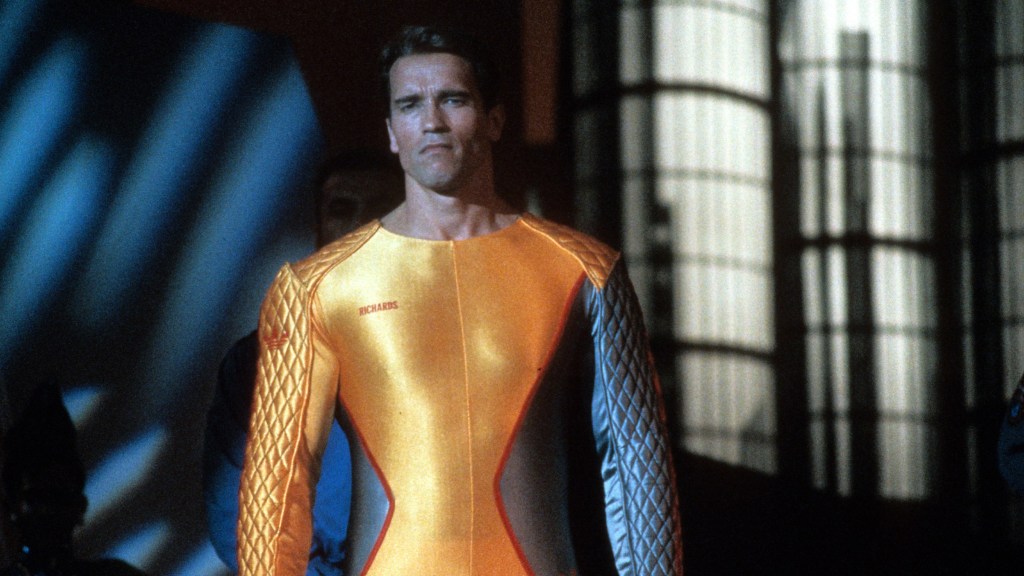
The Running Man earned mixed reviews (receiving the lowest Rotten Tomatoes score of Wright’s career), but it does have its fair share of highlights. The funny Schwarzenegger reference is chief among those for a few reasons. First, this kind of Easter egg is perfectly in line with Wright’s sensibilities as a director. A lifelong film enthusiast, he’s always been one to pay homage to other movies in his works by making clever references. It stands reason to believe that when developing The Running Man, Wright probably looked at Demolition Man (another dystopian sci-fi action film) as a source of inspiration and felt compelled to include a humorous nod to it.
It was also a nice way to pay homage to Schwarzenegger himself. Though the actor doesn’t physically appear in Wright’s film, he’s been a pillar of support for the director and his team throughout the process. Prior to production starting, Schwarzenegger gave new Ben Richards actor Glen Powell his blessing, and he later praised Wright’s The Running Man for its realization of Stephen King’s vision. Paying Wright the utmost compliment, Schwarzenegger believes the new version is an improvement over the one he made decades ago. Since the action icon has been behind this new adaptation from the beginning, it makes sense that Wright wanted to have a Schwarzenegger reference.

One doesn’t have to be familiar with Demolition Man or the original Running Man to get a laugh out of seeing Schwarzenegger’s face on a $100 bill. The gag works on its own just as a piece of world building to establish the wild, dystopian society of The Running Man and where things stand in the American political landscape. In that sense, it’s the best kind of Easter egg; it’s a fun bit of fan service for those who fully understand the reference, but it’s subtle enough that it won’t be distracting for viewers who lack the proper context. It’s not as if the entire plot of The Running Man hinges on the joke, so if someone’s never seen Demolition Man, they won’t be lost.
It’s a shame Wright couldn’t have found a spot to give Schwarzenegger an in-the-flesh cameo, but since the goal was to stay as faithful as possible to King’s novel, that would have been difficult to fit in. Wright’s film is a near-perfect adaptation with regard to sticking close to the source material, with a controversial new ending being the biggest deviation from King’s original narrative. The president is not a character in the book, so Wright would have had to add material to the story, which would have run the risk of feeling forced. Given the fast pace of the film and Dan Killian’s status as the main antagonist, there wasn’t a need to feature the president beyond the new United States currency.
Most Viewed
-

Image courtesy of Netflix -

Image courtesy of Bethesda -

Image courtesy of Nintendo