
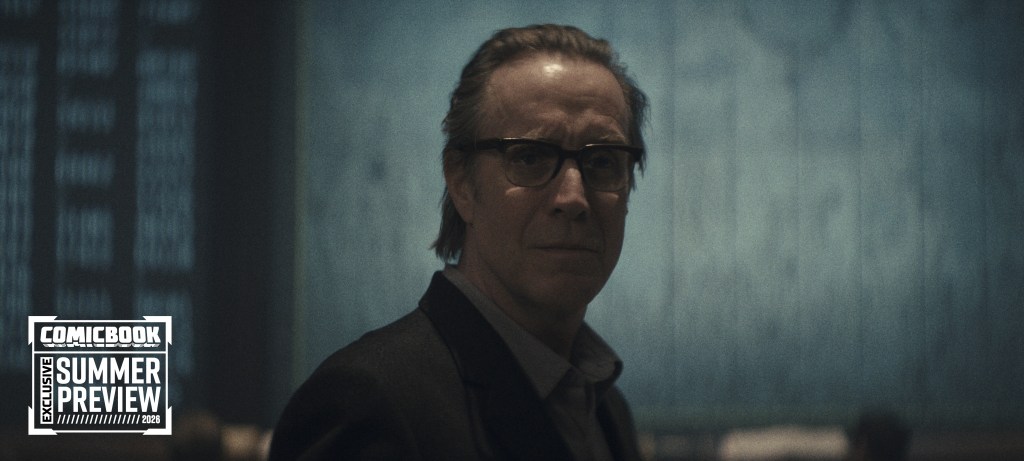
Building on the For All Mankind Universe, spinoff Star City also unfolds in an alternate history where the Soviet Union beat the United States to the moon. Created by Ben Nedivi, Matt Wolpert, and Ronald Moore, this political thriller shifts focus to behind the Iron Curtain, spotlighting the paranoia and dangers associated with their space program as the cosmonauts, engineers and intelligence officers are placed under a microscope. But in an environment shrouded in secrecy, the key players must carefully watch their every word and action… or suffer the consequences. Among those individuals is the Chief Designer (portrayed by Rhys Ifans), the brilliant mind behind the space program and a man with his own agenda.
Videos by ComicBook.com
Nedivi, Wolpert, and Ifans recently spoke to ComicBook about taking on the Soviet perspective, the Chief Designer’s covert affairs, crafting a tense atmosphere, and how it’s all going to come crashing down towards the season finale.
Obviously, you didn’t want to simply rehash what you did with For All Mankind. What kind of stories did you want to tell with Star City? How would you describe Russia and its mentality after beating the Americans to the moon?
Matt Wolpert: It was an incredibly important thing for us to differentiate the show, but it was driven by our research into the Soviet Space program and how different a program it was. It was essentially a secret program. Star City, where they engineered everything, was not on any maps. Where they launch rockets from Kazakhstan is in the middle of nowhere. They chose that spot because it was far away from everything. If something went wrong, as sometimes it did, there were rockets that blew up on the pad and killed dozens of people, and nobody knew about it for decades afterward because of the secrecy of that program.
The idea of the secret program drove the types of stories we wanted to tell and the sense of… These people couldn’t admit where they worked, if they were out and about in Moscow. They also didn’t know who was listening to their conversations. People in Star City were watching all the time. It just felt like a great world to tell human stories under this authoritarian system.
Rhys, how’s it been playing a character with so many layers? He’s a man who is loyal to the Soviet Union, but has his own game plan.
Rys Ifans: That was the appeal. Any character with obstacles is a very pleasing challenge for an actor. It’s what you just stated there. He’s a genius with vision and seemingly infinite curiosity, having to navigate and negotiate his way through a system that only has its own self-serving interests. The space program, for the U.S. government and the Soviets, was not about the pioneering, yearning to know more scientifically. It didn’t have any higher aspirations. It was about being the first. And that’s not necessarily what drives the Chief Designer. It’s something else for the Chief Designer. The Chief Designer, in many ways, is trying to please the child in hi that stared up at the moon and said to himself, “I wonder what’s up there.”
Similar to Matt and Ben, did you have to any special preparation for the role? Did you do a deep dive into history or talk to anybody who might have been associated with Russia at that time?
Ifans: I read extensively about Sergei Korolev, who the Chief Designer is based on. And of that time, not just the space program, but culturally what it was like to live in the U.S.S.R. You Had the U.S.S.R., which was arguably a difficult to live. But, within that, you have Star City where surveillance and listening in is cranked up even more. So, you are living in a city, an industry town if you like, but no one even knows of its existence. The scrutiny on everyone who lived and worked there was immense. But even within that, there’s a sense where when you work in any of these oppressive regimes and societies, people are resilient and mischievous. We innately enjoy breaking the rules, as a species. We need to break the rules on a daily basis. And they did, even in Star City. I remember reading alcohol was banned in Star City, but one of the major components in rocket fuel is alcohol. A lot of that was being drunk.
This show features drama, intrigue and conspiracy. There’s spy elements woven in. It almost feels like a powder keg that’s ready to explode. What would you say you are building towards for the end of the season?
Ben Nedivi: Exactly that. On some level, I think the ingredients are there for the powder keg to explode. The moment that the Chief Designer goes about this secret mission, we are already understanding the risks he is taking to go about that. The tension, the stakes, are so high from episode one on. You understand the closer that mission comes to existing, to happening, it’s just going to be a disaster. I think it’s such a great microcosm of everything in the Soviet program. The idea of achieving this great success… these incredible successes… and then the risk of achieving these successes, both in space and on the ground. The idea is the danger did not end with them going into space. In fact, you could argue the danger was higher on the ground on Earth than up there. That’s something we are exploring, as well…. The consequences of these missions, both in space and when they come back. That’s something you can expect a lot of towards the end of the season.
Ifans: I think pioneers like the Chief Designer are always infuriating people. I like to hope with an audience, when they see what he’s planning, there’s a sense that the audience will be going, “What are you doing?” It’s people like him that do these crazy things. Without them, we’d still be sitting in fields eating berries.
What do you think? Leave a comment below and join the conversation now in the ComicBook Forum!
