
The 1978 Faces of Death movie notoriously – or supposedly – featured actual deaths captured on film. Being banned in numerous countries only piqued people’s interest in the videotape and whether the images were real or some faux documentary done for shock value. Turned out to be the later.
Videos by ComicBook.com
Daniel Goldhaber, Director/Co-Writer, and Isa Mazzei, Co-Writer/Producer, combine for a contemporary take on Faces of Death, which follows Margot (Barbie Ferreira), a content moderator who spots some unsettling footage that seems all too authentic. Could someone be re-enacting the murders from the original Faces of Death? Unfortunately, as Margot dives into the case, she catches the attention of Arthur (Dacre Montgomery), a deeply disturbed individual who decides to make her his next victim.
Goldhaber, Mazzei, Ferreira and Montgomery spoke to ComicBook about the controversy surrounding the old and newer versions of Faces of Death, the actors screaming their lungs, society’s infatuation with social media and violence overload.
ComicBook: Your Faces of Death posters were barred from theatres. The red band trailer was removed from YouTube. How surprised were you by that censorship?
Daniel Goldhaber: I think we were a bit surprised by the censorship, honestly. There is nothing particularly more violent about this movie than any given war film or a lot of other horror films that out there. I think that the problem the MPAA has with this film is that it is a movie about censorship and a movie about the hypocritical relationship that censors have with violent media and how often violent media is allowed to slip through the cracks because it benefits people in power. That’s the thing. The posters with the censored imagery on them were the things that were banned from movie theatres. Go look at the They Will Kill You posters. It’s somebody dripping with blood and holding a human eye. And they are like, “No, no, no…” But this blurry, out-of-focus bloodied face… That’s a real problem for children to see. It’s like, “What’s the real issue that you have here, MPAA? Go get a real job.” That’s my opinion.
What’s the fascination with the Faces of Death IP and how did you incorporate the lore into the movie?
Isa Mazzei: That movie was so formative for so many people. Any time we mention Faces of Death to people who are just a little bit older than us, they are always like, “Oh my God. That movie fucked me up. That scarred me.” Or, “I remember seeing it at a sleepover.” I think to us, it’s incredibly cool to get to work with a property that had such a massive cultural impact, even if it’s a cultural impact that not everyone wants to talk about. For us, in wanting to respect the original, that is why we fundamentally made a movie about Faces of Death. It’s not a remake of Faces of Death. It’s not even an adaptation of Faces of Death. It’s just a movie about Faces of Death. We really wanted to stay true to that cultural iconography of that object, of the VHS of Faces of Death.
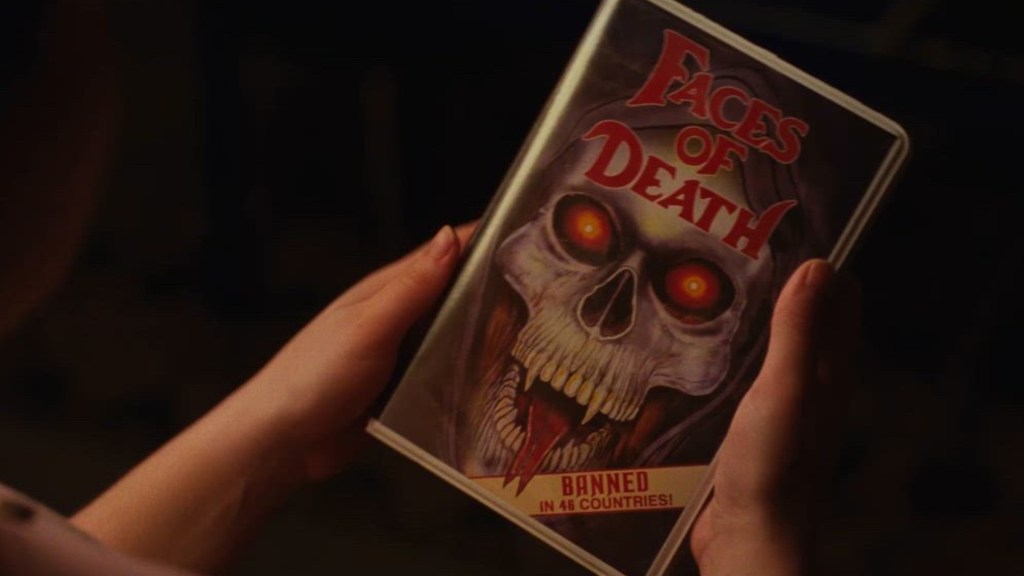
Back in the day, that VHS tape was taboo and the validity of those deaths were almost an urban legend. In what ways are you blurring those lines again in your rendition?
Mazzei: We have real death in our film. Like actually. We went out and licensed real footage. To us, you can’t make a movie called Faces of Death and be disingenuous to the original, which does have real death in it. A lot of it is faked, but some of it is real. In an era where we are served real death on our social media algorithms, to not have real death in our movie would be completely disingenuous to the experience of being alive in 2026. This is what it feels like. This is what happens when we open our phones.
Goldhaber: The scary thought of our movie is Faces of Death is everywhere now. Not only is the content everywhere, not only do we see death all the time, we are constantly asking this question: Is what I am seeing real? Is it fake? Is it AI? Is it restaged? Is it edited? And because we have decided to mediate our relationship to reality through our phones, it means we are constantly wondering what reality actually is. That’s one of the things the movie just wants to embrace, is the fact we are perpetually in a destabilized relationship to the world around us.
At one point, Margot says, “Give the people what they want.” In what way do you feel Faces of Death delivers on that promise for horror fans?
Barbie Ferreira: What I felt that was really cool about Faces of Death that it’s a re-imagining. Obviously, they didn’t remake a gore tape from the late ’70s that was largely faked and was made to look like a real snuff film. What I thought was really amazing about the script. thanks to Isa and Danny, is it’s a larger conversation about violence and how much money that makes in huge corporations and how much more normalized it is becoming to have violence in your everyday life. It’s just been creeping so slowly in society that at this point in 2026, we don’t even bat an eyelash at someone being murdered in a video that’s just coming across our feed. We shot this film in 2023 and even now, it’s even more relevant.
I feel like every year, there’s a new level of violence that we are subjected to as people, we are expected to normalize and to be OK with, being seen all the time. There is almost no way to go around it unless you just stop going on the internet or stop watching the news. And, so with Faces, it just felt like a really interesting take on it because what would be shocking in Faces of Death in the late ’70s is very PG for us in 2026. We can watch Faces of Death on YouTube, which is a largely sanitized social media platform that runs on ads. So, the difference in society now then it was 40, 50 years ago, and what causes us to have reaction is so different, that the only way to remake this movie, and to make it smart, is to address the fact that we are in a hyper-violent state of clip culture, of violent clip culture, of watching people die for real, not fake, all the time. What does that mean? How do we, as people, fight back against it if there’s even a way to do it? The whole movie is really raising that question.
Society is like, “What happens when you live in a hyper-violent, hyper-capitalistic society that encourages people to murder and to post these kinds of videos?” It’s not banded. Why are we allowed to always have this in out algorithm? How is there no safety guards for that? In fact, it feels like it almost gets pumped into the algorithm more rather than less. For me, what was always very interesting about Faces is the level of violence that was really crazy in the late 70s and the level of violence that is normalized now, and how society has changed.
Dacre Montgomery: I completely concur. I also just think it is fascinating, our fascination as human beings with death. There is this complete unknown around what that is. It means a lot of things for a lot of different people, who believe in different things, obviously. The meaning of life, I’m talking about. This idea of the finality of it is so fascinating to people, that we are drawn so intensely to it. Then, inherently, we are drawn into very intense kinds of mixed media, of very violent stuff. That’s what, often times, has to do with death. Not all death is just a peaceful fading away in the middle of the night in your 90s, right? It’s often, especially stuff that is publicized, is very intense. I think the world’s attention is captured by that for a long time. And now we have access. This movie is really about access and responsibility.

There’s also the obsession with social media. Arthur and some of the other characters suffer from it. Why do you believe so many people fall down that rabbit hole?
Mazzei: For a lot of people, social media is the place where you go for human connection. Ironically, what you end up with is more isolation. Some of my earliest friends were friends I made online and to this day, I have friends I still have not met. We are just kind of mutuals. We talk all the time. Both Margot and Arthur represent different sides of a relationship to social media. Margot is someone who has a flip phone. She doesn’t even have a laptop in the beginning of the film. She is someone who says, “I don’t need this. I don’t want this.” Then Arthur is someone who is reaching out to the internet for connection, for validation, for a sense of power in the world. I think both of those viewpoints are incredibly relatable to most people these days.
Dacre and Barbie, you both do a ton of screaming in this movie. What’s your process? How did you go about perfecting your sound?
Ferreira: Oh my gosh. I will say that we shot most of the things that required screaming in the beginning of the film. I learned a lot about my vocal cords and what I can take and what I can’t. For me, very physically and very practically, I had a steamer that I would steam my voice every night. It’s a hard job being a scream queen. Hats off to all the girls who have that piercing scream. I did it and it blows out your voice and then the next day, you still have to go and pretend you are the character. For me, it was really learning about my body and, in a crazy way, how to maintain my voice and my physical limits in that film. It really felt as physically demanding as it looked. It was really about me learning how to be a scream queen. It was more of a trial and error, with lots of error. Thankfully, the whole movie came together, but I was like, “Oh, I am prone to laryngitis/ I need to be aware of that.”
Montgomery: I like the idea of now knowing what is going to come out. I like the idea of Arthur is going crazy because even though it’s so much blood and stuff, he has so many elements that protect him from that. As soon as he notices the blood, I like the idea of saving it. I was like, “What’s going to come out? Is it going to be the nothingness, where my voice just completely goes or is it going to be whatever?” I kind of like that idea of not having done it and then the camera rolls and then you see it and you just go fucking ballistic. And what comes out comes out really weird. But that’s the interesting thing. When we see people in distress or dying, often the sounds are not sounds we have seen on screen before. That’s what makes it so hauntingly effective, especially when you see someone in a movie make a different choice like getting stabbed or choked or whatever… Not just the actor, but the filmmaker and the way they shoot it… It can be quite effecting.
That’s what is interesting about the original movie is there was this question around, “Is it real or is it not real?” Obviously, there is enough difference in the shades of death in the original to make that question even relevant back in the day, to go, “Is it real or isn’t it?” People hadn’t seen that kind of stuff before, in that way, outside of war or outside of those heightened, awful moments in history. That was personally my process. I didn’t do a very good job of preserving my voice.
Stranger Things really put you in the spotlight. Did you ever consider following in the footsteps of your fellow Aussies, like Chris Hemsworth and Hugh Jackman, and audition for a superhero role?
Montgomery: My first role in the film industry was I played the Red Power Ranger. I don’t know. Not really. Like I was saying to someone before, I really want to do indie films. I like having a bit more bandwidth as an actor to play and make co-creative decisions. A lot of times the effects are practical, which is much better, than I think for me. Everyone is different. But, in saying that and just to jump on the Hugh and Chris thing, those two Extraction films, those single takes Chris did… I am just talking about the action genre now… are f*cking insane. Hugh, I have met and is a friend. He is great and super-lovely. Again, he was the action man. He was the Wolverine and then fought his bloody ass off to get in Les Mis and worked his ass off to make it the best possible thing.
There is so much courage in every type of performance, whether it’s a superhero or not. It’s just not something that I have been drawn to. Isn’t it ironic that on a shoestring budget, you actually have more control as an actor to kind of play than on something massive that you, and often times the director, don’t? I think that’s really my main draw as opposed to not liking superheroes. I love superheroes.
Faces of Death is released on April 10. Are you looking forward to it? Leave a comment below and join the conversation now in the ComicBook Forum!
