Toy Story as a film franchise has been inspiring fans for decades at this point. After completely changing the face of animated movies with the first film, Toy Story made a name for itself not only because of its brand-new way of making movies but also because of its catchy songs, iconic characters, and themes of friendship. When the series became a franchise, though, it started introducing a new element that has become a defining characteristic of the series: wildly depressing moments. Toy Story 3 might have the most iconic of these with the moment that the toys are trapped in garbage and make peace with their fate as they appear to be headed for their deaths.
Videos by ComicBook.com
The first incredibly depressing moment of the Toy Story franchise that still haunts one of its characters, though, is the reveal of Jessie’s backstory in Toy Story 2. Accompanied by the Grammy and Oscar-nominated song “When She Loved Me,” Jessie’s backstory reveals the harrowing tale of a toy that was loved by her owner, Emily, until one day she was cast aside. It created a major sense of existential dread for Jessie and caused her to develop abandonment issues. As if this moment wasn’t traumatizing for the character and the audience, Toy Story 5 finds a way to twist the knife even further for Jessie and fans. Spoilers follow.
Toy Story 5 Returns to Jessie’s Tragic Backstory With Major Update
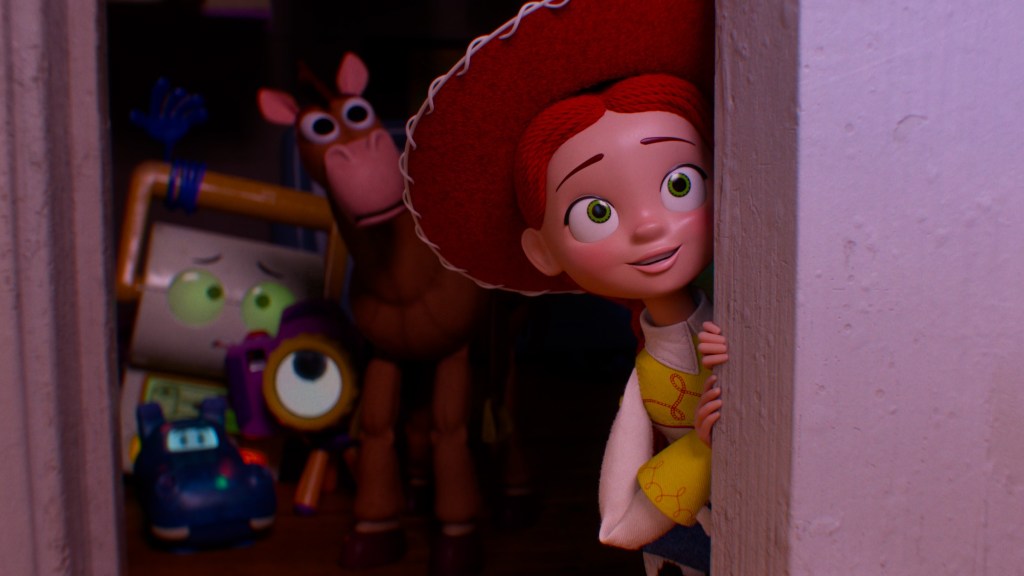
Toy Story 5‘s larger plot is one that is a little familiar to fans, with Jessie immediately suspicious about a newcomer to the house. Unlike Buzz Lightyear’s arrival in the first Toy Story, though, Lilypad is a tablet that completely consumes Bonnie’s time upon arrival with mindless screentime. Seeing this, and the bullying from other girls that comes with it, Jessie starts having flashbacks to being abandoned by Emily, hoping that she can do something to prevent Lily from taking over and losing yet another kid.
The story gains even more connectivity to Jessie’s origin, though, as she’s found on the ground while trying to help Bonnie, with an older couple picking her up and noticing the faded address written on her cowprint chaps, which Emily inscribed on her favorite toy years prior. Believing that they’re doing a good deed, they take Jessie and Bullseye to the house, which kickstarts an all-new part of the adventure when they learn that a new family lives in the house and the young girl, Blaze, there would be a perfect friend for Bonnie.
After befriending some other toys, Jessie attempts to set a, let’s call it a friendship trap, to bring Bonnie and Blaze together. When it doesn’t work, Jessie runs off from the house, sulking by the big tree and tire swing that she and Emily used to play by all the time. There, though, comes the truly devastating reveal. Carved into the tree, we see the words “Jessie was here” with an arrow pointing to the ground. Eventually, Jessie is able to dig through the spot and discovers an old lunchbox, filled inside with special mementos and reminders from an adult Emily to her daughter, whom she named Jessie and refers to as her “little cowgirl.”
Toy Story 5’s Big Jessie Reveal Is a Key Piece of Its Theme

This reveal confirms that not only did Emily actually love Jessie this entire time, but that love was buried deep in her heart that she named her own daughter after her favorite toy. The love that they shared as a kid and her toy became foundational for Emily and allowed her to grow up into a caring, thoughtful mother. Not only does this evolve the traumatizing backstory that Jessie has had since 1999’s Toy Story 2, but it delivers what can only be described as an emotional uppercut for the audience.
Even more than that, though, is that this moment serves as the primary fuel for Jessie into the final act of Toy Story 5. Knowing that she actually made a major impact on Emily gives her the drive to make the same kind of impact on Bonnie, but it goes even deeper than that. A key piece of the larger puzzle that is Toy Story 5 is the “feud” between the real toys and the tech.
In the film, screens are dominating kids’ lives, spending all their time mindlessly tapping away at games and consuming the digital interfaces from their first waking moment until it’s pried from their arms at night. The case it’s making is clear: these devices may have an addictive grasp on almost all of us, but they’re not actually something that can be used to make great, long-lasting memories.
There’s almost no chance that a kid, in the context of Toy Story 5, will one day go on to name their kid Lily after their Lilypad tablet, but a toy like Jessie that is tangible and can be used as a vessel for their own creativity and create an actual connection will make memories for a lifetime. This is why it was not only worth Toy Story 5 going back to the most traumatizing part of the entire franchise, but also delivering an update that was equally as emotional, even if the emotion this time can only really be felt by the adults in the audience.