Introduced in 1977 as the Galactic Empire’s ultimate instrument of fear, the Death Star has anchored the mythology of Star Wars across five decades of storytelling. Its shadow stretches over the entire franchise, from the destruction of Alderaan and the trench run that ends A New Hope to its resurfacing in The Empire Strikes Back, cameoing in the prequel trilogy, and even anchoring fan-favorite spinoffs like Rogue One. Even Andor built an entire season around the human cost of the machine’s construction, treating the Death Star as a slow-moving act of industrial genocide. That kind of narrative gravity is rare, and it explains why the battle station remains the default shorthand for unstoppable firepower whenever a new Star Wars project needs a doomsday threat.
Videos by ComicBook.com
However, the galaxy that Star Wars has built across films, games, comics, and novels is far too vast for a single space station to hold the title of the biggest threat. For instance, decades of Expanded Universe storytelling, later reclassified as Legends material after Disney’s 2014 canon reset, pushed the concept of the superweapon well past the original blueprint of a moon-sized battle station with one exhaust port weakness. Other machines outscale the Death Star in raw size or outpace it in efficiency, being more dangerous and deadly.
5) Sun Crusher

The Sun Crusher first appeared in Jedi Search, the 1994 opening volume of Kevin J. Anderson’s Jedi Academy Trilogy, and it proved that a superweapon does not need to be large to be catastrophic. Built at the hidden Maw Installation and protected by nigh-indestructible quantum-crystalline armor, the vessel carries resonance torpedoes capable of triggering a supernova in any star it targets, obliterating every planet in that system in the process. Unlike the Death Star, which requires a full-scale superlaser and a massive crew to threaten a single world, the Sun Crusher accomplishes system-wide annihilation with one pilot and one torpedo.
In the book, Kyp Durron, a Force-sensitive prisoner turned Jedi trainee, steals the ship after falling under the influence of the spirit of Exar Kun, and he uses it to ignite the sun of the Carida system, wiping out the planet and killing his own brother in the process. The New Republic ultimately has no way to neutralize the weapon through conventional combat, and Kyp is forced to drop it into a black hole to keep it out of Imperial hands permanently.
4) World Devastators

Introduced in Tom Veitch and Cam Kennedy’s Dark Empire, published by Dark Horse Comics between December 1991 and October 1992, the World Devastators land directly on a planet’s surface and consume it, converting terrain, cities, and natural resources into raw material for building new battle droids, starfighters, and additional Devastators on the spot. The comic deploys them against Mon Calamari, the homeworld of Admiral Ackbar, where they threaten to strip the planet bare before Lando Calrissian and the Rebel fleet can intervene.
The self-replicating design makes the Devastators considerably harder to counter than a single space station, since destroying one unit does nothing to stop the others already devouring a different continent and spawning copies of themselves. A weapon that grows stronger the longer it operates, and that multiplies its reach using the very worlds it attacks, represents a threat that the Death Star’s single planet-killing shot never approached. Sadly, we are yet to see the World Devastators in live-action.
3) Centerpoint Station

Roger MacBride Allen’s Corellian Trilogy, concluding with 1995’s Showdown at Centerpoint, introduces a station that physically dwarfs the Death Star. Centerpoint Station stretches roughly 350 kilometers in length, positioned at the gravitational balance point between the twin worlds of Talus and Tralus in the Corellian system, and its true function turns out to be an ancient superweapon known as the Starbuster. The station fires a tractor-repulsor hyperspace burst capable of forcing a targeted star into a nova, and by the time Han Solo, Luke Skywalker, and Lando Calrissian uncover the secret, it has already destroyed two stars and their entire populated systems.
Unlike the Death Star, which the Empire designed and built, Centerpoint Station predates recorded galactic history entirely, and no one in the story fully understands its inner workings even after they manage to jam its firing sequence using a planetary repulsor. That combination of unmatched scale and origins nobody can explain makes Centerpoint a weapon the New Republic can barely comprehend, let alone reliably defend against.
2) Starkiller Base
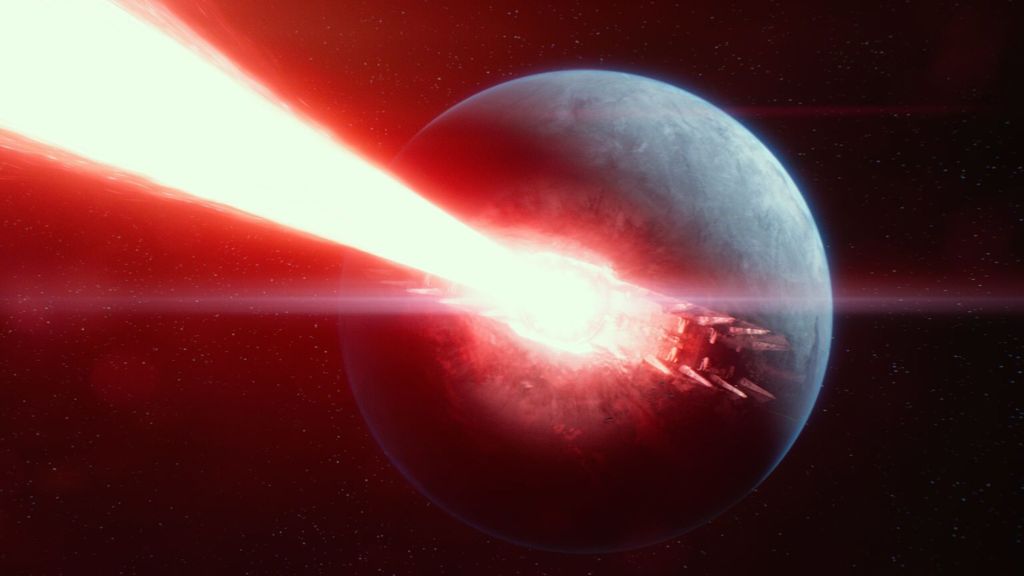
The Force Awakens introduced Star Wars‘ most destructive on-screen superweapon in 2015. That means Starkiller Base is the only Death Star competitor part of the official canon rather than the Legends continuity. Built into the ice planet Ilum by the First Order, the base drains an entire star’s energy directly into the planet’s core and converts it into a beam that splits into multiple currents upon firing, allowing it to hit several targets across a single system at once.
The Death Star needed to be in orbit around its target to fire, but Starkiller Base launches its beam across the galaxy through hyperspace, meaning no system is ever truly out of range regardless of distance. During the Hosnian Cataclysm, that single shot destroys Hosnian Prime, Hosnian, Cardota, Courtsilius, and Raysho in one strike, wiping out the New Republic’s capital, its Senate, and the bulk of its Defense Fleet in an instant. That single attack accomplishes more strategic damage than either Death Star ever managed, collapsing an entire galactic government before the Resistance can even mount a proper defense.
1) Star Forge

Introduced in BioWare’s 2003 role-playing game Star Wars: Knights of the Old Republic, the Star Forge easily earns the top spot. Constructed by the Rakatan Infinite Empire around 30,000 BBY using slave labor, the station orbits the star Abo in the Lehon system and draws energy and matter directly from that gas giant, combined with dark side Force energy, to manufacture an endless supply of battle droids, starships, and war material. When the Sith Lord Darth Malak seizes control of the station roughly four thousand years before the film era, he uses it to build what the game’s opening crawl calls an invincible Sith armada, a fleet that the Republic cannot outproduce because the Star Forge simply never runs out of resources to convert.
The station is also described as a semi-living entity that feeds on dark side energy and gradually corrupts anyone who tries to control it, meaning it poses a psychological threat as much as a military one. A weapon that can be destroyed ends a crisis, but a factory capable of arming a galactic conquest indefinitely, while warping the mind of whoever sits in its command chair, never truly runs out of ways to be dangerous.
Which Star Wars superweapon do you think should appear in live-action next? Leave a comment below and join the conversation now in the ComicBook Forum!
More Movies
-

Image courtesy of Warner Bros. -

Image courtesy of Universal Pictures

![Broken Lizard Reveals How Super Troopers Franchise Can Keep Going After 3 [EXCLUSIVE]](https://comicbook.com/wp-content/uploads/sites/4/2026/08/super-troopers-3.jpg?w=300)