Star Wars is one of the most important pieces of pop culture of the last 50 years. George Lucas, known for his love letter to American teen culture of the ’50s and ’60s American Graffiti (and to a lesser extent THX-1138), created a story that would enthrall generations of fans. While we now know that film by its full title – Star Wars: Episode Four – A New Hope – back then, it was just Star Wars. It was a massive moment in pop culture history and it’s one that Marvel Comics played a rather large role in. Everyone wanted a piece of Star Wars in the late ’70s and Marvel was given the chance to adapt the screenplay into a comic. The book was stacked with talent – Marvel legend Roy Thomas and just plain old comic legend Howard Chaykin – and the first issue sold like gangbusters.
Videos by ComicBook.com
Now, fans were able to go and watch the movie, then walk down to where ever they bought comics and pick up a part of the story. However, it was not a straight adaptation of the film itself. Much like the novelization, the six issues adapting A New Hope was made from the shooting script, which included numerous parts of the story that we wouldn’t get to see until 1997’s Special Editions were released. Star Wars is full of iconic moments and the comics gave readers things they hadn’t before, including the second issue. It contained one of the major re-additions to the Special Editions and is honestly a bit harder to find than the first issue; everyone wants issue one, but sales go down for the second, making them more valuable.
Comics Have Always Played a Huge Role in the History of Star Wars
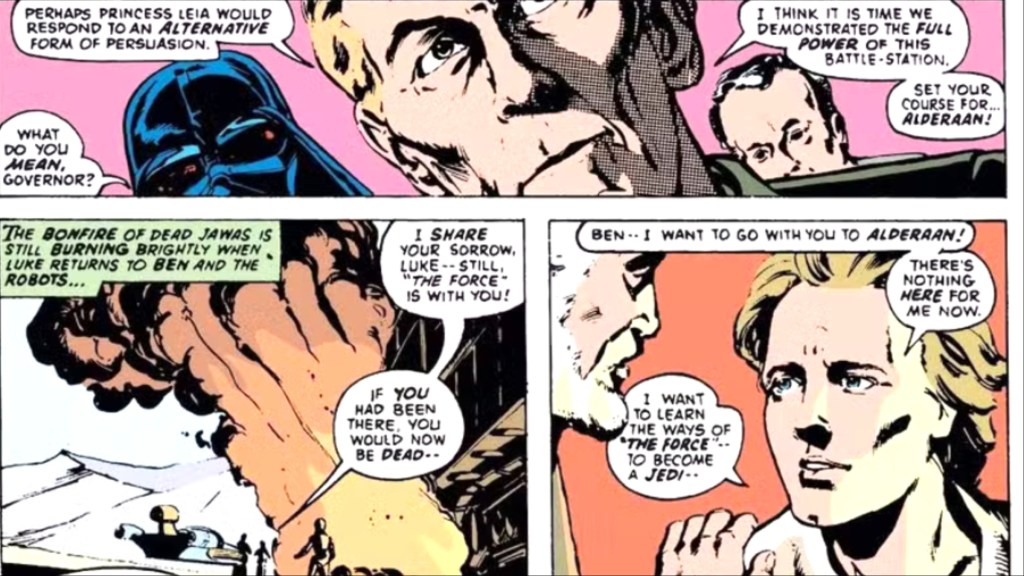
The success of the original Star Wars is one of those things that even I, an older person born in 1980, can only take about in the most general terms. It was one of those moments that you only got back in the days of the monoculture, when a piece of media hit that everyone loved. The pictures of people lined up around the block at the theater, the rabid fans talking to news crews, the endless merchandise that you could still find at comic conventions and in the houses you’d go to back in the day; I was once just given a 1980 Yoda figure by someone that had been sitting on their mantle for years. Star Wars was big business from the beginning.
Comics were huge in the late ’70s. You could buy them everywhere and they were cheap. They were the perfect impulse purchase; anyone could talk their parents into buying them something to read. Major movies would sometimes get adaptations and it was something of a no-brainer that Star Wars would. In fact, the process had begun in 1975, when Roy Thomas played a massive role in getting Lucasfilm publicity supervisor Charles Lippincott a meeting with Stan Lee, mostly because he wanted to edit the series, and history was made. They were given a version of the shooting script closer to the film’s release, with Thomas joined by Chaykin, one of ’70s Marvel’s best artists.
The second issue of the book introduces readers to Obi-Wan, contains the first major crime of the Empire in pop culture with the death of Uncle Owen and Aunt Beru, and the trip to Mos Eisley and the cantina, as well as some of the Death Star scenes. Because they were using the shooting script, the issue contained Han’s meeting with Jabba the Hutt, the first time that fans got to see that version outside of the novelization. Thomas and Chaykin took the script and the material they were given and filtered it all through their sensibilities, so even for fans who watched the movies, there was more to discover.
That was the triumph of the early adaptations of Star Wars; it took the movie that everyone had seen and tweaked it. This was Thomas and Chaykin’s version and it was spectacular. All of this added to the mythic quality of the nascent franchise; there were numerous versions of the story told to others and then they told it their way and so on. While Star Wars would have been popular without the comic, it helped add to the fever pitch of the movie’s premiere. You couldn’t escape it, which played a big role in it becoming the blockbuster franchise it is today. We didn’t get the Special Editions for 20 years, but we honestly had them all along. They were just on the pages of Marvel Comics.
Star Wars #2 Is Perfect for Any Fan of the Franchise
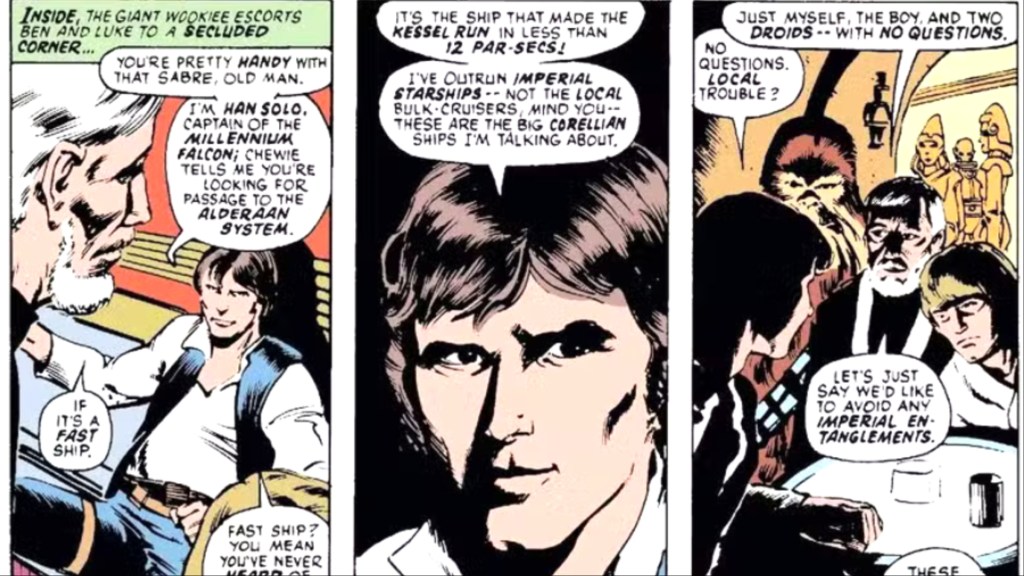
Comics and Star Wars have gone together since the beginning. The adaptation of the first movie sold a hundred thousand copies an issue, so obviously there was going to be more adventures with the “Star Warriors” (yes, Marvel seriously put that on the cover of comics and ads sometimes). Much like the adaptation, these took the characters to new places, keeping the hype alive throughout the wait for the next two installments. After Star Wars disappeared in 1986 (the last year I remember being able to buy Kenner Star Wars figures in my hometown), it would partly be comics that brought them back, with the one-two punch of 1991’s Timothy Zahn’s Thrawn Trilogy and Star Wars: Dark Empire. This led to the second Golden Age of Star Wars, which lasted until 2005 and gave us the Prequels.
Marvel has since gotten back into the Star Wars business, thanks to parent company Disney, and it’s putting out what many fans feel is the best Star Wars content of the Disney era. It’s a relationship that stretches 52 years into the past and is directly tied to this comic. It takes scenes that everyone had seen before and remixed them, giving them something they didn’t get on the big screen. It’s still fun to read this issue, and the others in the adaptation, and see the way Thomas interpreted the events of the script. Luke and Leia’s relationship is… something. Star Wars #2 never gets the praise or attention that the first issue gets, but it’s an important part of the relationship between Star Wars and Marvel.
What do you think? Leave a comment below and join the conversation now in the ComicBook Forum!
More Comics
-
Image Courtesy of Marvel Comics -

Image Courtesy of DC Comics -
Image Courtesy of Marvel Comics -
Image Courtesy of DC Comics -

Image Courtesy of Marvel Comics -
Image Courtesy of Marvel Comics -
Image Courtesy of Marvel Comics