Clive Barker’s Hellraiser: Revival just released a demo for players to try, showing off a bloody new chapter in the esteemed Hellraiser franchise. This game is set to bring the series’ grotesque body horror to players, with a new story about protagonist Aidan trying to rescue he’s girlfriend Sunny from the otherworldly powers of the Labyrinth. Although the first-person gameplay for Hellraiser: Revival looks quite polished already, it introduces several features that give it more potential than horror game fans probably realize.
Videos by ComicBook.com
The gameplay of Hellraiser: Revival begins with you helpless, but after you acquire the mysterious Genesis Configuration puzzle box, the game opens up significantly. Although the demo only covers a portion of the game’s first Chapter, the initial slice of story here shows off puzzle solving, item crafting, and first-person combat against various enemies. Multiple weapons and the promise of an upgrade system make Hellraiser: Revival into a competent survival horror experience already, but other systems within the demo go the extra mile.
Hellraiser Revival Has Put Out A Playable Demo Filled With Body Horror From The Series
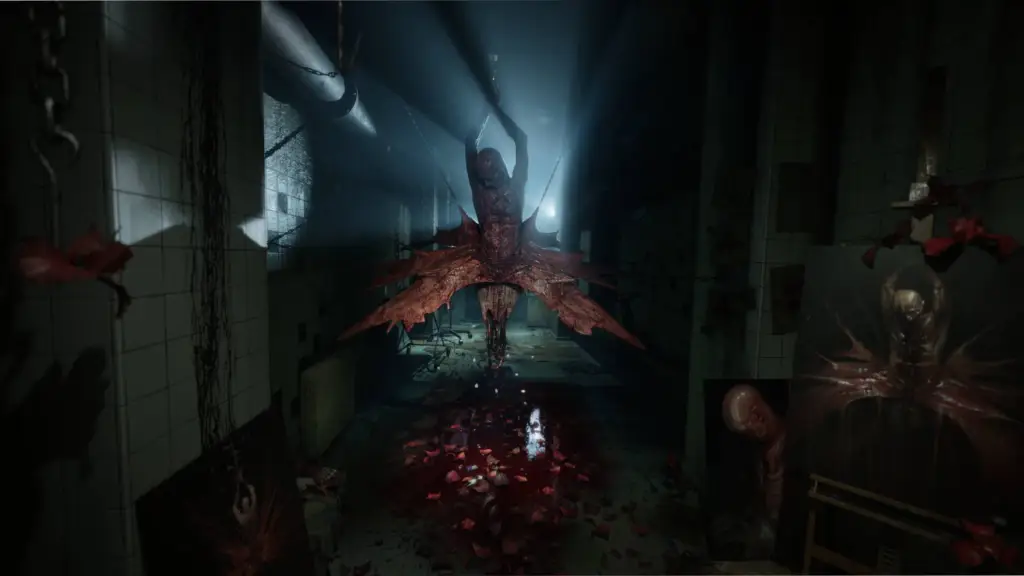
One of the aspects of Hellraiser: Revival that stood out to me the most was how it captured the extreme violence of the original novel and first few movies accurately. Hellraiser has always been about pleasure and punishment intermixing, with displays of graphic brutality and sensual relationships tied into its themes. This game clearly understands the necessity for blood and gore, as well as the depraved nature of it giving birth to supernatural threats. The game’s main antagonists, the cultists of the Scarlet Church, are a prime example of this philosophy being displayed to players vividly as they progress.
However, the body horror on display also serves a gameplay purpose, as the game is not simply a first-person survival shooter like other titles in its genre. Unlike games like Outlast, Alien: Isolation, or the upcoming Silent Hill Townfall, your character has access to supernatural abilities to help overcome challenges, as well as an arsenal of weapons to use against enemies. You inflict punishment just as much as enemies, acting more like Ethan Winters from Resident Evil Village rather than a helpless bystander to the game’s cruelties.
Complex puzzles also challenge your ability to navigate the horrors around you, forcing you to interact with the more disgusting parts of the environment. The demo itself doesn’t fully dive into the Genesis Configuration powers or puzzle solving, but it does hint at the gameplay variety that will come with each. Yet, even without the biggest mechanics being promised for Hellraiser: Revival, the demo already establishes an atmosphere far different than what other horror games are trying.
One Cenobite Boss “Fight” Has Me Completely Sold On The Game’s Perspective & Premise

The biggest selling point for Hellraiser: Revival‘s demo came with an intense interaction with one of the series greatest figures — a Cenobite. Those who remember the first Hellraiser movie can remember the distinct supernatural creatures to were “demons to some, angels to others.” Although Pinhead is the most famous Cenobite, the others with him in that first movie were equally memorable, including the Chatterer, who shows up in Hellraiser: Revival‘s demo as a mini-boss you can’t defeat in any way.
The moment the Chatterer shows up, your only option is to flee further into the strange space of the Labyrinth, which appears out of nowhere in the first place. Every twist and turn you take changes the shape of what was behind you, forming alternate pathways and making the space feel like a living, oppressive realm that’s impossible to truly understand. Combined with Pinhead’s chains appearing to block your path at times, this segment was a pulse-pounding experience far different from other horror games I’ve experienced.
Unlike other horror game “pursuer” enemies like Resident Evil‘s Nemesis or the Xenomorph from Alien Isolation, the Chatterer keeps appearing over and over in your field of vision, teleporting as you move. To evade it, you have to constantly turn around 180 degrees to go back from where you came, sometimes seeing a path behind you that simply wasn’t there before. Hellraiser: Revival smoothly and sneakily opens up new routes when you can’t perceive them, but keeps putting The Chatterer in places to block what you thought was an escape route, adding to the terror of your experience.
Horror Game Atmospheres Rarely Blend With Gameplay As Seamlessly As Hellraiser Revival

Those moments in the Labyrinth are hard to describe, but ultimately, represent everything the Hellraiser series should be about. The fear of the unknown extended to both the Cenobite in the game and the environments around it, making it feel like I was truly lost in a realm I could never fully understand. While plenty of horror games have terrifying monsters with intelligent behavior, quite rarely do the enemies you face work with your surroundings to make its presence known beyond what you can see. The closest example I can imagine is the Xenomorph in Alien Isolation crawling into vents to hunt you from locations you can’t reach.
If there are more sections of this game like the Chatterer segment, it may be one of the best horror games of the year. Having moments where control is lost and fear sets in rapidly is one of the best feelings, and it feels uniquely different through the lens of Hellraiser‘s characters and settings. While it remains to be seen if the full Hellraiser: Revival can meet the expectations set by its demo, this introduction is certainly a promising first step.
More Gaming
-

Courtesy of Konami