
While the Fast & Furious franchise always had plenty of untapped potential, it took until 2011’s sequel to truly turbocharge the series with a few major changes. The Fast & Furious movies have been through many changes since the franchise first began way back in 2001 with director Rob Cohen’s The Fast and the Furious. That original movie and its first sequel, 2003’s 2 Fast 2 Furious, turned series protagonists Vin Diesel, Paul Walker, and Michelle Rodriguez into blockbuster stars, but it wasn’t until a while later that the franchise truly found its footing with one ingenious change.
Videos by ComicBook.com
Although the Fast & Furious movies were originally about illegal street races, 2011’s Fast Five saw director Justin Lin and screenwriter Chris Morgan take the series in a radically different direction. The plot saw Diesel’s Dom and Walker’s Brian work with Jordana Brewster’s Mia to rob $100 million from a businessman, but this ambitious plan was complicated by DSS agent Luke Hobbs’ attempts to track down the crew. With this storyline, Fast Five turned the Fast & Furious franchise into a heist series, and the movies have never looked back since.
Fast Five Turned The Fast & Furious Franchise Into A Heist Series
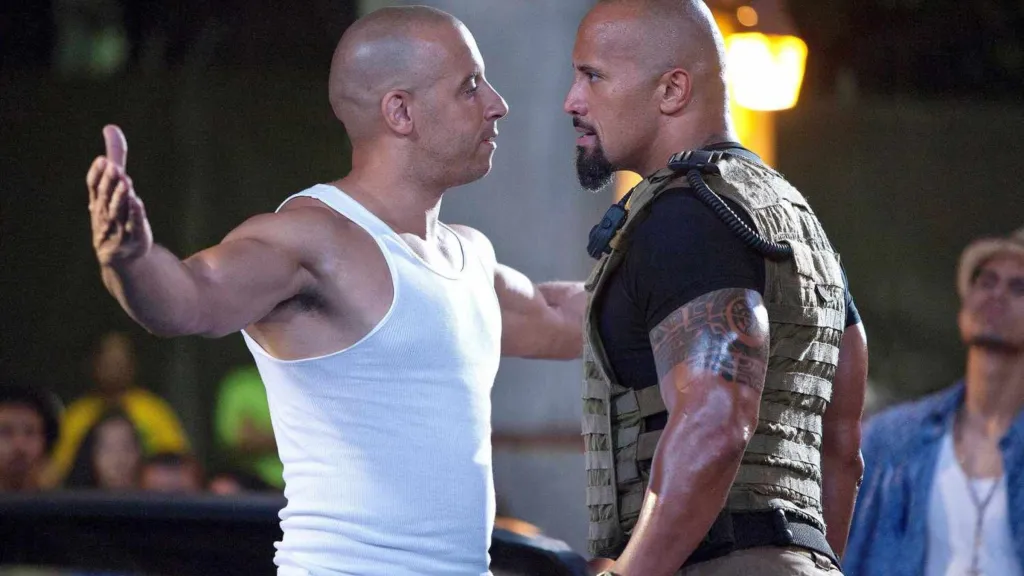
Fast Five’s gear shift away from the world of car culture and into more mainstream action-adventure territory was an active choice on the part of the filmmakers, as the creators of the franchise believed the blockbuster series had the potential to reach a bigger audience if its core story was less insular. Since the first four Fast & Furious movies had already done the heavy lifting of setting up the main characters and their winning chemistry, Fast Five could swoop in and change the genre without much fuss or complication.

As such, Fast Five got away with featuring only one conventional car race sequence, with the rest of the movie’s story focusing on the big heist. Car chases, fist fights, gunfights, and other action sequences were peppered throughout, and the result was a winning combination that supercharged the Fast & Furious franchise’s performance at the box office. While most blockbuster franchises struggle to maintain viewers after their third movie, the Fast & Furious movies became one of the only series in cinema history (alongside the Mission: Impossible movies) to make progressively more money with each new movie.
Fast Five’s Big Change Saved One Of Cinema’s Biggest Action Franchises

While 2006’s underwhelming The Fast and the Furious: Tokyo Drift made only $158,000,000, 20009’s sequel Fast & Furious improved the franchise’s outlook considerably with a worldwide take of $360,000,000. However, changing the franchise’s genre by making Fast Five a heist movie saw the fifth film in the series net its best reviews to date, and a whopping $626,000,000 payday at the box office upon its 2010 release.
The box office fortunes of the series improved even more from there, with Fast & Furious 6 earning $788,000,000 while 2015’s Furious 7 earned the franchise’s all-time best box office of $1,515,000,000. While the untimely death of series star Paul Walker contributed to the mammoth success of that specific sequel, Fast Five’s shift into heist movie plotting was undoubtedly the earlier movie that saved the Fast & Furious franchise as a whole.
