
Literature and cinema share a fundamental incompatibility. The page grants a writer unlimited space to build a civilization across a thousand years, inhabit a perspective no camera can replicate, and make the interior life of a character as visceral as any physical action. Cinema, in its turn, has roughly two hours to accomplish what a novelist spreads across hundreds of pages. It’s no wonder some fantasy books are deemed unfilmable. For instance, Steven Erikson’s Malazan Book of the Fallen has never been optioned at all, despite its critical acclaim, because no studio has publicly figured out where a single film would even begin. Plus, failed attempts like the 2007 movie adapting Philip Pullman’s The Golden Compass or the TV serial based on Mervyn Peake’s Gormenghast stripped the stories of their best qualities. Yet, spectacular adaptations such as Peter Jackson’s take on J.R.R. Tolkien’s The Lord of the Rings keep the hope alive for N.K. Jemisin’s Broken Earth trilogy to come to the big screen.
Videos by ComicBook.com
The first attempt at bringing Jemisin’s work to a screen came in 2017, when TNT optioned The Fifth Season for a television series. That project collapsed without explanation, and in June 2021, TriStar Pictures won the rights to the entire trilogy after a competitive bidding war, with Jemisin herself contracted to write the screenplay. By October of that year, Michael B. Jordan’s production company Outlier Society had joined as producers alongside Outlier Society President Elizabeth Raposo, signaling a studio-level commitment to the franchise. The latest development came in February 2023, when Jemisin confirmed she had already turned in the first movie script. However, as of 2026, no director has been publicly attached, no cast has been announced, and no release window has been set. The silence from TriStar following that script delivery is not unusual for projects of this structural complexity, but it still raises questions about whether the movie will ever be made.
Why Is The Broken Earth So Hard to Adapt?
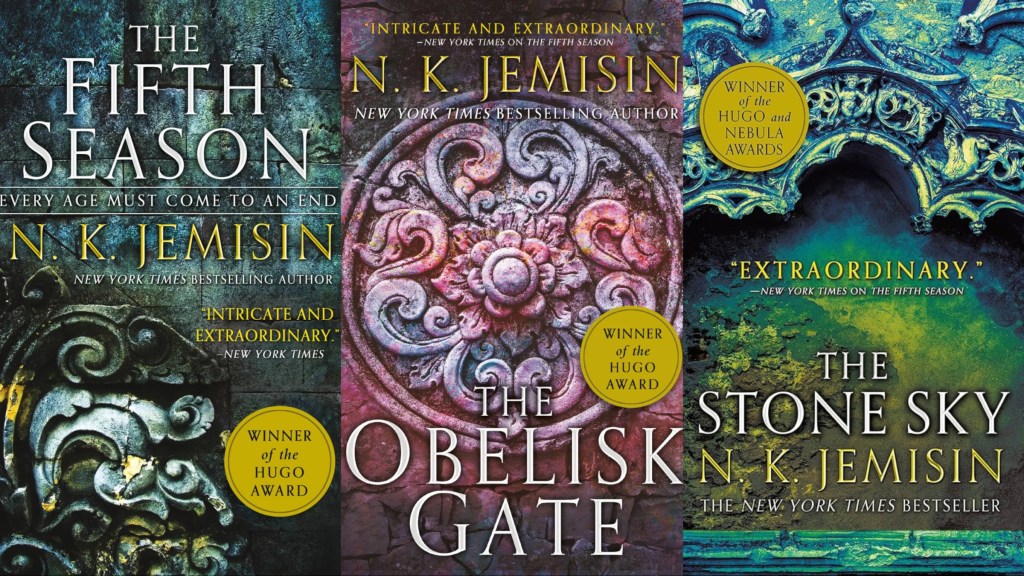
The Broken Earth trilogy — comprising The Fifth Season, The Obelisk Gate, and The Stone Sky — is set on a supercontinent called the Stillness, a violent landscape where catastrophic seismic events, known as Seasons, periodically reset civilization to zero. The books follow Essun, a woman whose power to manipulate kinetic energy drawn from the earth’s tectonic forces, called orogeny, has subjected her to systematic persecution throughout her life. Each book operates as a stage in a massive convergence, as three initially distinct storylines, separated in time and narrated from different vantage points, slowly reveal that they are the same story viewed at different distances. That convergence is the trilogy’s central dramatic achievement, and it won the Hugo Award for Best Novel for all three volumes, making Jemisin the first author to achieve that distinction for every book in a single trilogy.

One of the biggest challenges in adapting The Broken Earth trilogy comes from the books’ unusual language, as Jemisin wrote all three books in the second person, addressing the protagonist directly as “you.” The second-person narration is the mechanism by which the trilogy’s central revelation operates, because the narrating voice and the person being addressed share an identity the reader only gradually understands, a convention cinema can’t reproduce. A voiceover can approximate second-person address, but the intimacy of the literary version relies on the processing the word “you” that vanishes entirely on a screen.
Beyond narration, the three timelines that run in parallel across the novels present a further problem specific to the medium. On the page, two storylines can occupy the same chapter without confusion, because a reader processes text sequentially and can hold the separation in mind. A film audience watching a single continuous stream cannot split attention across narrative threads without substantial structural signposting, and the trilogy’s revelation depends on the audience not fully understanding the relationship between those threads until Jemisin is ready to show it.
The scale of the worldbuilding compounds both problems, as the Stillness is a planet whose geological instability has been deliberately engineered, a fact the trilogy reveals incrementally across all three books. The orogenes’ magic is rooted in scientific processes involving the planet’s core, the mysterious floating obelisks scattered across the continent, and a civilization-ending catastrophe that audiences only understand retrospectively. Translating this requires a film willing to withhold its central explanation for most of its runtime while building sufficient tension to keep audiences invested. Nevertheless, Jemisin’s decision to write the screenplay herself becomes the project’s strongest argument for confidence, as she is the only person who knows exactly how much the audience needs to understand at any given moment — and how much.
Do you think handing Jemisin full control of the screenplays is the right strategy for getting The Broken Earth to the screen? Leave a comment below and join the conversation now in the ComicBook Forum!
