In They Will Kill You, appearances can be deceiving. Directed by Kirill Sokolov, the high-octane, action-horror-comedy follows Asia (Zazie Beetz), a young woman who has been newly employed as a housekeeper for a New York City high-rise. What she doesn’t know is it’s all a ruse. The building houses a Satanic cult that must regularly sacrifice a victim. On the top of their list is Asia.
Videos by ComicBook.com
But Asia is not what she seems, either. Hardly a damsel-in-distress, she brandishes a sword and slashes, slices, and slays the worshippers in order to find her missing sister, Maria (Myha’la). Even decapitating or mortally wounding these crazy bastards – which include elitists Kevin (Tom Felton), Sharon (Heather Graham), Bob (Willie Ludick) and superintendent Lily (Patricia Arquette) – fails to stop them. Immortal, these cult members simply regenerate and continue to hunt Asia down. What ensues is a blood-soaked, hyper-violent fight to the finish.
Kirill spoke to ComicBook about Ready or Not comparisons, smashing expectations, barrels of blood, practical effects, and, importantly, sequel storylines. We asked about the potential for a sequel, whether you follow the girls again, delve into this immortal pact or go to another Virgil and whether the director had given any thought to that…
“I lived in this world, with these characters, for two-and-a-half-years now. Maybe even more. Maybe three. I love them so much. I would be so happy to go back. There’s multiple stories, as you said, to tell. The immortality aspect of it means that we can bring whoever we need. There is the Virgil story itself and lore and how it came up. There is Lilith and Ray’s story that would be interesting to explore and tell. There is the sister story. If you remember, the ending is a little bit open and now they have to deal with this piece of skin. Maria’s resurrection is still a question. Did we defeat it or not? I have a great idea of where it could lead from there. There are many, many possibilities, so I hope people love this world and appreciate those characters. I would be very happy to come back and tell more.”
The full interview follows:
ComicBook: The idea for this movie came from a stay in an apartment. Can you go into detail about how that inspired you?
Kirill Sokolov: Basically, my wife and I rented an apartment about 10 years ago. It was a strange building. Everybody else was older than 65 and mostly lonely ladies. Then, at some point, I did construction of the kitchen. I moved the kitchen cabinet and I found a hole that was leading to my neighbor’s apartment. I was like, “That’s so weird. It’s kinda like a cult.” We started to have this funny, running joke that, “At some point, we will just wake up and there will be people in masks that will come after us.” Then we forgot about it until a couple of years ago when I rewatched Rosemary’s Baby. When I saw it, I fully forgot about this whole closets and entrances and everything. Then I realized, “Wait a second. I know this story. I know what it means to live in an apartment where there is a secret entrance. Oh, we can make a movie from that.”
That might have been the germ of the plot, but what were some of the biggest changes in the script from conception development?
You know, surprising enough and funny enough, this movie is so bizarre and wild from the scratch, from the script level, that when people read it, I think we had this note or that note. “Oh, you accept it?” And fully, it was, “This is a wild journey. We love it.” Or you hate every aspect of it. It’s like the reactions for the movie that we are seeing now, which I am excited about. People either adore it or hate it. That’s an awesome place to be. That’s why when we started to sell the script and show it to people, basically they were like, “OK, we want to make this movie or not. There are minor things we want to tweak, but nothing really dramatic.” I don’t remember that I gave up on anything I really regret.
A kernel of the plot – the fact that there’s a character trapped in an enclosed space and being hunted down – sounds a little bit like Ready or Not. Were you concerned by the similarity or was it, “Audiences… Trust me?”
I mean, it’s not only Ready or Not. It’s a lot of movies of that genre. It’s a classic trope. What we basically did was writer Alex Litvak and me talked a lot about how to play with audience expectations and the movie does that constantly. We build up this beginning that starts off like Rosemary’s Baby or Ready or Not, where this female steps into this building and there’s a lot of dangerous people there. You understand that. “OK, I know where it goes. Probably, she will try to survive.” We were like, “No, no, no. Let’s build up this expectation, promise the audience something and then, on page 10, we will do a wild left turn and surprise everyone.” What can we do with that? How can we trick them? “Oh yes. She should be the most dangerous person in the room.” That immediately turns everything upside down. We did that and that was the first step. We understand that from now, we had to keep surprising the audience and build this expectation. “No, here we go. Expected? No here we go.” I think it was later proposed to give the audience the biggest surprise when they see the movie. I think now when they see the movie, this comparison just like disappears.
A big gamechanger came when Asia decapitated Tom Felton and mortally stabbed Heather Graham. It seemed the marquee actors would only be in the film for 10 minutes… And then they are alive and kicking again in the hallway. Can you talk about crafting that moment and defying expectations?
As a script writer, you get to this point now where you are like, “Oh, you have a badass character and she is tough. She kinda destroys everyone. Where does the movie go? How do you bring the stakes up? How do you bring the danger up? What can you do?” We were like, “Oh yeah. It’s a cult.” It’s such a great thing that we could create a very different and new version of all those zombie movies. And they are not like zombies. They are not just undead, like Evil Dead or zombie or something else. “Oh, that’s so cool. Let’s try and do that.” I’m very happy that it works like a big surprise. We even improved it because we shot a little bit more of Tom Felton, where he was in the lobby. He talked to her, so we had more introduction. When you put more of him and then he’s cute, you are like, “Nah, he’ll come back. No wait” But when I took him away from the lobby, the surprise is bigger because people believe it’s a cameo and shows up just for that scene. I’m so happy it worked this way.
Did you play around with the masks and the aesthetic of these cult members? How did you land on their look?
Oh yeah. The idea was the cult has operated for a very long time. There are things that come from the past. There is a lot of traditions and rituals that people cannot believe anymore, but they still follow. The idea was they have these handmade-carved masks, like the interpretation of the head of the cult. But, also, each mask is different depending on the owner. Somebody dressed it with something. Somebody doesn’t do anything on top. It was reminiscent of African wood carved mask, but also with personal touches on every one. We actually made almost 250 or 300 personal individual masks for each member, with different style. It was interesting because we let cast members choose their own masks. We put them all on the table and every time a new cast member came to the set, it was, “OK, what do you think your character would take?” That’s why Heather chose this elegant one with golden chains and rings. Bob, our most brutal, took this very rough and empty mask. It was interesting. We tried to add some personality to it.
What was your philosophy when it came to shifting tones? There’s the horror and the action, and then you punctuate it with humor in spots.
I just love when movies surprise you. I love when you have this roller coaster, not only when the plot surprises you and you have story twists, but also when you are surprised by emotions you feel while watching the movie. For example, South Korea movies does it so well. I am a huge fan of Park Chan-wook and when I watch his movies, it’s dark thrillers. Then it has very sad moments, but then you laugh suddenly. Then you feel shame that you just laughed and then you are kind of terrified. That emotional journey gives you the best movie experience. I tried to do the same and just shift the tones, so you never know. You are afraid a little bit. Now you laugh. Now you are excited with action. Now you laugh again. That’s one part of it.
Another part of it is playing with audience expectations. We stick together very different genres and refer to very different movies because it starts like Rosemary’s Baby. Then it turns into almost a Kill Bill kind of thing. Then it turns into Sam Raimi kind of horror. Then it goes fully anime tone. I knew I needed something that would link all of that together.

You referenced Sam Raimi. Besides the zombie aspect, one scene that felt very Raimi involved a travelling eyeball. When you are constructing a gag like that, do you worry how that is going to land with audiences?
I didn’t worry. I knew that it would work 100 percent. Funny enough, that was the one question that most producers had every time we talked. “Everything is good, but this eyeball is so goofy. It’s like so over the top. No way will it work.” Especially the studio heads. I was like, “Guys, it won’t cost much. Let me do it and you can make a decision later. I can cut it. Just let me do it.” And they trusted me and gave me a chance to do it. It immediately became the most favorite moment from the movie because it’s so funny how our emotions are unpredictable. You basically show a part of an exploded head, with chunks of skull, and then an eye popping out from the gore. And people do this. “Hmm…” And they are charmed. It’s very confusing. People are really charmed by a ripped-out eyeball, but it’s fun.
How difficult was it filming the maze portion when they are crawling underneath this hotel?
They were crawling for two -and-a-half days. We were filming this chase scene for two-and-a-half days. It’s not only that. The entire movie was physically challenging. It took a lot for all of the cast members to bring it. I can’t appreciate their work enough because a lot of the work was done by themselves. The only thing that helped them in the crawling space was the floor boards they made from soft material. It’s not like actual wood. It’s a little softer, so it was less painful for the knees. That’s it. Everything else they just had to do it. We literally did two-and-a-half days of, “Again. Again. Again.” When you do action, people also don’t think you do different takes to get the perfection of synchronized actors and camera and movement and everything. It was so exhausting. It destroyed them a little bit. Funny enough, those shooting days were for Heather and Tom. They came back, “Oh, that’s the kind of movie we are doing. OK.”
The movie features three levels of the Virgil. Did you have discussions about having Asia endure other levels and what they would look like?
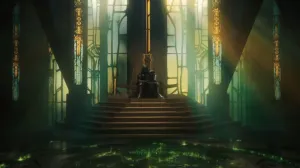
So, yes. The system behind the floors is very clear. We specifically didn’t push it too forward. The building is called Virgil and not just randomly. It’s basically Dante’s Inferno. Each floor of this building is a specific circle of Hell. It’s thematically separated. We used different symbols and colors and patterns. Then you have this rug that is basically the River Styx, even with the waves. Then it’s like limbo. You have the gluttony floor, with this restaurant and where they eat. Then they get to the ninth floor, which is Frozen Lake, where Satan sits. In the very first version of the script, we had floors in between, but it was just too much. It was, “OK, we need to speed up and cut something.” It just helped this idea to structure this building. Now, you have a very clear idea of themes each floor has and tonal. Also, when you are stuck in one location for the entire movie, you need to come up with things that will make it exciting for the audience, that will surprise them and entertain them, because it is very boring to stare at four walls all the time.
How much was done with practical effects versus CGI?
Ninety percent was practical, except, of course, for the final demonic pig. Even for the pig we had a dummy. I grew up on films in the 80s and 90s. I learned how to make movies watching back stages. I made two really tiny movies, when I had no budget to do things. Finally, making this movie inside of a studio system, I felt like a kid in a candy store, where you could actually make prosthetics. You could actually make gear to create some extremely interesting camera movement. You can do those things. I was like, “Guys, let’s push as hard as possible for that.” I grew up and dreamed that was how movies are made. Then, thanks to Crafty Apes and our VFX team – we have a lot of VFX – but they nailed them and put them in the space as handmade stuff, so you can’t find the difference. We even had a miniature in this movie, that nobody finds. To make a movie in 2026 that has a miniature, that’s kind of sick.
What was the miniature?
Oh… I won’t tell you. Try to find it.
There’s a sequence where Heather Graham’s character has a shrunken head. That was reminiscent of Beetlejuice.
It is straight from Beetlejuice.
How much blood did you end up using for the practical effects?
Lots. We didn’t even count. Too much. It’s funny. To build this pressure, they used specific pumps and put blood in beer barrels with high pressure. I remember we did the first test. Kevin had his head chopped off. They opened it and we had these sprays. The barrel immediately went empty and that was the first test. They were like, “Oh, we will need a lot of blood.”
Those tests require rolling camera, resetting, examining the blood splatter and then repeating…
It’s a lot of cleanups. A lot of continuity issues. You must be very clever about, “If you shoot them, you better shoot them from the back so they don’t spoil their faces because it’s one hour of loss for cleanup.” Working with a lot of blood and practical effects just takes so much planning. Any recharge will take time. Prosthetics takes so much time and it’s so unpredictable how it works. But, also, it gives you so much charm and awesome feeling.
Let’s talk about your collaboration with Andy and Barbara Muschietti. The siblings are best known for their It and Mama features. How did they come on board and how did they help realize your vision for this movie?
They are my blessing. Basically, they read the script. They loved it. They believed in it. Then, they gave me all the freedom I could dream about. They were very supportive and protective. When your producers are extremely talented filmmakers, I could go ask them questions on how to do things. I called Andy and asked him how he did that shot from It or that shot. I showed him storyboards. It’s just such a privilege and such a luck. It’s not only colleagues. You not only get support and help, but you also learn so much. I abused them a lot. In a very selfish way, I took as much as possible from them.
What was your favorite action sequence in this movie and how challenging was it?
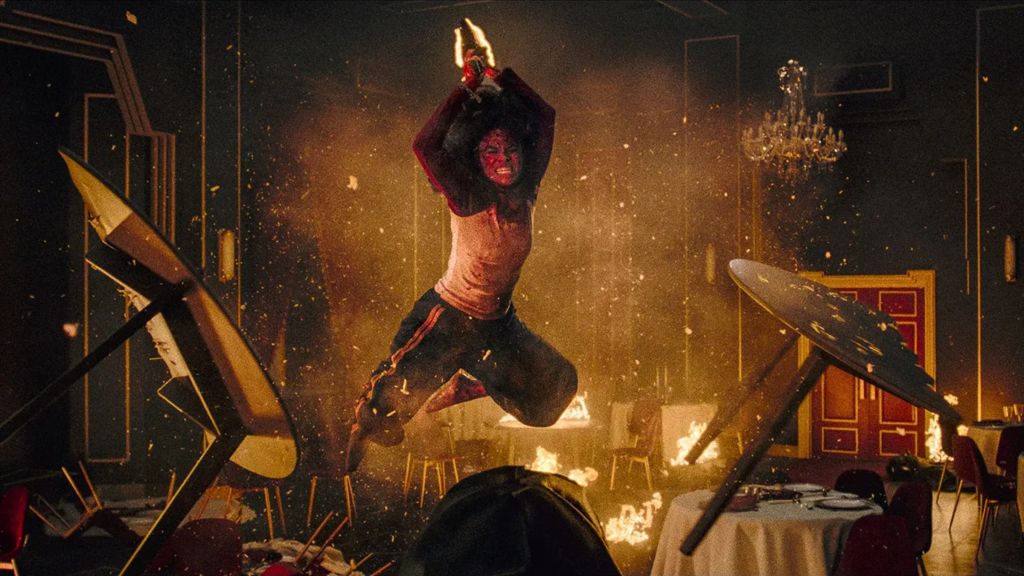
There are three big ones. The opening, the fire-axe scene and the freezer scene. I am very happy that they are very different. They escalate and look very different and depending on the time of post-production, my personal favorite jumps from one to another to another to another. The first apartment fight is so visceral and it goes from zero to 100 right away. It is very hard to repeat late in the movie because you are prepared. You wait for something like that. That still works perfectly.
But, also, the fire scene is incredible because we achieved it practically. The fire is practical. Zazie was riding and whooping people and put them on fire for real. That also took so much preparation and so much effort. People watching it will probably question if its CG or what. But you feel the fire is hot and the people are afraid of it. There is tension and energy that wouldn’t happen without making it in onscreen camera. The final five is awesome just because it’s so crazy. It is full anime. It’s like real anime. You have Patricia Arquette with a rotten pig head on top doing kung-fu sword fight. What could be better?
What do you think? Leave a comment below and join the conversation now in the ComicBook Forum!
More Movies
-

Image Courtesy of Universal -
Image Courtesy of DC Studios