Darth Maul, from the moment he stepped onscreen in 1999’s Star Wars Episode I: The Phantom Menace, has been nothing if not frightening. With Sith presence in the Original Trilogy being limited to Darth Vader, who required a full mechanical suit to stay alive, and the geriatric (though still overwhelmingly powerful) Darth Sidious, Maul was designed to be a shock to audiences. Appearing in the film that would be many viewers’ first introduction to the decadence of the Galactic Republic and to a time when Jedi were not a legend, but a cultural institution, Maul’s devilish appearance, mad red eyes, double-bladed lightsaber, and ferocious, agile fighting style were outside anything audiences had ever seen.
Videos by ComicBook.com
Despite seemingly meeting his death at the end of The Phantom Menace after being bisected at the waist by Obi-Wan Kenobi and falling down a shaft, Maul would return to become a lasting presence in galactic events, surviving his bisection through sheer force of rage, and returning decades later to hunt down Kenobi for revenge. Eventually, Maul would largely abandon his quest for vengeance— and his strict alliance to the Sith— to become a crime lord, general evildoer, and galactic nuisance for roughly another two decades before dying again, for good (that we know of).
Initially believed to be a one-movie villain, Maul has become a regular presence in Star Wars canon, appearing in Star Wars: The Clone Wars, Star Wars: Rebels, Solo: A Star Wars Story, and the ongoing Maul: Shadow Lord, as well as various comics and novels set in the Star Wars universe. Through all of this, it is easy to attribute Maul’s intimidating presence, and his ability to survive and thrive amidst multiple galactic civil wars, to his unusual lightsaber, quick bladework, and ability to channel the Dark Side through his anger. However, nonstandard sabers, blink-and-you-miss-it fights and rage-fueled Sith are all common to Star Wars— So, what sets Maul apart?
Form VI Lightsaber Combat Combines Bladework, Footwork And Strategy From Previous Forms

The first step to understanding how and why Maul’s approach to combat works is to look at his saber (or in this case, staff) technique. Lightsaber combat is divided into seven “forms”, each form referring to both a style of combat— blade angle, footwork, posture, movement, etc. — and the mindset in which the style is used. While this mindset is primarily based around the style’s function, such as defense, precision or even something specific like blocking blaster shots, it also shapes how the Jedi moves through and interacts with The Force while fighting. Due to this, Form VII, which channels the Dark Side, is almost entirely used by Sith— although this is not the form that defines Maul’s fighting style.
While skilled in several forms, Maul largely utilizes Form VI, also known as Niman or the Way of the Rancor. Form VI’s defining trait is variability, as it takes aspects and techniques from the five forms developed before it and, rather than adapt them to new purpose as with previous evolutions in lightsaber combat, keeps them unchanged and focuses on switching seamlessly between these different, and often contradictory, physical and mental approaches to combat.
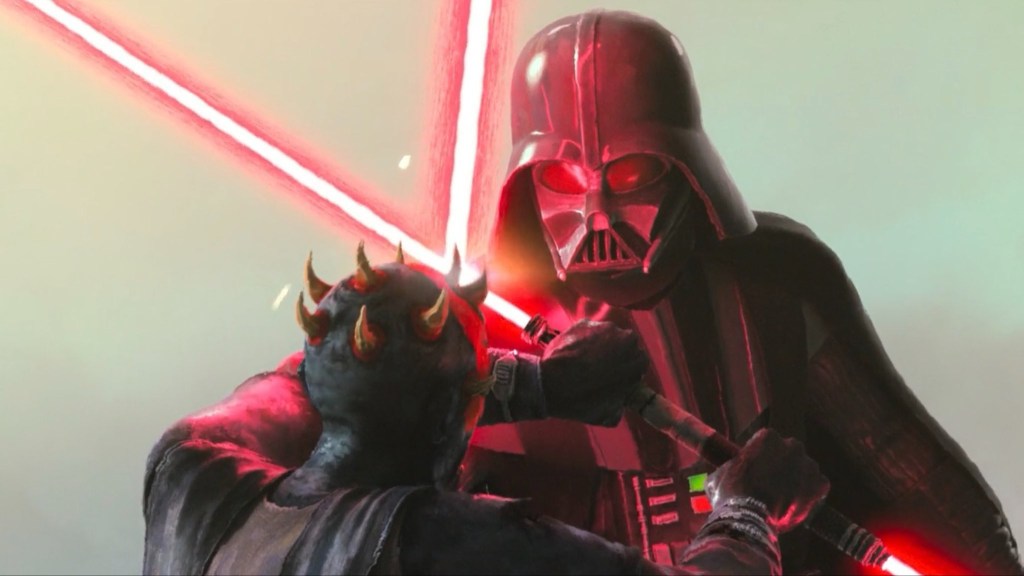
The result is a fighter whose actions, and more importantly reactions, are extremely hard to predict, as while other lightsaber forms have a core goal or value that informs how they respond to a given circumstance in combat, form VI’s core value of Moderation (ie, no form is fully mastered, with individual techniques from multiple forms being used as-needed) causes them to react in whatever way is most suitable to the specific moment. This proves especially treacherous for any Jedi facing a Form VI fighter, as while Form VI did originate within the Jedi Order and had at least a few adherents within the order by the time of the Clone Wars, the majority of forms focus on either responding to a certain scenario, achieving a certain goal, or both.
Even the Sith standard of Form VII centers aggression and the enjoyment of violence, meaning that there is still a single concept guiding the actions and reactions of the fighter. Because of this, the majority of training and combat seen by Jedi will necessarily involve fighters whose moves fall within a pre-determined pattern of goals, cause, effect and action, with each strike by a fighter provoking a form-determined response from their opponent — making Form VI fighters, who respond to strikes with whatever is most immediately effective and whose overall “goal” in the altercation may be unclear, extremely hard for a Jedi to keep up with.
Maul’s Saberstaff Is Unusual For More Reasons Than Just Its Two-Bladed Design
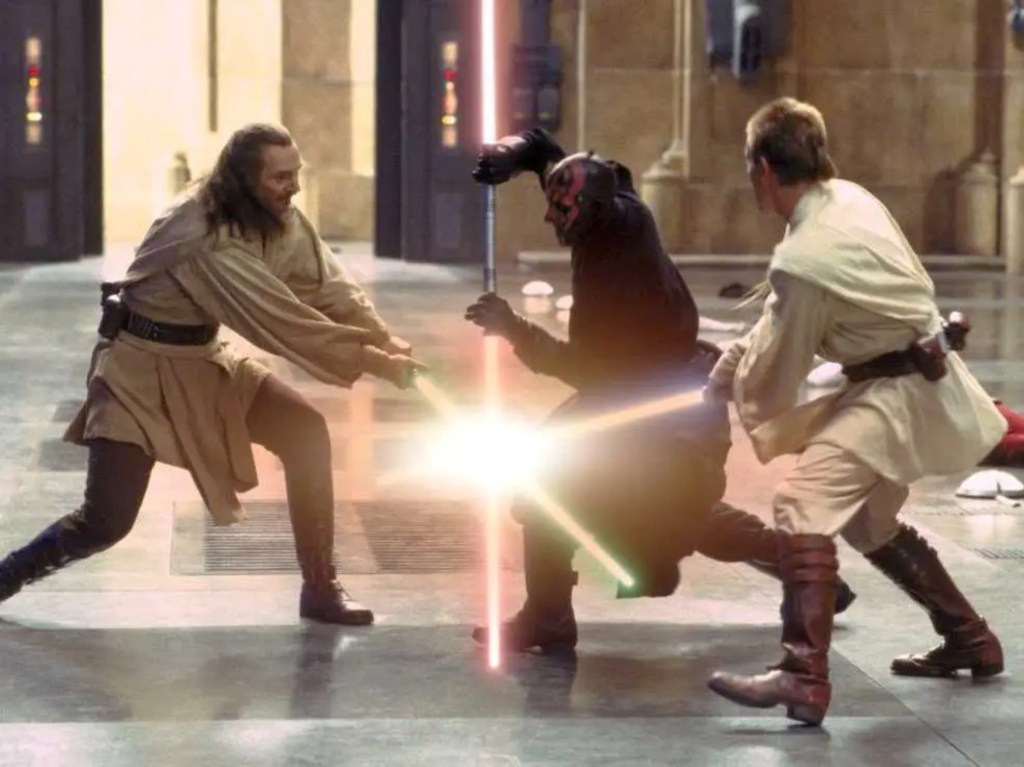
The unpredictability inherent to form VI is enhanced even further both by the nature of Maul’s weapon, and how he uses it. Maul’s saberstaff, made of two sabers fused together at their hilts’ far end (making this a two-crystal weapon, with one complete and self-contained blade on either side of the combined hilt), allows the Sith to effectively hold two stances at once, as angling the hilt brings one blade into a higher guard, and the other blade into a lower— easily able to defend or attack from above or below.
Taking full advantage of this possibility alongside the versatile and spur-of-the-moment nature of Form VI, Maul can often be seen holding his saber at a perfect horizontal between bouts of combat, waiting for his opponent to make the first move— even if that move is simply taking their own fighting stance— before using a minute and calculated angling of the hilt to bring the saberstaff into whatever position is best suited to counter them. This utilization of the saberstaff to enhance the power of Form VI continues during active combat, as Maul constantly adjusts the angle of the hilt relative to his body as he fights, thus switching both blades in and out of positions standard to various other forms in perfect tandem— one blade remaining in high guard while changing angle and position, the other doing the same in low guard.
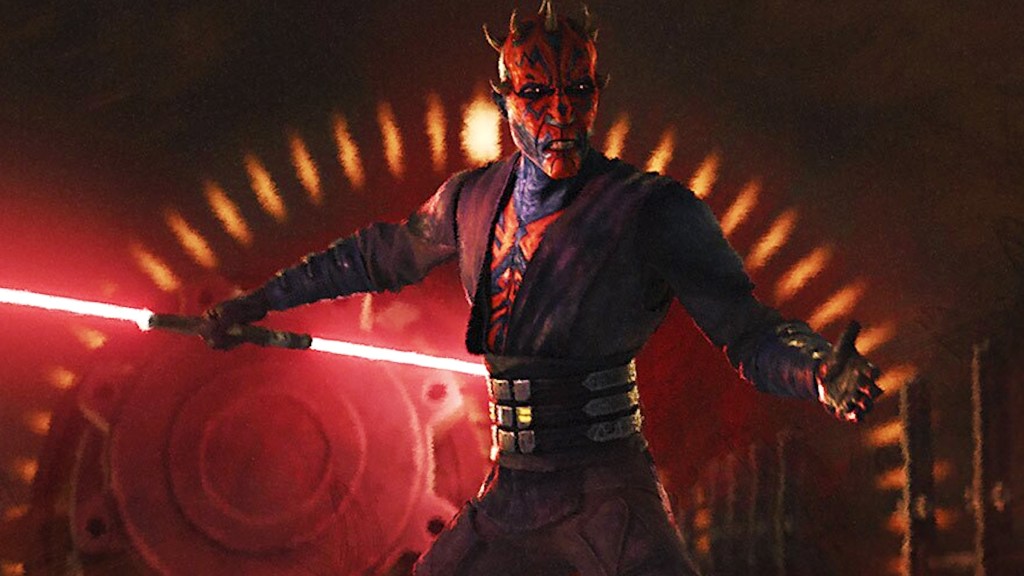
Note: the use of a saberstaff differs from conventional staff combat, and combat with a double-bladed weapon, due to a lightsaber blade being a roughly cylindrical plasma field where the entire surface of the “blade” is an equally lethal cutting “edge”. This allows equal opportunity for strikes from the lower and higher blade at all times, while leaving the hilt as the only surface available for bracing or hand movement).
The saberstaff also allows Maul’s next move to remain unknown to his opponent, as the simultaneous upper and lower guard make a downward or upward strike equally likely. As single-bladed sabers can only guard from one direction at once, Maul’s opponent is constantly left guessing at which direction their foe will strike from— although, should his opponent strike first, any connection of their blade to one of his naturally serves as counterweight for an immediate upward strike with the staff’s opposite blade— a true no-win situation when choosing how or if to engage. Paired with Form VI’s lack of goal- or value-driven combative choices, a battle against Maul forces his opponent to not only match him in skill and strength but predict his movements instantly from what are at most miniscule tells.

The final important aspect of Maul’s staberstaff is its hilt. The central positioning and doubled length of the hilt allows both it and its blades to be used in ways otherwise unfamiliar to lightsaber combat. As previously mentioned, the hilt’s length and placement allow Maul to, through comparatively slight adjustments of its angle, change the positioning of both blades entirely. It also gives Maul a greater surface area to brace himself against, allowing a stabler and stronger position when bearing down on— or defending against— his opponent’s saber in a contest of brute strength.
However, these factors also make the hilt a weapon in its own right, as its central position on the staff’s combined blade length allows Maul to use it as a hard bludgeoning weapon— something impossible with a single-bladed saber unless the wielder faces the blade away from their opponent. This tactic is most notably used in The Phantom Menace, when Maul smacks the hilt into Qui-Gon Jinn’s face, momentarily disorienting him and allowing Maul to deliver a lethal stab to the chest, but has been used by the devilish Sith in other fights as well.
The Dark Side Pairs Well With Calculated Unpredictability
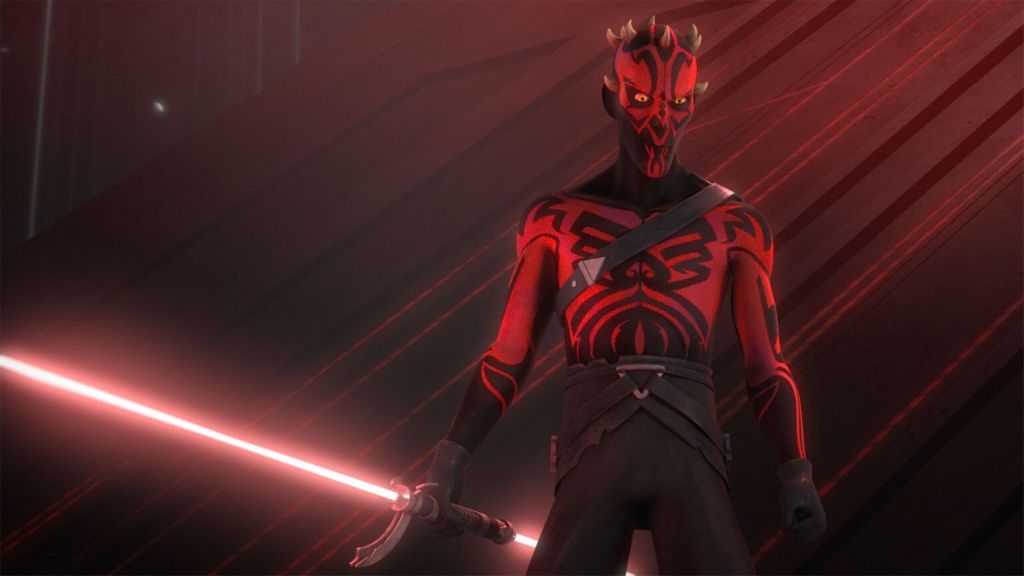
The final aspect required to understand the effectiveness of Maul’s fighting style is an understanding of how The Dark Side functions. Fighting a Sith requires a Force-user to bring themselves into proximity with a being whose movement through the living Force is defined by fear, anger and hatred, feelings which they also seek to impose on their enemies. The Dark Side both feeds off of and intensifies negative, aggressive and chaotic emotions— making a style like Maul’s an extremely effective tactic.
Watching combat scenes involving Maul, his opponents are consistently on their back foot as they try to simultaneously predict his strikes and keep up with him, often tiring quickly in their efforts while he alternates between outfighting and outrunning them. The constant hyperawareness, split focus, and willingness to work within disorientation required to hold one’s own against Maul is itself a disorganized and reactive state of being that Jedi are ill equipped to work within. Maul’s domination in combat comes from his ability to create instability and overwhelm, embodying strategic chaos while fully immersing himself in the ferocious chaos of the Dark Side.
More Movies
-

Image courtesy of Warner Bros. -

Promotional image from Wuthering Heights: House of the Damned