
The legendary sword is one of fantasy cinema’s most durable narrative devices. Its roots run directly to Arthurian mythology, where a single blade drawn from a stone by the rightful king became a symbol of power, legitimacy, and sacrifice. That template transferred to film with remarkable efficiency, as visually distinctive swords communicate in an instant what pages of exposition might struggle to establish. For instance, the sword often functions as a shorthand for the hero’s journey, a physical object that concentrates the weight of destiny into something an audience can see, hold in their imagination, and even acquire in the form of merchandising.
Videos by ComicBook.com
Peter Jackson’s The Lord of the Rings trilogy brought two specific blades into the forefront of popular consciousness. Sting, the Elvish dagger that glows blue near orcs, and Andúril, the reforged sword carried by Aragorn (Viggo Mortensen) into the War of the Ring, became touchstones through a combination of precise prop craftsmanship and the global reach of one of cinema’s most successful franchises. Both weapons deserve their recognition, but fantasy cinema has crafted many other memorable blades that became embedded in pop culture.
7) Inigo Montoya’s Rapier (The Princess Bride)

Arguably the most memorable character of The Princess Bride, Inigo Montoya (Mandy Patinkin) spent twenty years hunting the six-fingered man who murdered his father, and the rapier at his hip is the record of his mission. The rapier had been commissioned by Inigo’s late father, stolen by the man who killed him, and recovered by the swashbuckler as both inheritance and instrument of revenge. The sword’s design is deliberately ornate, featuring a distinctive hilt that makes it instantly recognizable in a genre where functional simplicity tends to dominate. Finally, the choreography of the final duel against Count Rugen (Christopher Guest) treats the rapier as the extension of a lifelong character arc rather than a prop, elevating the status of the weapon.

6) The Vorpal Sword (Alice in Wonderland)

Tim Burton’s take on Alice in Wonderland updated Lewis Carroll’s source material by imposing a heroic structure on the plot. Named in one of Carroll’s poems but left undefined, the Vorpal Sword is reimagined by Burton as the only blade capable of killing the Jabberwocky (voiced by Christopher Lee), and whose recovery by Alice (Mia Wasikowska) forms the backbone of the film’s third act. The prop design leans into a fairy tale aesthetic, featuring an etched white blade that grounds the mythology in the visual grammar of a fantasy epic rather than a children’s illustration. The climactic sequence in which Alice wields the Vorpal Sword against the Jabberwocky underlines how the movie was committed to epic fantasy as a way to stand apart from the animated Disney original.
5) The Three-Bladed Sword (The Sword and the Sorcerer)

Albert Pyun’s The Sword and the Sorcerer operated on a micro-budget and an outsized imagination, and its central prop became the purest expression of both. The three-bladed sword wielded by Prince Talon (Lee Horsley) is unique because the two outer blades can be loaded and fired at enemies as projectiles, leaving the center blade for conventional combat. That design concept transformed a broadsword into a medieval multi-tool, and the image of a blade launching across a dungeon corridor remains one of the most inventive weapon moments in the genre’s history. Its impracticality is precisely what makes it memorable, and one of the reasons why The Sword and the Sorcerer is still remembered as a classic.
4) The Sword of Gryffindor (Harry Potter and the Chamber of Secrets)

The Sword of Gryffindor materializes inside the Sorting Hat during the final act of Harry Potter and the Chamber of Secrets, allowing Harry (Daniel Raddcliff) to survive the battle against the basilisk. Dumbledore (Richard Harris) later explains that the sword presents itself to a true Gryffindor in a moment of genuine need, which repositions it as a weapon that operates on merit rather than on inheritance or prophecy. The sword reappears at the saga’s conclusion when Neville Longbottom (Matthew Lewis) wields it to kill Nagini in Harry Potter and the Deathly Hallows: Part 2, confirming its status as a weapon that selects its own wielder.
3) Connor MacLeod’s Katana (Highlander)
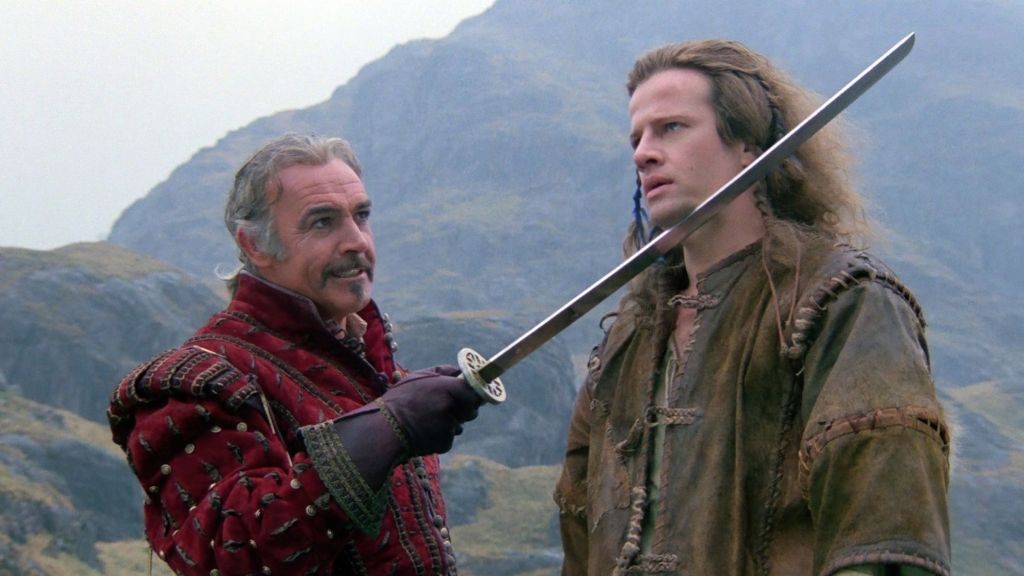
The original Highlander film built an entire mythology around immortal warriors dueling across centuries, and the weapon at the center of that mythology is a Japanese katana given to Connor MacLeod (Christopher Lambert) by Juan Sánchez-Villalobos Ramírez (Sean Connery). Forged by the legendary swordsmith Masamune, the blade is embedded in a deliberate chain of historical anachronism, as a Scottish Highlander receiving an Eastern weapon from a figure claiming Egyptian birth, trained to survive a contest spanning millennia. As a result, the katana’s origin communicates Highlander‘s central argument about the borderless nature of immortal existence more efficiently than any scene of dialogue could.
2) The Atlantean Sword (Conan the Barbarian)

In John Milius’ Conan the Barbarian, the Atlantean Sword is discovered in the tomb of an ancient king early in the film, its steel still functional after thousands of years, and Conan (Arnold Schwarzenegger) uses it as the primary instrument of his revenge against Thulsa Doom (James Earl Jones). Designed to reference a pre-Cimmerian mythology, the sword features a distinctive double-edged profile and a simple cross-guard that communicates purpose over decoration. The Atlantean Sword’s cultural impact proved substantial, as commercial replicas entered production almost immediately after the film’s release, generating a collector market that remains active today.
1) Excalibur (Excalibur)

John Boorman’s 1981 adaptation of the Arthurian cycle remains the definitive cinematic treatment of the blade from which all of fantasy cinema’s legendary swords descend. In Excalibur, the sword is the physical embodiment of the kingdom’s legitimacy, and its return to the lake in the film’s final act marks the definitive end of the heroic age. Boorman photographed the sword with consistent visual reverence, using light and polished metalwork to create a reflective luminosity that preceded the computer-generated shimmer of later fantasy productions by two decades. The prop design also gave Excalibur a weight and dimensionality that convinced audiences the blade was genuinely ancient, and Nigel Terry’s performance as Arthur treated every scene involving the sword with a gravity that elevated the material well above its $11 million production budget.
Which fantasy movie sword do you consider the most iconic of all time? Leave a comment below and join the conversation now in the ComicBook Forum!
