The Boys is finally over, and Prime Video’s superhero series ends on a more hopeful note than the comic series it’s based on — though it keeps certain details from the original story. Despite being an adaptation of Garth Ennis and Darick Robertson’s comics, The Boys paves its own path from the beginning. The series makes numerous changes to the source material over its run, rendering a comic-accurate finale unlikely from the start. And by the end of Season 5, The Boys‘ characters and storylines are too different for the show to go in the same direction. It just wouldn’t make sense, nor would it be as satisfying. SPOILERS ahead for The Boys Season 5, Episodes 1-8.
Videos by ComicBook.com
That said, The Boys Season 5, Episode 8 still finds ways to honor the source material, even if it’s not a direct take on it. There are huge differences, but they work for the story the adaptation is trying to tell. And the finale keeps certain details from the comics, offering several nods to fans of the source material. The TV show will leave them in a vastly different place, but its creators are clearly well acquainted with the original telling.
How The Boys Comics End (& What the Show Keeps From the Original Story)

The Boys comics end with far more carnage than the TV show — and with a less satisfying conclusion to Butcher and Homelander’s long-running feud. In the source material, Butcher confronts Homelander at the White House, much like he does in the show. However, the lead-up to and execution of this is quite different. For one thing, Homelander’s government takeover is motivated by entirely different circumstances. Comic Homelander isn’t trying to install himself as God; he’s angry that Vought created a clone of him — the true identity of the comics’ Black Noir — who is committing the terrible acts he’s blamed for.
The show runs with Homelander as a villain rather than turning him into a supe who is being framed. As a result, it’s tasked with giving him a more deserving fate. In the comics, Black Noir is the one who kills the real Homelander. Then Butcher faces off with Black Noir and kills the clone with a crowbar. There’s no V1 in the equation, and Ryan and Kimiko aren’t present for this final fight. (Ryan is killed almost immediately after being born in the comics, so he’s not around at all.) Since Homelander is truly the one responsible for the heinous crimes committed in the show, including the assault of Becca, the series has Butcher finish him off for real. He still uses a crowbar to split his head open, a nice nod to the source material.
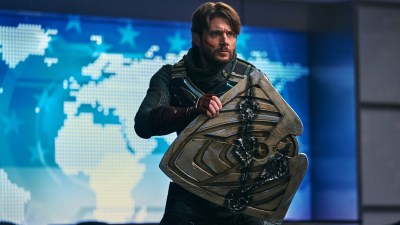
Apart from staging the final showdown at the Oval Office and making the crowbar Butcher’s weapon of choice, the other thing The Boys Season 5 keeps from the comics is Butcher’s fate. Like his fight with Homelander, it has more differences from the source material than similarities to it. However, Hughie is the one who kills Butcher in both, so the show keeps the most important aspect of his demise. Hughie does this for the same reason, too: Butcher is hellbent on unleashing the supe virus and killing all superhumans.
Terror’s death sets Butcher off in both versions of the story, but for different reasons. Terror is killed by Black Noir in the comics, and Butcher rightfully assumes a supe is responsible, drawing a more direct line from the bulldog’s death to Butcher’s attempt at genocide. In the TV series, Terror dies of seemingly natural causes. Butcher’s choices after are driven by his loss of purpose and the belief that Vought will start the cycle of supes anew. Ultimately, it still ends with Hughie killing him. In the comics, this happens at the Empire State Building instead of Vought Tower, and Hughie stabs rather than shoots him. Again, the build-up differs but the outcome is the same.
What The Boys Season 5 Changes From the Comics’ Ending

The Boys Season 5 keeps elements of Butcher and Homelander’s final fight, as well as Hughie killing the team’s leader. However, it changes almost everything else about the comics’ ending. Black Noir dies (twice) before the big climax, as does Frenchie. In the comics, Butcher kills Frenchie, M.M., and Kimiko before Hughie manages to stop his rampage against supes. Of course, all the members of The Boys are supes in the source material, inevitably placing them on the receiving end of his crusade. The show refuses to fully turn the team against one another, and it gives M.M. and Kimiko more positive endings. M.M. reunites with his family and adopts Ryan, while Kimiko visits France and adopts the Bernedoodle she and Frenchie were looking at.
The nature of Hughie killing Butcher is also altered, and not just because of the changed location and weapon. Butcher actually seems to hesitate in the show, leaving us to wonder whether he would’ve stopped even if Hughie hadn’t pulled the trigger. It makes the whole scenario more tragic, as does the fact that Butcher comforts Hughie in the end. All of this adds a bittersweet spin to Butcher’s fate and gives The Boys good reason to host a proper funeral for him.
Hughie and Starlight get a happy ending in both iterations of The Boys, but the couple’s send-off differs in the TV series. The final scene shows that they’re expecting a baby, and they’re not yet married — much to the chagrin of Annie’s mother. Their situation is the opposite in the source material. They get married after the events of The Boys, but Annie isn’t shown to be pregnant in the comics. Hughie also takes the CIA job offered to him.
The Boys Season 5’s ending may spare the main team a couple of deaths, but it does add one for an especially unlikable villain. The Deep survives the comic series, going on to form a new team for Vought after the White House incident is done. He’s not involved in the final battle, but the show pits him against Starlight, a face-off that ends with him being tossed in the ocean and killed by sea creatures. Oh-Father does die at the White House, but he’s killed by the military, not Hughie and M.M. And of course, Homelander’s dramatic fate in the show — which sees him losing his powers and begging Butcher for mercy on live TV — is much more fitting and gratifying than what happens in the comics.
Which Conclusion Is Better: The Boys TV Show or the Comics?

It’s hard to say whether The Boys show or comics have a “better” ending, as the stories leading up to their conclusions are so different. Prime Video’s series couldn’t have successfully replicated the original. Its version of Homelander is too despicable, its Butcher isn’t as morally bankrupt, and the story leans into the idea that good will overcome evil — even if that fight requires time and sacrifice.
In that sense, The Boys TV show certainly paints a more hopeful picture of the fight against oppressive forces, and it’s one that feels needed. The series finale is cathartic in ways that The Boys comic simply isn’t. The source material is bleaker and bloodier, which is tonally consistent and works well for its story. Prime Video’s adaptation may lean into gore and darkness, but it’s ultimately striving for a different takeaway. It sticks the landing in that regard, though it may still prove disappointing for those attached to the original story.
What do you think of The Boys‘ ending in comparison to the comics? Leave a comment below and join the conversation now in the ComicBook Forum!
More TV Shows
-
Image Courtesy of Marvel