The Testaments Season 1 has, to its credit, been pretty restrained with Aunt Lydia. While Ann Dowd is the one returning Handmaid’s Tale actor with a main role in the series (Elisabeth Moss’ June Osborne has had a couple of smaller appearances), the focus has very much been on Agnes MacKenzie (Chase Infinity) and Daisy (Lucy Halliday). The prep school that the Plums attend may be named after her and even have her statue, but she’s been kept a little more in the background… until Episode 6, “Stadium.” Warning: SPOILERS ahead.
Videos by ComicBook.com
The decision to keep Lydia in a smaller role pays off massively in this installment, which thrusts her back to the forefront in both the present and the past. There’s plenty to enjoy in the former, but it’s the latter that is particularly interesting. The Handmaid’s Tale flashed back to Lydia pre-Gilead once before, but it wasn’t to this degree. Here, we essentially get to understand her entire story: how she came to be in Gilead, and the lengths she went to in order to survive. There was already a lot of depth to the character, but this changes how you see her even more, and has a few major shocks.
Aunt Lydia’s Backstory In The Testaments Changes The Character For The Better
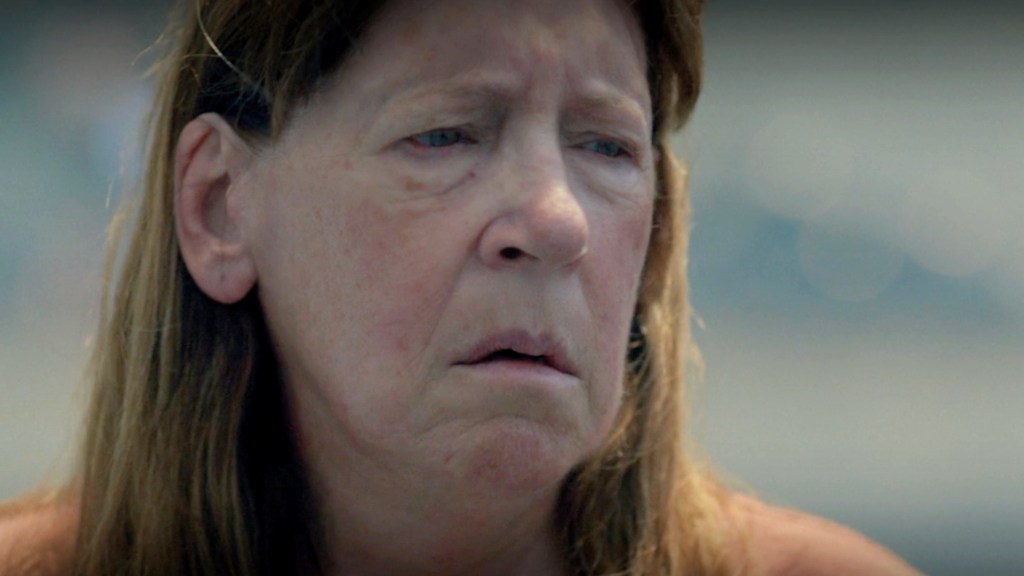
The previous flashbacks to Lydia suggested someone who was already extremely pious even before Gilead, but this presents a rather different view. Instead, the one we see here is a tired, caffeine-dependent teacher; she’s a bit curmudgeonly, but seems quite separate from the character we’ve watched over the last nine years on screen. She’s just a regular person, the kind that anyone could’ve known and worked with. Perhaps most surprising of all, given what we’ve seen of her, is that she once had an abortion. It all makes her transformation even more stark: she’s forced into a do-or-die situation and goes full survival mode, doing whatever is necessary to keep her life.
What was necessary, in this case, was betraying her colleague, Vivian, who goes on to become Aunt Vidala (explaining the frosty relationship between the two in the show’s present), and everyone else. We learn that it was Lydia who came up with the entire concept of the Aunts, right down to choosing the most uncomfortable material possible, and was even willing to kill Vivian to prove herself to Commander Judd. It makes Lydia more of an architect of Gilead’s regime than we’d seen before, but that also makes her redemption arc more powerful.

The duality of Lydia perfectly highlights twin themes that were so often played with in The Handmaid’s Tale (and more than any other episode of The Testaments, this really feels like the parent show): good and evil, hope and despair, control and freedom, faith and manipulation, power and powerlessness, often explored within the same person, which is definitely the case here with Lydia.
Lydia’s fast adjustment to the rule of Gilead, and working with Judd, is a shining example of the banality of evil, and how “normal” people will do things they otherwise never would in extreme circumstances (though she herself questions whether this was always in her or not; is she a “phoenix… or a cockroach?”).
But the end also shows there is good inside of her, that hope can still be found even in the most harrowing darkness, and that a person can still choose to make a difference. The end of the episode, where Lydia is seen documenting things in order to create a better world for her girls, is setting up the fall of Gilead, even if she might not be around to see it.

It’s difficult to pinpoint exactly when The Handmaid’s Tale started building to this redemption of sorts (if she can ever truly be “redeemed”), but it was certainly after Margaret Atwood’s The Testaments book released, since that was such a shocking change for the character. I’d probably date it back to Season 5, when Esther and Janine were poisoned. Lydia’s concern for the girls was genuine, and it’s where her affection for Janine in particularly really started to show. More than that, it also showed a willingness to question and challenge Gilead’s structures – she wanted to keep the Handmaids with her at the Red Center, and told Janine to keep her informed when that request was shot down, in a small moment that set up a big change.
Even with all of that, though, it’s one thing to think it’s coming, another to set it really play out in front of us. Ater six seasons of The Handmaid’s Tale, there are still new layers to Aunt Lydia, which is a testament to Atwood, the writers of both shows, and, as much as anything else, Dowd’s incredible performance. It sheds remarkable new light on the character, and shows her story coming full circle in a way no one could’ve predicted when The Handmaid’s Tale started.
New episodes of The Testaments release on Wednesdays on Hulu.
What do you think? Leave a comment below and join the conversation now in the ComicBook Forum!
More TV Shows
-

Courtesy of Paramount+ -
Image Courtesy of Sci-Fi Channel