There are a lot of ways to make a list about Star Trek. You can rank the captains, argue about which Enterprise was the coolest, or spend three hours explaining why your favorite alien is obviously the best alien and somehow end up in an argument about Deep Space Nine. Trek fans have been doing this for decades, and honestly, I respect the commitment. But there’s another way to look at the franchise. Instead of asking which episodes are the most popular, what if we ask which ones actually changed what television could do? Because Star Trek has never been just a show about spaceships. It has been a courtroom drama, a tragedy, a philosophical debate, a story about racism, an experiment in linguistics, and occasionally a very expensive way of reminding us that humans are terrible at leaving mysterious glowing objects alone.
Videos by ComicBook.com
So this isn’t a list of the five “best” Star Trek episodes. That’s a completely different argument, and frankly, one that could get you banned from several internet forums. These are five stories that pushed the boundaries of what a television episode could be, whether by proving science fiction could be genuinely tragic, turning a season finale into a cultural event, putting personhood on trial, confronting the realities of representation, or making an entire episode about the surprisingly complicated business of understanding another person. In other words, Star Trek didn’t just make great television. Every once in a while, it quietly changed the rules.
5) “Darmok” — Star Trek: The Next Generation

You know an episode of Star Trek is doing something unusual when the biggest problem isn’t a Klingon battle, a Romulan conspiracy, or some enormous space anomaly. It’s a conversation. Or, more accurately, it’s a conversation where almost nobody understands what the other person is saying. In “Darmok,” Captain Picard encounters the Tamarian captain Dathon, whose civilization communicates through references to stories and shared cultural experiences. To Picard, phrases like “Darmok and Jalad at Tanagra” sound completely meaningless. And that is precisely the problem. The episode takes something television normally treats as background—language—and makes it the actual dramatic conflict. Picard can’t simply translate the words because the words aren’t the message. He has to understand the culture behind them. That’s a pretty wild premise for an hour of mainstream television. There isn’t a superweapon to deactivate or an alien fleet to blow up. The thing Picard has to defeat is his own assumption that everybody means things the same way he does. The big takeaway about TNG is that Picard would have been cast differently if it were up to Roddenberry.
That’s what makes “Darmok” endure. The Tamarians aren’t speaking gibberish, and they aren’t incapable of communicating. They’re communicating perfectly well according to their own cultural framework; Picard is the one who doesn’t have the key. Suddenly, an alien-language episode becomes something much more interesting: a story about whether two civilizations can understand one another when their entire systems of meaning are different. “Darmok” essentially made linguistics the action sequence, and somehow it worked. Decades later, “Darmok” remains one of the most recognizable Star Trek stories precisely because it took an incredibly abstract idea—how humans create meaning—and turned it into something audiences could actually feel. No phaser fight required.
4) “Far Beyond the Stars” — Star Trek: Deep Space Nine
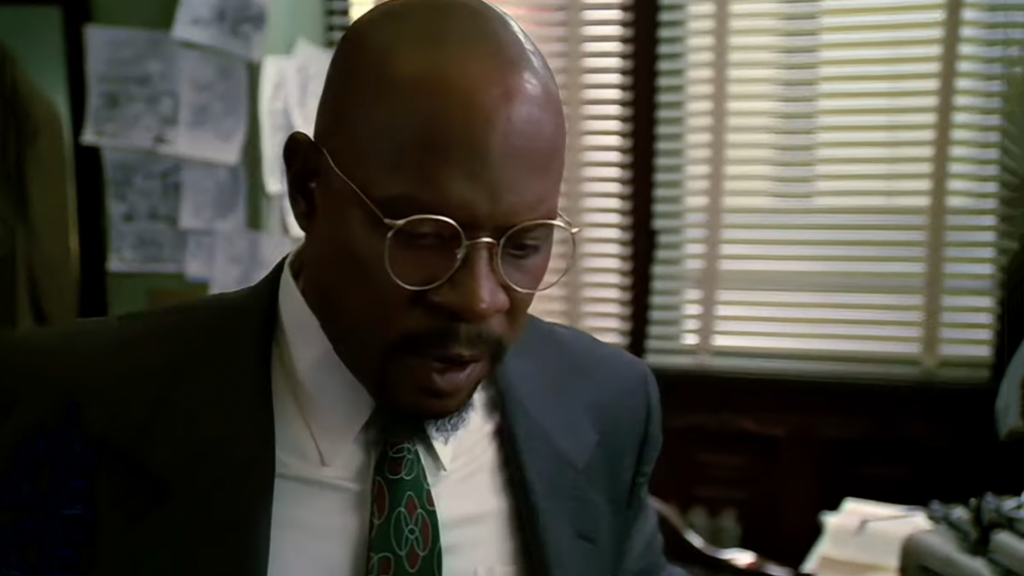
Here’s the weird thing about Star Trek: sometimes the episode that hits you hardest barely feels like Star Trek at all. In “Far Beyond the Stars,” Benjamin Sisko ends up in 1953 New York as Benny Russell, a Black science-fiction writer trying to get his stories published. There are no starships, no phasers, and no aliens plotting to destroy the Federation. Just Benny at a typewriter, trying to convince his editor that the future can have a Black captain in it. And his editor can’t imagine it. That’s the whole point. The episode takes something we rarely think about—who gets to write science fiction—and makes it the story. Benny isn’t short on imagination. Far from it. Avery Brooks later pointed to writers like Samuel R. Delany and Octavia E. Butler as proof that Black writers were already imagining futures of their own. The problem wasn’t imagination. It was who got heard. And that connects Benny’s struggle to the real science-fiction world of the 1950s, the same literary culture that would eventually help make Star Trek possible.
That’s what makes “Far Beyond the Stars” so powerful. It’s not simply saying, “Representation matters.” It’s asking who gets to decide what the future looks like. Science fiction is supposed to dream about tomorrow, but somebody has to be allowed to dream it first. Scholars have connected the episode to Afrofuturism for exactly this reason: Benny isn’t asking to squeeze himself into somebody else’s future. He’s imagining one of his own, rooted in Black history, literature, and experience. And Avery Brooks makes that hurt. Sisko knows the future Benny is trying to write about is real. He knows Black people will be captains. He knows things can change. But sitting there in Benny’s shoes, he also sees how impossible that future must have looked from the other side of the typewriter. For an episode of Star Trek, that’s a surprisingly brutal idea: the future can exist and still be impossible to imagine, especially when nobody will let you imagine it. And remember—if it wasn’t for the woman who saved the show, Star Trek would have been history.
3) “The Measure of a Man” — Star Trek: The Next Generation
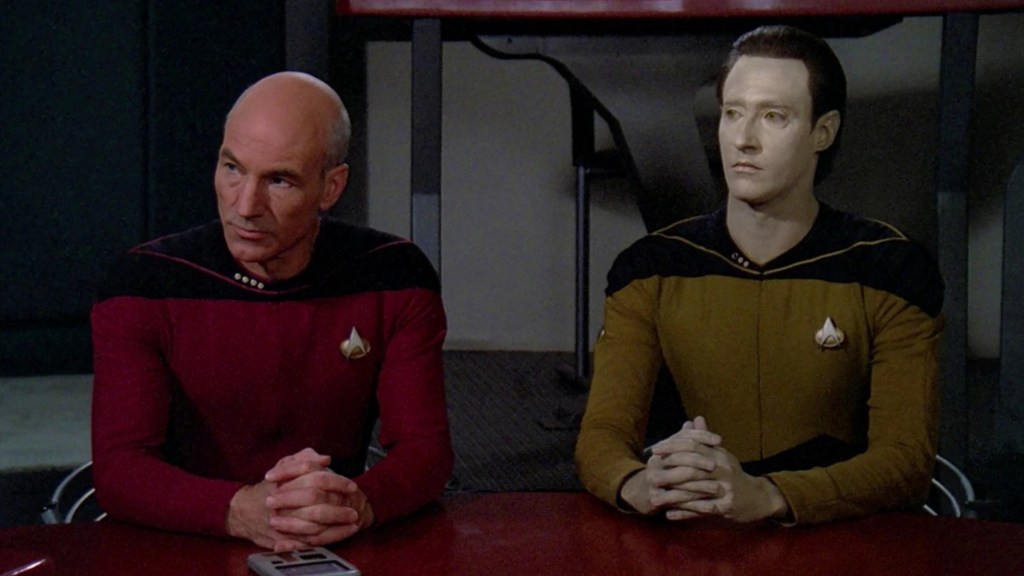
At some point, practically every science-fiction story about artificial intelligence asks the same question: “Is this thing a person?” Star Trek got there in 1989, and it did it by putting an android on trial. In “The Measure of a Man,” Data is ordered to undergo a procedure that could dismantle him and create additional copies. The question isn’t simply whether Starfleet can do it. The question is whether Data has the right to refuse. Suddenly, this shiny space show has turned into a courtroom drama about personhood, individual rights, and what exactly separates a person from a piece of property. Picard is forced to argue that Data is a sentient individual, while Riker has to argue the opposite. And that is a particularly nasty assignment, because Riker isn’t the villain. He’s doing his job. The story works because the conflict isn’t “good person versus evil person.” It’s a legal system trying to decide what Data is before anyone has even agreed on what consciousness actually means.
That’s the clever part. “The Measure of a Man” takes an apparently futuristic problem and makes it understandable through an incredibly familiar framework: a courtroom. You don’t need to know anything about positronic brains to understand the question, “Does this individual have the right to make decisions about his own existence?” And watching the episode today gives that question an entirely different resonance, because television has spent decades becoming increasingly interested in artificial intelligence, synthetic consciousness, autonomy, and what happens when machines begin behaving like people. Star Trek wasn’t predicting every modern AI debate, but it understood remarkably early that the most interesting question wouldn’t be whether machines could become powerful. It would be whether humans would recognize their rights when they did. Data’s trial isn’t really about whether an android can look human. It’s about whether that should matter.
2) “The Best of Both Worlds” — Star Trek: The Next Generation

Here’s where Star Trek stopped asking television audiences to simply come back next week and made them wait for it. “The Best of Both Worlds” ends with one of the most famous cliffhangers in television history: Picard has been assimilated by the Borg and transformed into Locutus, Riker is ordered to fire on the Borg ship, and Picard is on that ship. Then the episode ends. That’s it. No reassuring little scene where everything turns out fine. No last-second technobabble solution. Just “To Be Continued” and a summer of wondering whether Captain Picard was actually going to survive. That sounds completely normal now, especially in an era where streaming services can dump an entire season onto your television before you’ve had time to finish dinner. But television wasn’t always built around that kind of anticipation. The Best of Both Worlds demonstrated how powerful it could be to leave an audience hanging when the audience genuinely cared about what happened next.
And this wasn’t merely a clever way to sell the next episode. The Television Academy has described the cliffhanger as a landmark moment in television, noting the enormous speculation it generated and its role in pushing The Next Generation to another level of popularity. The episode also helped demonstrate how season-ending cliffhangers could turn a television show into an ongoing conversation. People didn’t just watch the finale and move on. They spent the summer wondering what would happen to Picard. Other science-fiction shows took notice, and the season-ending cliffhanger became an increasingly important part of serialized television. Star Trek certainly didn’t invent the cliffhanger, but “The Best of Both Worlds” showed how much power it could have when you combine one enormous unanswered question with characters audiences have spent years getting attached to. The Borg were terrifying, sure. Locutus was terrifying. But the real weapon was making everyone wait.
1) “The City on the Edge of Forever” — Star Trek: The Original Series

This is the episode that proved Star Trek could break your heart. “The City on the Edge of Forever” begins with a time-travel story, which sounds perfectly reasonable for Star Trek. Kirk and Spock travel back to Depression-era Earth after McCoy accidentally changes history. As a result, they need to find the point where everything went wrong. Along the way, Kirk meets Edith Keeler, a woman running a mission for the poor, and falls in love with her. Unfortunately, Kirk eventually discovers that Edith’s survival would change history. She has to die for the original timeline to survive. And Kirk knows it. That’s where the episode stops being a science-fiction adventure and becomes something much more painful. Kirk isn’t trying to save the woman he loves because that’s what heroes do. He’s forced to understand that saving her is precisely what he cannot do. There is no clever loophole, no convenient piece of alien technology, and no technobabble escape hatch.
In 1968, “The City on the Edge of Forever” won the Hugo Award for Best Dramatic Presentation. It has also remained one of the most celebrated stories in Star Trek history. But its importance goes beyond awards and fan rankings. The episode demonstrated that science fiction television didn’t have to be disposable entertainment that existed only to get the characters to next week’s adventure. It could be tragic. It could be literary. It could use an outrageous science-fiction premise to tell a fundamentally human story about love, sacrifice, history, and the terrible consequences of changing the past. And that’s why it belongs at number one on this particular list. The story helped demonstrate that genre television doesn’t make a story less serious. Sometimes the spaceship is just the doorway. And sometimes, on the other side of it, there’s a story that can absolutely wreck you.
That may be the real trick the series has been pulling for nearly sixty years. It keeps dressing up big human questions as stories about aliens, androids, time travel, and spaceships, then somehow makes us care about the people underneath it all. The technology dates, the uniforms change, and the special effects get better, but the questions keep finding us. And Star Trek has left its fans many questions.
More TV Shows
-
Screenshot from Shazam! -
Courtesy of Spelling Entertainment