
The House of the Dragon Season 3 Premiere has re-ignited the Game of Thrones fandom with a massive battle sequence that is already being hailed as an instant classic. Queen Rhaenyra Targaryen (Emma D’Arcy) thought her pact with Lady Alicent (Olivia Cooke) would bring an end to the Targaryen civil war for the Iron Throne, but instead, the situation took a hard left turn.
Videos by ComicBook.com
Without dropping spoilers, “The Battle of the Gullet” in the House of the Dragon Season 3 Premiere was no doubt one of the biggest action set pieces in the entire Game of Thrones TV universe, but does that make it one of the best? Let’s look at the rankings and find out where it stands. NOTE: Our list includes Game of Thrones, House of the Dragon, and A Knight of the Seven Kingdoms. If you don’t see a battle on our list, it didn’t enter the light of the seven chosen ones.
7. Trial of the Seven at Ashford Meadow

In the spinoff series A Knight of the Seven Kingdoms, Ser Duncan the Tall (Peter Claffey) was faking it ’til he made it as a knight, when he entered the tournament at Ashford Meadow. Dunk had a good heart, but few wits about life and custom at royal court, so it’s no surprise he quickly ran afoul of the worst that nobility has to offer. When Prince Aerion Targaryen (Finn Bennett) tries to abuse Dornish stage performer Tanselle (Tanzyn Crawford) for mocking Dragons, Dunk steps in and causes an entire fiasco. The Targaryens determine the punishment should be a “Trial of the Seven,” i.e., a seven-vs-seven trial by combat, where the gods decide the outcome. Against all odds, Dunk manages to get six other knights to fight with him, including Aerion’s uncle, the wise Prince Baelor Targaryen (Bertie Carvel).
Dunk’s Trial of the Seven (S1E7) ranks at the bottom of our list because it’s not much of a battle sequence at all, by GoT standards. Granted, the entire point of the battle is placing the viewer inside Dunk’s head and POV, for a real-time (and brutal) lesson in what it is to be a knight fighting in combat. From the obscured helmet vision to the total pandemonium of bloodshed and violence all around, this battle was more character study than major action setpiece. In that respect, it did its job well enough – down to the sickening last round of a limp, injured, half-mad Dunk slogging through the mud and beating Aerion into submission. Then came the heartbreaking final reveal that Dunk (and Westeros) lost something so much greater, even though he “won” the duel. But in terms of spectacle, scope, and stakes, it has to be ranked lower than the other battles this franchise has given us.
6. The Battle at Rook’s Rest
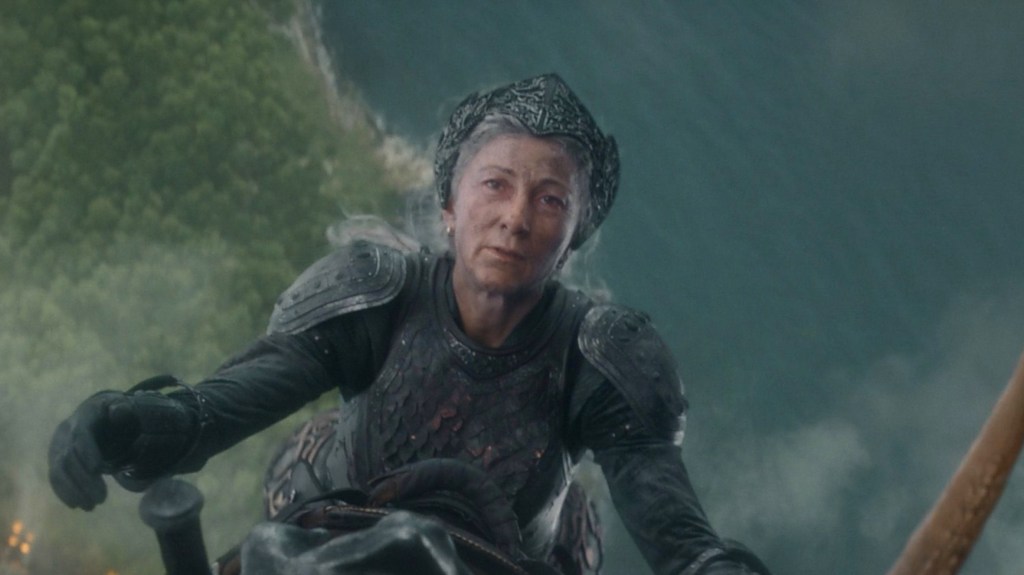
House of the Dragon is chronicling the Targaryen civil war known as the “Dance of the Dragons”. However, what was a family conflict became an official military conflict thanks to a game-changing event called “The Battle at Rook’s Rest” (S2E4). Ser Criston Cole (Fabien Frankel) had been sacking the Crownlands in the name of Prince (turned King) Aegon II and his “Greens” faction; Lord Simon Staunton (Michael Elwyn) of Rook’s Rest called upon Queen Rhaenyra and her “Blacks” faction to come and protect his lands.
Rhaenyra had to weigh the perilous choice of whether or not to unleash her dragons on the battlefield, and change the nature of military conflict entirely; if she failed to protect her bannerman, her claim to the throne would be all but lost. Not wanting Rhaenyra to risk her own life and dragon, Princess Rhaenys Targaryen (Eve Best) flies into battle on her own dragon, Meleys. Meanwhile, Aemond lurks in wait to ambush the Blacks with his massive dragon, Vhagar, while a drunken Aegon lets pride get the better of strategy and makes a surprise entry into the fray riding his dragon, Sunfyre.
The Battle of Rook’s Rest has many elements of a great Game of Thrones battle (a race against the clock, several double-crosses, and some twist outcomes), but like so much of House of the Dragon Season 2, it felt lackluster in its execution. The dragon duels looked like poorly-shot blue screen CGI, and the “battle” itself wasn’t choreographed or staged in accordance with the usual GoT standards. It was supposed to be a mid-season climax; instead, a great character like Rhaenys went out in one of the lamest battles of the franchise.
5. The Battle of Winterfell (The Long Night)

For 8 seasons, millions of viewers around the world watched Game of Thrones for one major overarching reason: the day when the various characters of Westeros would have to stand against the Night King and his undead army of White Walkers. That day (or rather night) came at the one place where the series started: Winterfell. The surviving Starks and Arryns united their bannermen (and some Lannister stragglers), while Jon Snow and Daenerys Targaryen arrived with two dragons and the massive army that Daenerys had raised. And none of it was enough. Several major supporting characters die in the fight (Lady Lyanna Mormont, Jorah Mormont, Theon Greyjoy, Belric Dondarrion, and others), before Arya Stark fulfills her destiny and kills the Night King with a Valyrian steel dagger.
The Battle of Winterfell (S8E3) is the longest, most elaborate, and definitely the most expensive production in the original Game of Thrones series. It is also credited with being one of the biggest letdowns, as well as one of the biggest reasons why GoT is now ranked high amongst TV shows with the worst climaxes. Production-wise, the episode has become the poster child for the problematic technique of series director Miguel Sapochnik, whose ultra-dark and shadowy color palette often made the action impossible to actually see. All that waiting and fan dedication for so much disappointment. GoT Season 8 would only twist the knife by delivering an even worse series of final episodes (including a battle so bad it’s not even listed here) before it ended.
4. The Battle of the Gullet

When Alicent’s son Aemond (Ewan Mitchell) seized the throne from his older brother Aegon II (Tom Glynn-Carney), he immediately made moves to further the war effort against Queen Rhaenyra and her faction, the Blacks. The Greens’ ally, Master of Coin, Lord Tyland Lannister (Jefferson Hall), traveled across the Narrow Sea and succeeded in securing the Triarchy pirate group’s help in ambushing Lord Corlys Velaryon (Steve Toussaint) and his naval fleet. That battle on the seas is an event known in author George R.R. Martin’s lore as “The Battle of the Gullet”, named after the narrow sea passageway Corlys uses to his tactical advantage when cornered by Triarchy leader Sharako Lohar (Abigail Thorn). It is the first blockbuster-sized naval battle we’ve seen in a GoT show, with some of the most intricate dragon battle action thrown in for good measure.
Director Loni Peristere has worked on some of TV’s best action series (Banshee, Warrior), as well as directing “The Red Sowing” episode of House of the Dragon Season 2, which is considered a high point of that season (with its dragonrider trials). However, “Salt and Sea, Fire and Blood” (S3E1) is a new high point achievement for Peristere, HBO, and the GoT franchise, solely based on the complexity of the production and the visual challenges it required. While the battle doesn’t feature virtually any of the main characters of House of the Dragon, it is a major showcase of so many of the secondary characters, from Lord Corlys to Jacaerys (Harry Collett) and Baela Velaryon (Bethany Antonia), and even Rhaena Targaryen (Phoebe Campbell) and her “wild dragon” Sheepstealer, who is an instant breakout star. This battle was so good, it’s making House of the Dragon as much of a water cooler show as GoT, and raising the bar for what fans expect from a battle episode.
3. The Battle of the Blackwater
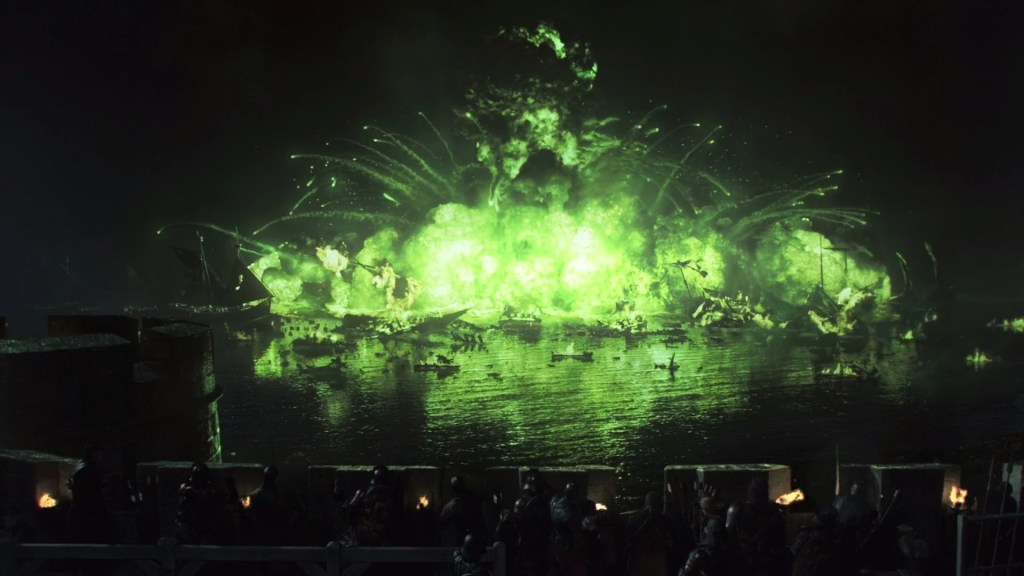
Game of Thrones has proven itself as a Medieval fantasy series with a modern socio-political edge in Season 1, but the show has also avoided depicting many of the battlefield action that took place through clever visual side-steps or exposition about off-screen events. However, by Season 2, with the breakout popularity of the show, HBO and showrunners had the incentive (and budget) to truly cement GoT as next-level blockbuster TV with a movie-sized battle. They tapped director Neil Marshall (The Descent) to helm the penultimate episode (S2E9), and he did so well that he would go on to become one of the show’s best go-tos for future battles.
The Battle of the Blackwater sees King Joffrey Baratheon (Jack Gleeson) have his usurping of the throne formally challenged by his uncle, Stannis Baratheon (Stephen Dillane), who invades King’s Landing by sailing his naval fleet into Blackwater Bay, under the guidance of smuggler Davos Seaworth (Liam Cunningham). Tyrion Lannister (Peter Dinklage) tries to use his smarts to lead the Lannister army in defending the city, while ladies of the court like Cersei Lannister (Lena Headey) and Sansa Stark (Sophie Turner) realize their fates rest in the hands of the men with the swords (unless they kill themselves first).
“Blackwater” is one of the earliest “classic” episodes of GoT, and it still holds up as one of the best battles in the series, thanks to some iconic imagery and quotables (“There are brave men at our door. Let’s go kill them!”). Marshall’s direction is great, making the battle action gritty, frenetic, and brutal, but always discernible. The episode elevates itself by tying multiple major character arcs and conflicts into the battle itself, and keeping things complicated enough, morally, that you were sympathetic to almost every character on the battlefield, and worried for each of them, no matter the outcome. Best of all, the tide of the battle is the biggest point of tension, with victory constantly shifting from one side to the other, all the way to a twist ending, which has also become an iconic moment for the series.
2. The Battle For the Wall
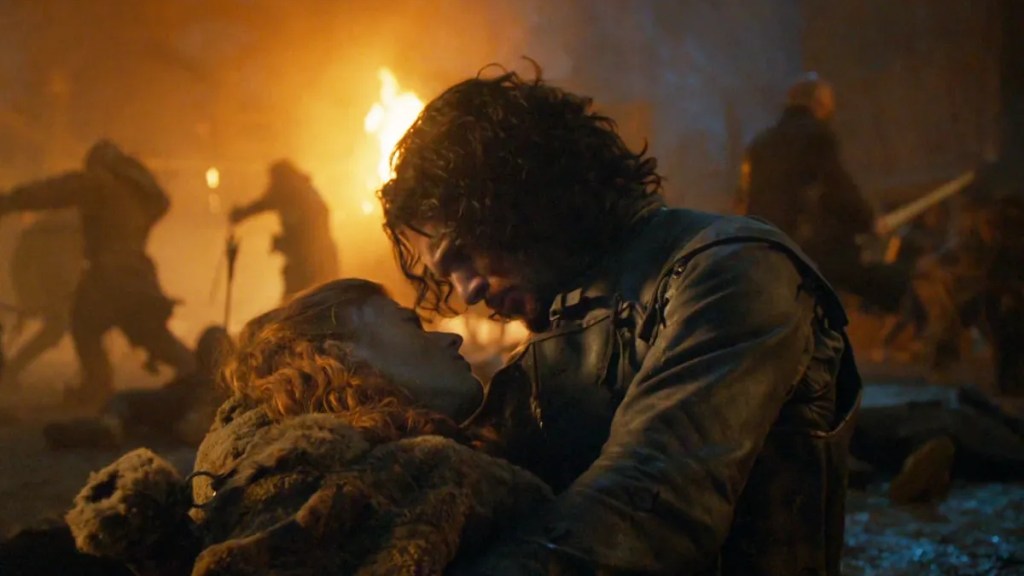
Jon Snow (Kit Harington) had been leading a dangerous double life while serving in the Night’s Watch. He had ventured out beyond the Wall to spy on the Wildlings living outside Westeros’s borders, to find out about their new king, Mance Rayder (Ciarán Hinds). Jon discovered that he liked life with the “Free Folk” more than he thought he would, and even fell in love with a Wildling girl, Ygritte (Rose Leslie). But eventually, Jon returned to his service at the Wall, and it wasn’t long before Mance Rayder and his army (including a scorned Ygritte and other vengeful Wildling friends) came to knock down the Wall and invade Westeros.
Director Neil Marshall returned to deliver another classic Game of Thrones battle episode (S4E9), at a time when most series start to drag from age. Not only was the episode complex, logistically, in terms of how the battle was unfolding and what the objectives were (defend the Wall from multiple breach points), it was one of the most complex, emotionally, as Jon Snow had to watch his two surrogate families go to war and choose which side he truly belonged to. There was no real way to “win,” either way, and Lord Snow paid a heavy emotional toll by the end.
“The Watchers on the Wall” also featured a more complex set of combatants, as the Wildling army had giants, woolly mammoths, and other mystical/supernatural creatures that hadn’t been featured heavily in the series up until that point. Selling them to the audience wasn’t easy, but Marshall did a better job with it than the fights against the White Walkers that would follow.
1. The Battle of the Bastards

For many fans, Game of Thrones‘ worst villain is and always will be Ramsay Bolton (Iwan Rheon). Ramsay was as sadistic and sociopathic as he was twistedly cunning. He was every bit the dark reflection of Jon Snow, a bastard child of a great house who decided to defy the status quo and claim greatness on his own terms (murder and conquer). It was inevitable that he and Jon would collide, and the penultimate episode of Season 6 (S6E9) was when it finally happened. And we were not disappointed.
Ramsay had already tormented the Stark family like no other, turning their ward, Theon Greyjoy, into a broken, brainwashed husk of a man (“Reek”), using him to capture Sansa and put her through all kinds of torment, while under constant threat of being fed to his hounds. Ramsay also took over the Starks’ home at Winterfell, leaving Jon and his army looking to reclaim it.
The Battle of the Bastards (named for Jon “Snow” vs. Ramsay “Snow”) was everything a great battle should be. It was epic in scope, thrilling in terms of guessing the outcome, while still reflecting thematic subtext and the nature of the main characters. Ramsay outwitted, mind-screwed, and outmaneuvered his opponents, while Jon won on bravery and nobility, which inspired so many others (Davos, the Wildings, allies from the Vale) to come to his aid. Production-wise, this episode is widely regarded as one of GoT‘s top “masterpieces,” won multiple Emmys, and dominated the ratings. It was also the achievement that convinced HBO and showrunners D.B. Weiss and David Benioff that director Miguel Sapochnik should be handed the keys to the rest of the series (whoops!).
“Battle of the Bastards” is often counted as one of the best TV episodes of the last decade (if not longer), and arguably marked the high point for Game of Thrones in terms of delivering on the hype.
You can stream all Game of Thrones universe content on HBO Max. Let us know about your reactions to House of the Dragon Season 3 on the ComicBook Forum!
More TV Shows
-

Courtesy of South Park Studios / Shueisha -
Image Courtesy of Marvel





Forum Conversation: What did you think of House of the Dragon Season 3, Episode 1?
Go to ForumThey clearly debated ending Season 2 on this episode, but I think the time and budget ran out. Zaslav was all about measuring out costs across seasons.
But between Knight of the Seven Kingdoms and this HotD premiere, it feel like GoT is SO back.
Totally – from seeing the first four, I think this feels like it should’ve been a classic GOT Episode 9 and the next ep would’ve made more sense as a season finale, then Episode 3 is like the REAL beginning of Season 3. Silly from HBO, but I still massively enjoyed it
The wildest thing about it, and I can’t help but wonder if I feel this way because of the shift in episode count last season, is that this episode didn’t feel like a season premiere, it felt like the ending to Season 2.