
The last few years have been pretty rough for Disney, as the studio has become almost entirely dependent on existing franchises, with very few new original hits managing to break through the way they used to. And when it comes to the sci-fi genre specifically, the studio has tried to branch out several times, but most of those attempts simply didn’t work out. Still, one of them in particular had something different going for it — it was a highly original idea, one that connected back to Disney’s own history and felt really interesting to explore within a narrative. Even so, it ended up becoming one of the most talked-about cases of wasted potential in an entire decade.
Videos by ComicBook.com
What makes it interesting is that, even though it’s not that widely remembered today, the real curiosity isn’t just its failure on its own, but the ripple effect it had on another massive franchise. Because while this project was being developed, the same director behind it was essentially out of the running to helm the return of one of the biggest sci-fi sagas in cinema history: Star Wars. And when you look at both productions side by side today with that context in mind, the comparison is hard to miss.
Why Did Tomorrowland Become One of Disney’s Biggest Flops?

Released in 2015, Tomorrowland follows Casey Newton (Britt Robertson), a brilliant teenager obsessed with science who, after finding a mysterious pin, stumbles upon clues leading to a parallel futuristic reality known as Tomorrowland — a place designed to be an idealized version of the human future. Alongside Frank Walker (George Clooney), a genius inventor who basically gave up after becoming disillusioned with the real world, she tries to figure out what happened to that place and why it stopped functioning as a promise of hope. And the interesting part? It’s actually inspired by one of Disney’s own theme park areas in Magic Kingdom.
The issue with the project really comes down to its script planning; specifically, how to turn that idea into an actual story, because there’s a big difference between building mystery and just withholding information, and the movie spends way too much time doing the latter. The first act is full of clues and partial explanations that constantly feel like the story is waiting for the right moment for things to finally kick in. But when it does finally get going, it struggles to win back the audience’s attention. The journey to Tomorrowland itself is longer and more expository than it should be, and that naturally hurts the pacing.

It would, in a way, be understandable to think this was a strategy to make everything more explicit, since the studio’s target audience is younger, more family-oriented, or not necessarily very familiar with the sci-fi genre itself. But considering Brad Bird as both director and one of the writers, that’s not an easy argument to fully defend. And why is that? According to Bird himself, the core of Tomorrowland was always this obsession with a specific idea: why the future stopped feeling aspirational and started being treated as something dystopian. He even described it as a “fable” built around that shift in mindset. So it’s not really subtext he tried to soften — it’s the actual engine of the movie. The problem is that it just ends up being too heavy-handed.

Basically, the whole production feels like it operates in blocks of ideas that don’t always connect smoothly. You understand what the film is trying to say, but you don’t consistently feel it in a cohesive way. It explains too much and shows too little when it should be doing the opposite, and when it finally reaches Tomorrowland itself, the world that was supposed to be the big standout ends up feeling more like a conceptual set piece than a place with real rules and consequences. At several points, it feels less like a sci-fi adventure and more like a movie interrupting its own narrative to make a commentary about the real world.
Tomorrowland had a production budget in the range of $190 million and grossed just a little over $200 million worldwide, which in practice translates to a loss once marketing is factored in. It’s estimated that Disney lost around $120–150 million on the film, when a project like this would typically need something closer to $400–500 million just to start making commercial sense. And Star Wars enters this conversation because Bird was once considered to direct one of the movies in the saga, but turned it down to focus on this Disney production. So just imagine how different George Lucas’ franchise might have been (even slightly) with him involved.
How Did Tomorrowland Impact Star Wars‘ Cinematic History?
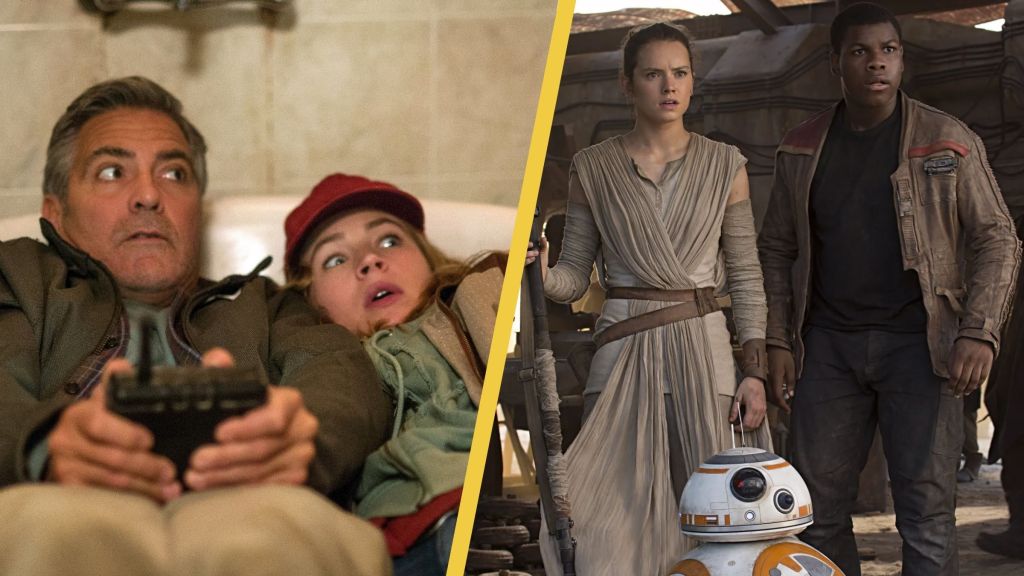
Bird isn’t just any director. We’re talking about someone who came off a nearly flawless streak with The Incredibles, Ratatouille, and Mission: Impossible – Ghost Protocol, meaning someone with a clear track record of balancing emotion, pacing, and spectacle all at once. That’s exactly why there was interest in bringing him into Star Wars: Episode VII after Disney acquired Lucasfilm. And that’s where you start to question the logic behind turning it down. At the time, though, it made sense: it was an enormous original project versus stepping into an already established franchise under big pressure. Plus, he wasn’t just directing and co-writing Tomorrowland; he was also one of its producers and creative architects.
It’s a shame that the outcome of that decision turned out to be the worst possible one, especially because Star Wars: The Force Awakens went on to become a massive $2.07 billion global success under J.J. Abrams, helping solidify him as one of the most reliable directors in the industry (particularly when it comes to franchise reboots and large-scale blockbusters). In 2015, it became the third highest-grossing film of all time. Tomorrowland, on the other hand, couldn’t even sustain its own initial promise. And the irony is that both movies deal, in different ways, with the idea of restoring hope in a future that feels stagnant.

The aftermath for Bird’s career is just as important to note, because after this film, he didn’t return to the same level of creative freedom on large-scale projects. Instead of new massive live-action ventures, he was steered toward something safer within his own franchise: Incredibles 2. And even when he remains involved in big projects, such as the development of Incredibles 3, he tends to function more as a writer/mentor/creative producer rather than someone leading a brand-new high-risk original from scratch (although this year he does have a new original animated project coming out, Ray Gunn).
In the end, it’s undeniable that Tomorrowland has ambition, a strong visual identity, and ideas that came from a very genuine place and were worth exploring and bringing to the screen. However, it’s also a perfect example of how that alone isn’t enough when the execution doesn’t hold up. Eleven years later, it might still be remembered by Disney fans, but less for what it actually delivered and more for what it could have been — and that’s not exactly a good legacy.
Have you ever seen Tomorrowland? Leave a comment below and join the conversation now in the ComicBook Forum!
