
Backrooms opened as the No. 1 movie in the world, and has brought the supernatural lore of the hit web series to the big screen. Backrooms web series creator Kane Parsons also directed the feature film, and longtime fans of the series have been spotting all kinds of tie-ins with the web shorts.
Videos by ComicBook.com
While it’s not at all required to view the original Backrooms shorts before the film, they do offer a more complete view of Parsons’ lore. They help explain why things take such a wild turn in the third act of the Backrooms movie and what the enigmatic ending really means.

What Happens In Backrooms‘ Final Act? (SPOILERS)
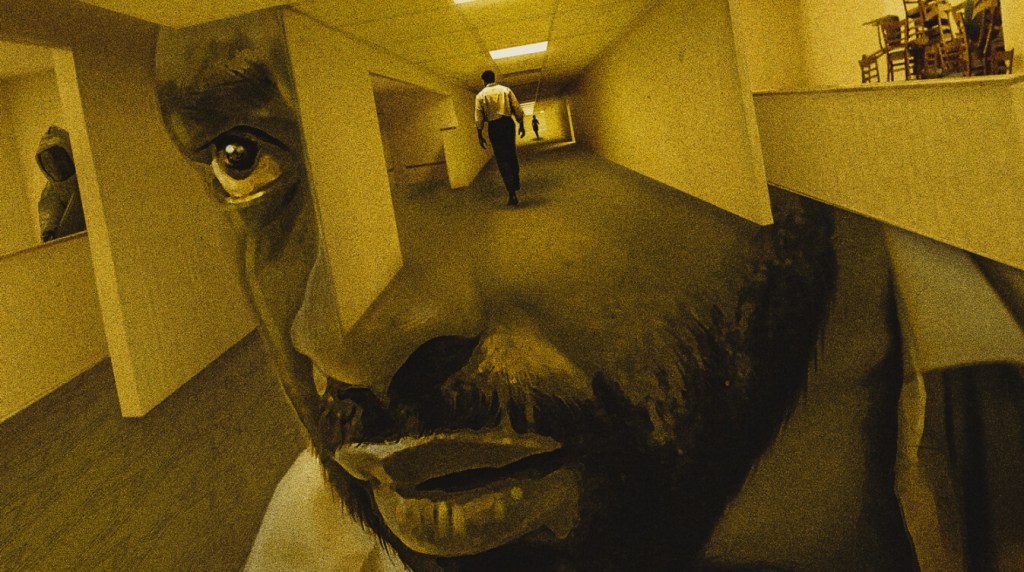
The Backrooms movie follows failed architect-turned-struggling furniture store owner Clark (Chiwetel Ejiofor), who is desperately trying to navigate post-divorce life. Down on his luck and reduced to sleeping in the store, one night, Clark discovers a portal into the Backrooms in the basement. Over the course of the film, he tries to explore the surreal realm and then hires a film crew to document the space. Things go tragically wrong, and the film crew is killed, while Clark loses his mind from being in the Backrooms for too long.
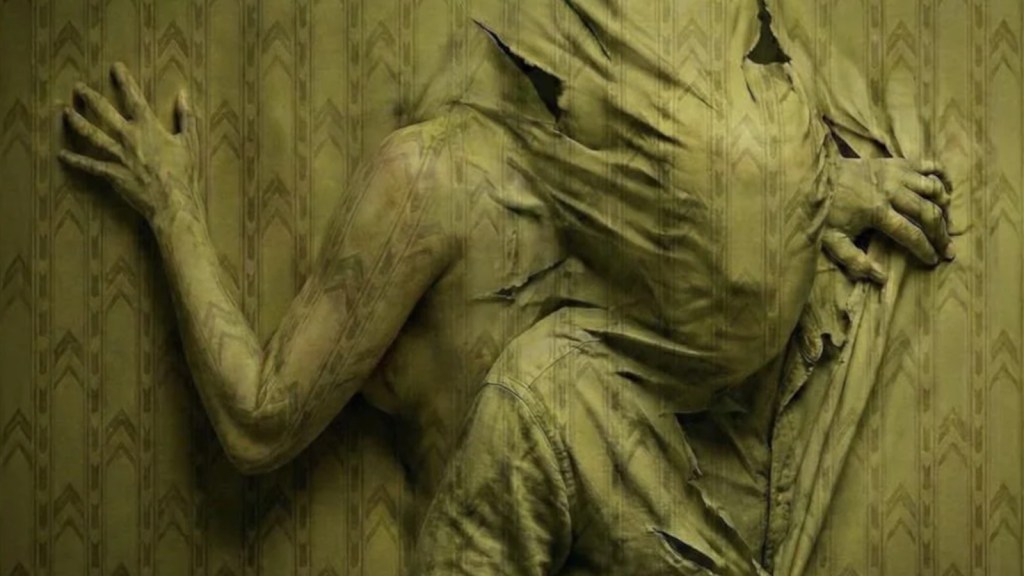
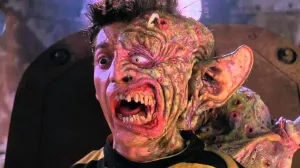
The final act of the film sees Clark’s therapist, Dr. Mary Kline (Renate Reinsve), go searching for him after Clark had been acting erratically in their last session. She tracks things to the portal in the basement and similarly gets stranded in the Backrooms. She finds Clark, but he knocks her out and takes her hostage, revealing his insanity by introducing Mary to his “friends,” who are three nightmarishly disfigured humanoids. One of them, who looks like Clark dressed up as the pirate-themed mascot of the furniture store, goes mad and kills Clark, before chasing Mary back through the Backrooms. Mary faces the monster in a Backrooms version of the furniture store, and barely escapes before she’s captured by the Async Research Institute, which has been exploring the Backrooms for some time.
Backrooms Ending Explained: Bad Copy
There’s a now-famous monologue from Clark, midway through Backrooms, in which he tries to explain to Mary what the mystery realm actually is: “Imagine describing a dog to someone who’s never seen one before and then asking them to draw it,” Clark said. “It will look similar, but the devil is in the details.”
The implication of that quote and the sequences of the film in the Backrooms suggest that what Clark says to Mary is more than just an analogy: it’s a key insight into the nature of the Backrooms. The long and short of it is that the Backrooms seem to function like an amplifier of memory, suggesting it has some sort of psychic consciousness at work, which can “read” the minds of those who come there, and tries to “reflect” their memories. However, being some otherworldly realm, the Backrooms can’t comprehend the basic nature of people or the inaccuracy of their memories, which results in twisted, distorted copies of people, places, and things from the minds of those who enter the backrooms.
While it’s never confirmed directly, there is a heavy implication that the domestic setting where Clark takes Mary as his hostage is his former home. Similarly, there are a lot of fans who think that at least one of the two twisted copies that Clark is with is his ex-wife. That theory is supported by the fact that Clark scalps the female copy and makes Mary wear the scalp and hair as a wig, for her to “role-play” as his wife, as she often did in their therapy sessions.

In the final scenes, when Mary is with the Async team and talking with researcher “Phil,” (Mark Duplass), the camera cuts to panning around the Backrooms, and reveals that Mary’s traumatic memories of living in a house with an agoraphobic mom, and the eventual forced demolition of that house, are all memories that are starting to be collected and manifested by the Backrooms. The final shot of the film reveals that Mary is also starting to lose herself and her sanity, as teased by the final sight of a Backrooms version of Mary, who looks made of broken pieces all slapped together into a single disfigured body.
Backrooms is listed as “psychological horror” for a reason. It’s clear from the film that Kane Parsons is less concerned with nightmare “entities” and more focused on the psychologies of the characters venturing into the Backrooms, and the traumas that they bring into the freakish space. That’s probably for the best, as the premise is wide and open enough that any sequels can function more like anthologies, following new sets of characters as they become trapped in the Backrooms, and have the surrealist space take the shape of whatever is lurking inside their heads.
Backrooms is now playing in theaters. Or check out the web series HERE.



Forum Conversation: HORROR MOVIES – The Official NEW BLOCKBUSTERS?!
Go to ForumI saw the title and went to grab the “always has been” gif… But James already perfectly put it. Horror has always had massive ROI in Hollywood because budgets are small and marketing is way more organic. I would even dare to say before this decade. I started to write about horror professionally around 2014. Since then, every single year, without exception, there has been some kind of discussion framed around “Is horror back?”
Horror has been big since the slasher era of 1970/1980, and while the kind of horror that blows is different, I see it as incredibly stable when we take into account the budgets and box office.
Their success is amazing, I’m not sure if it’s a “new era” so much as a continuation/evolution – horror has been one of the most reliable genres at the box office this decade, when so many other movies have struggled through/post-pandemic, going back to things like Smile, M3GAN, and Talk To Me in 2022 which were (somewhat) similar in becoming viral, word-of-mouth hits, Five Night’s at Freddy’s (which sort of feels a bit like a pre-cursor to Backrooms’ success), Zach Cregger’s movies, etc. Obsession in particular obviously takes it to a new level though, given its week-on-week-on-week increases are near-unprecedented (but Focus did pay $15m for it, so it’s not like it being a success at all is some kind of shock).
There’s obviously a YouTuber factor to this now as well – these guys are like big name directors/actors to younger generations because they’ve cultivated a following in a similar, perhaps even deeper, way (Iron Lung another good example). And part of me does worry that the lesson from this will be “let YouTubers make movies” and we’ll get all the big studios racing to hire any and every YouTuber with a following and probably kill the fun of it quite quickly. Likewise “IP” in the Backrooms sense – to a lesser extent with how Barbie led to a deluge of toy movies being announced, there’ll probably be more of this stuff as well.
I think the idea that “franchises are dead” is very much being overstated, and it’s not simply wanting something “new” – otherwise movies like Good Luck, Have Fun, Don’t Die ($9m), Mother Mary ($2.9m), Is God Is ($4.5m), to give just a few recent well-received examples – would’ve also performed better. I’m way too old to truly speak to what Gen Z and below wants, but the suggestion is that they want things that are “theirs,” often made by people who can relate to their experiences, feelings, interests, and that does include IP (hence Minecraft being such a huge hit last year, the GentleMinions thing a few years ago, etc – it does work with franchises too).
Ultimately I think a huge part of this, especially for younger people having grown-up in a pandemic and with lockdowns but true of all filmgoers, is wanting something that feels like a true communal experience. Mando & Grogu didn’t promise that, these movies did (and horror as a genre as always a) been really good at selling/delivering that, and b) been the most finger-on-the-pulse genre). I’ll be interested to see how far it can go beyond horror – success of something like Project Hail Mary is different, but also great – but on the whole I think it’s a very encouraging time for the box office, where both original movies and franchises can both thrive. (Also, make movies with lower budgets, Hollywood.)
Fuck me this ended up being long so I’ll stop rambling
I think it means hiring YouTubers with massive audiences and making a movie of something with years of established lore is smart business. I don’t think it’s as transformative as some of the social media hysteria is suggesting, because IP will continue to reign, but if it means more curveballs, then this is no bad thing.