Superhero movies have been highly influential and impactful in a variety of ways, and some of the most important ones in that respect have not been under either the Marvel or DC umbrellas. When one thinks of superheroes, the characters who immediately pop to mind originate either from DC Comics, like Superman, Batman, Wonder Woman, and the heroes of the Justice League, or Marvel Comics, like Spider-Man, the X-Men, the Fantastic Four, and the Avengers. To be sure, the importance of DC and Marvel characters to the history of the superhero genre in comic books, movies, television, and every other medium cannot be overstated, to the point where superheroes as we know them might not even exist at all without the heroes of Marvel and DC. However, that does not mean that other superheroes are not of equal significance.
Videos by ComicBook.com
As superhero movies gradually grew in popularity from the ’80s and ’90s before fully hitting mainstream success in the 21st century, so too has the collection of characters forming the basis for superhero films. It may sound surprising, but some of the most important superhero movies all of time have not been derived from the pages of either Marvel or DC Comics, and in a few cases, did not even begin in comic books at all. Here are the four most influential superhero movies not based on Marvel or DC Comics.
1) Teenage Mutant Ninja Turtles (1990)
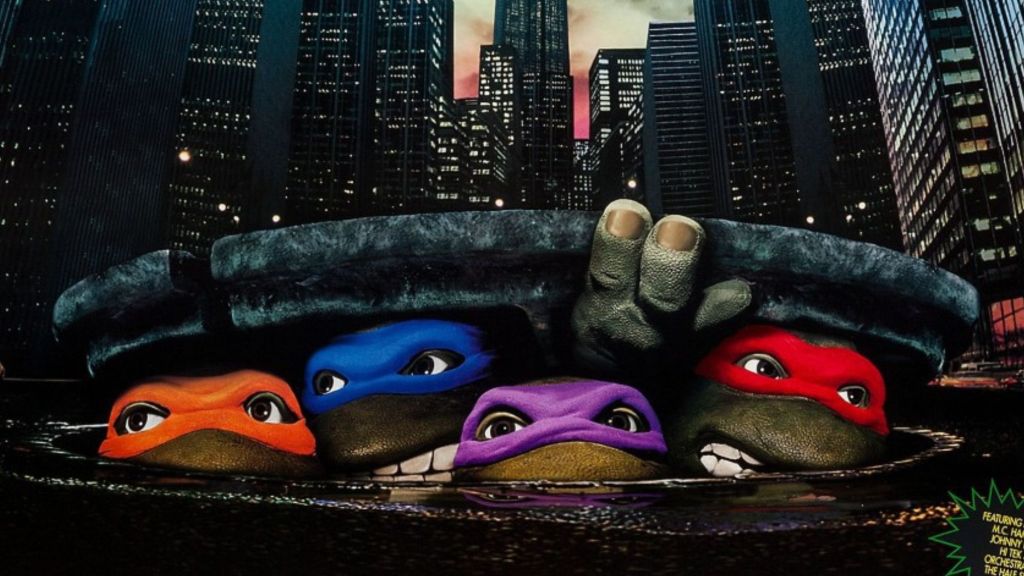
The Heroes in a Half Shell were a growing pop culture craze throughout the ’80s, but it was the release of 1990’s Teenage Mutant Ninja Turtles that truly brought Turtle Power to the masses. Teenage Mutant Ninja Turtles brought Donatello, Leonardo, Raphael, and Michelangelo to life as the Ninjutsu-trained crime fighters fans know and love, allying them with April O’Neil (Judith Hoag) and Casey Jones (Elias Koteas) in their battle against Shredder (James Saito) and the Foot Clan. The movie’s turtle suits were also genuinely impressive both as superhero outfits and as suits flexible enough for the stunt performers wearing them to execute the Turtles’ signature martial arts skills.
Teenage Mutant Ninja Turtles not only brought the Turtles to the big screen at last, but served as the first real theatrical superhero team movie, providing a foundation for subsequent team movies with the X-Men, the Avengers, the Fantastic Four, and the Justice League to break out in the 21st century superhero movie boom. Teenage Mutant Ninja Turtles was also the rare non-Marvel, non-DC superhero movie of the ’90s to become a big box office hit, proving that superhero movie success was not strictly in the domain of the world’s two biggest comic book publishers.
2) The Crow (1994)

The legacy of 1994’s The Crow is one sadly steeped in the tragic on-set death of Brandon Lee right as he was on the verge of becoming a major action movie star, but the movie’s emotional revenge tale also illuminates its influence on later superhero movies. Based on James O’Barr’s eponymous comic book, The Crow centers on deceased rock musician Eric Draven, who is revived on Devil’s Night one year after his and his fiance’s murder to take revenge, Eric guided by a supernatural crow through the streets of Detroit on his mission. Lee’s electrifying performance as Eric Draven solidified his stardom posthumously, while the movie’s gripping visual style set a standard for subsequent comic book movies to aspire to.
The Crow has often been likened to a feature-length music video, and director Alex Proyas certainly enlivens the movie’s world with a distinctive visual flair that gives the city and the mayhem of Devil’s Night a personality all their own. The Crow‘s success also showed the possibility of little-known and niche comic book properties reaching a wider mainstream audience with the right combination of strong writing, direction, performances, action sequences, and dynamic visual style. Since then, movies like Hellboy, 300, Watchmen, Kick-Ass, and Kingsman have pulled off the same trick to great results, all owing a debt of gratitude to The Crow showing the possibilities for edgier, darker, R-rated superhero movies based upon comic books outside of the main Marvel and DC character stables.
3) Robocop (1987)
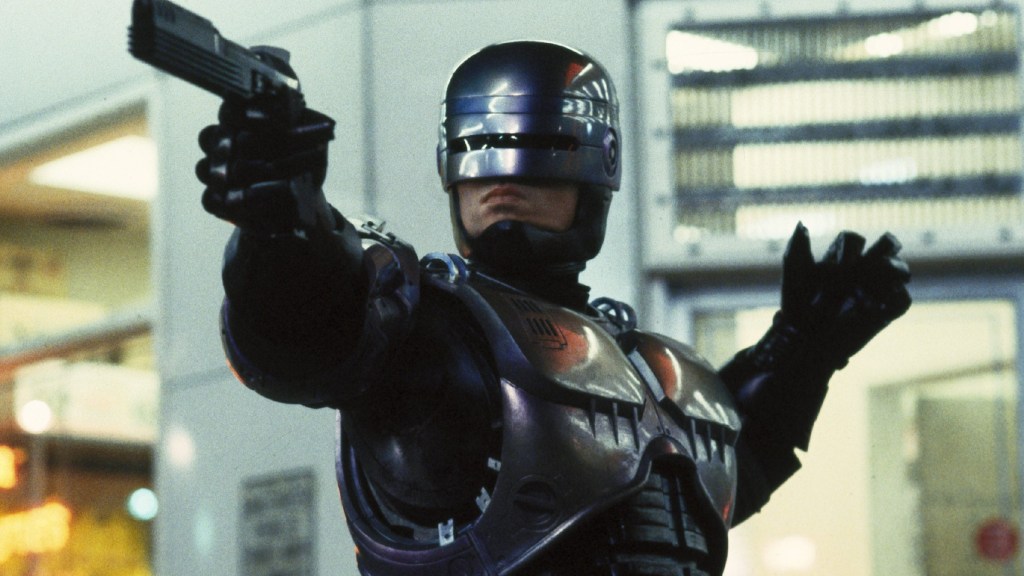
The term “superhero movie” tends to be used interchangeably and even somewhat synonymously with the term “comic book movie,” which makes any superhero movie not based on a comic book a real wild card, as was the case with Paul Verhoeven’s Robocop. Despite its creation independent of the comic book world, Robocop is a classic superhero origin story in its tale of Detroit police officer Alex Murphy (Peter Weller) being revived from his murder as the cybernetic law enforcement officer Robocop, and gradually regaining his memories and humanity in his new metallic form.
Even without any direct comic book connection, Robocop has the soul of one, with the movie’s news segments and dystopian future setting in a crumbling Detroit clearly drawing heavy inspiration from Frank Miller’s The Dark Knight Returns. Miller, in turn, would later appear in 1990’s Robocop 2, with his unrealized script for the sequel becoming the comic book Frank Miller’s Robocop. This subsequently led to Robocop being spun-off into numerous comic book stories, all while showing the possibilities of taking the basic template of a superhero movie and applying it to an original character with no comic book backstory. Combined with Paul Verhoeven’s well-known penchant for over-the-top violence to the point of being outright silly, Robocop‘s legacy is one of a superhero who did the opposite of most of his peers by beginning in movies and leaping into comics and other media, along with influencing the possibilities of darker, grittier storyteller in superhero movies and comics.
4) Hellboy (2004)
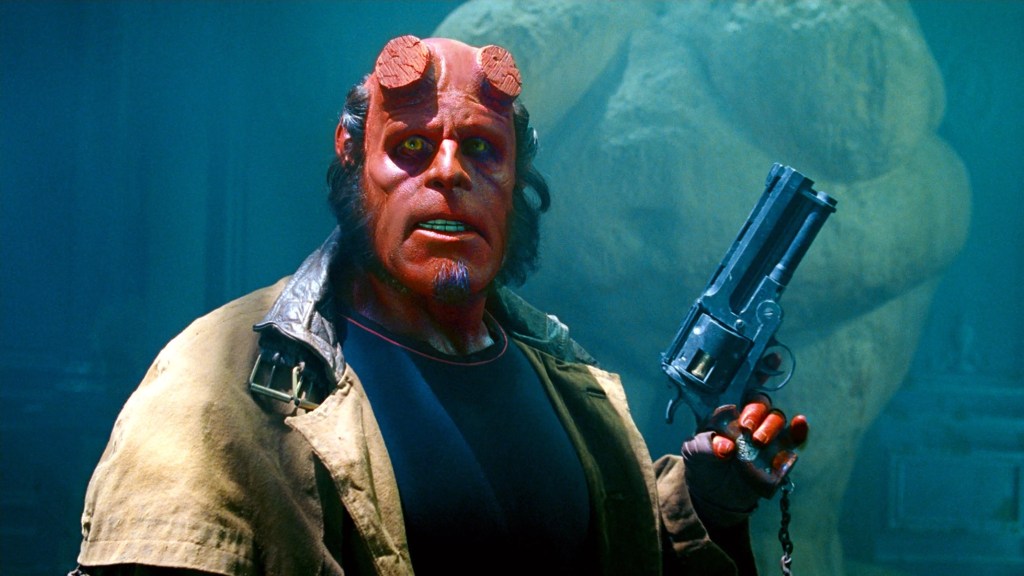
Guillermo del Toro had one superhero hit to his name already with 2002’s Blade II, with 2004’s Hellboy cementing his penchant for dark tales of non-mainstream comic book characters. Hellboy made its titular demon (played by Ron Perlman) into a widely recognized superhero outside of the Marvel and DC rosters, leading to an even more popular sequel in 2008’s Hellboy: The Golden Army. More importantly, Hellboy showed that Dark Horse Comics had more to offer cinematically than most moviegoers and even comic book aficionados had given it credit for.
While 1994’s The Mask and Timecop had both been big hits, Dark Horse Comics had not had a true breakout, big-screen hit to cement one of its characters as a truly mainstream superhero frequently seen in cosplay form in Comic Cons around the world. With Ron Perlman’s iconic performance as Hellboy and unmistakable demonic makeup job, Hellboy rode the wave of the superhero movie craze right as it was getting started in the early 2000s, and showed that there were plenty of great stories and characters to mine outside of strictly Marvel and DC Comics. With the subsequent aforementioned successes of 300, Watchmen, Kick-Ass, and Kingsman, Hellboy helped pave the way for comic book and superhero movies of a more off-beat background, along with setting a trend for actors transforming into superheroes through extensive makeup and motion capture tech to really bring the wildest superheroes in the world to life.
What do you think? Leave a comment below and join the conversation now in the ComicBook Forum!
Most Viewed
-

Image courtesy of Netflix -
Image Courtesy of Netflix -
Image courtesy of Bethesda