A Knight of the Seven Kingdoms doesn’t have White Walkers, but does still reference them in an important way. The overarching villains of Game of Thrones may have been defeated in Season 8, but their influence has still been felt as HBO has expanded its franchise. The first planned spinoff, Bloodmoon, would’ve documented the first Long Night, before it was cancelled after a pilot episode that didn’t work. House of the Dragon then introduced Aegon the Conqueror’s Song of Ice and Fire, which revealed he conquered Westeros because of a prophetic dream of the White Walkers.
Videos by ComicBook.com
The latest prequel doesn’t go as far as that – indeed, despite Targaryens, Aegon’s dream is never mentioned – but they do get a mention in A Knight of the Seven Kingdoms‘ Season 1 finale. At the beginning of the episode, when Lyonel Baratheon is talking with his Maester and Dunk, the knight becomes exasperated and says, “The Others f**king geld me.” It’s a throwaway turn of phrase, but with notable implications, because it’s the first time “the Others” has been used on screen instead of “White Walkers.”
Game Of Thrones Made Several Changes To The White Walkers From The Books

In George R.R. Martin’s A Song of Ice and Fire books, the term White Walker(s) is much less commonly used. The Others is what most people in Westeros use to refer to them – and they are, for the most part, considered the stuff of legend and tales designed to scare kids – and it’s mostly the wildlings who refer to them as “white walkers,” along with some of the older characters, such as Old Nan (who uses them interchangably) and Lord Commander Jeor Mormont.
Game of Thrones changed this for a couple of reasons, with the term White Walker being used from the very first episode. One reason is that the series was debuting just one year after LOST, another hugely popular TV show that had a villainous group called The Others, so it wanted to avoid confusion. The other reason is even simpler: it’s easy to differentiate on the page between the Others and simply referring to other people, because the former is always capitalized. That doesn’t work on TV, of course, so White Walker again helped mitigate any confusion.

This was far from the only change the show made to the Others. Their appearance is quite different in the book, where they’re described as being more ethereal and even beautiful, rather than the more clearly zombie-inspired scary design of the show. While they can be killed by dragonglass, their weakness to Valyrian steel is not just confirmed in the books, though it seems fairly likely given the events of the show. They also have their own language, described as sounding like cracking ice; this was developed for the show (called Skroth) and featured in the original, unaired pilot, but was later scrapped.
The biggest change of all, though, is with the Night King. In the books, the Others are more fully a supernatural force of nature (so far, at least). The TV show introduced the Night King, a former human who was turned into a White Walker by the Children of the Forest, in order to give the series a clearer main villain.
The novels do have a character called the Night‘s King, who was a Lord Commander of the Night’s Watch who, legend has it, fell in love with a female white walker, but there’s no actual Night King or leader of the Others, and that also means no “kill him, kill them all” rule for when the second Long Night happens.
A Knight of the Seven Kingdoms‘ reference to the Others may not mean much going forward, given it’s not going to be including them (barring a big twist), but it does highlight just how much the show strives for fidelity to Martin’s works, even beyond The Tales of Dunk and Egg. It’s a great nod to that, and fits perfectly with Lyonel’s character at that moment as well.
This also draws a neat connection between Lyonel and Robert. The way the former uses them in the phrase we hear in A Knight of the Seven Kingdoms is actually very similar to how King Robert uses them in A Game of Thrones, the first of Martin’s books. He uses them for annoyed expressions more than anyone in the novel, including “The Others take your mild snows,” “The Others take my wife,” and “The Others take your honor.” And now we know it was clearly something common in the family.
All six episodes of A Knight of the Seven Kingdoms Season 1, plus all eight seasons of Game of Thrones, are available to stream on HBO Max.
What do you think? Leave a comment below and join the conversation now in the ComicBook Forum!
Most Viewed
-
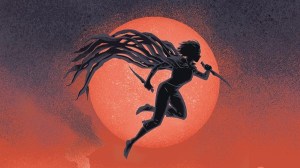
Image courtesy of Tor Books/Macmillan -

Official art by Bastien Lecouffe-Deharme