
The mass appeal of crossovers that defy company lines remains a popular endeavor, albeit a tricky one. Marvel and DC finally put their differences aside last year and began publishing the first crossover comics in two decades, bringing together Batman and Deadpool in two major stories, with two Superman and Spider-Man crossovers happening this year. Even though a proper crossover that goes across company lines is frequently rare, they remain a key source for debate. Fans still find themselves pondering the question of who wins in a fight: Goku or Superman? And when you start throwing in characters like Homelander, Hulk, and Invincible, it’s a good indicator of the saturation of franchises and fandom in the modern era.
Videos by ComicBook.com
Thirty-six years ago today, though, on April 21, 1990, an incredibly rare crossover moment aired in what was perhaps the most bizarre collection of franchises in one place. Even more strange than the cartoons that crossed over was the reasoning behind it, a moral lesson for the very young fans of these characters and cartoons. For anyone who remembers Cartoon All-Stars to the Rescue, a TV special financed by McDonald’s charity arm, it felt like the Avengers: Endgame of ’80s and ’90s cartoons, something that didn’t seem possible at all, but which was able to bring in ten giant franchises to tell one story. That story? A special that was essentially a combination of Who Framed Roger Rabbit with Reefer Madness.
Cartoon All-Stars to the Rescue Combined Your Favorite Franchises

At the start of Cartoon All-Stars to the Rescue, a young girl named Corey is sleeping when her piggy bank is secretly snatched by an unseen person. This theft awakens all of the cartoon characters that fans know and love, which leads us to the list of franchises that are all present in the story, including: The Smurfs, ALF, Garfield, Alvin and the Chipmunks, Winnie the Pooh and Tigger, Kermit, Miss Piggy and Gonzo from Muppet Babies, Slimer from The Real Ghostbusters, Bugs Bunny and Daffy Duck from Looney Tunes, Huey, Dewey and Louie from DuckTales, and Michelangelo of the Teenage Mutant Ninja Turtles.
Across its short runtime, Cartoon All-Stars to the Rescue quickly brings all these characters together in an attempt to not only convince Corey to not partake in drugs herself, but to scare straight her older brother, Michael, revealed to be the piggy bank thief to serve his drug habit. The special has Michael encounter the various cartoons (the first is Bugs Bunny, who initially tricks him into thinking he is a cop, which is as sure a sign as any that Michael’s drugs were working) in an attempt to scare him with worst-case scenarios about drug use as a young person. This is done not only by having Daffy Duck take Michael through time to show him how using drugs will destroy his life (a skeletal figure in one scene prompts the line from Daffy, “It’s not Freddy Krueger, it’s you”), but also an original song, “Wonderful Ways to Say No,” written by Academy Award-winners Alan Menken and Howard Ashman and performed by all of the characters. The song scene is one of the few scenes with all the characters present, as most scenes just feature a few at a time.
By the end of its very short run time, Cartoon All-Stars to the Rescue has not only done the impossible in bringing all of these pillar characters together in one place (explaining it, largely, by having them come to life ala Toy Story in Corey’s bedroom; EG: The Smurfs come to life from a comic, Garfield is her bedside lamp, etc) but managed to include every drop of anti-drug indoctrination that it can. If there’s one thing that’s clear about Cartoon All-Stars to the Rescue almost forty years later, it’s that the only lasting influence it had on the world was the key art that includes almost all of the characters from the special, as its messaging plays out like a relic from an ancient time.
Cartoon All-Stars to the Rescue Was a Big Deal (And Also Propaganda)
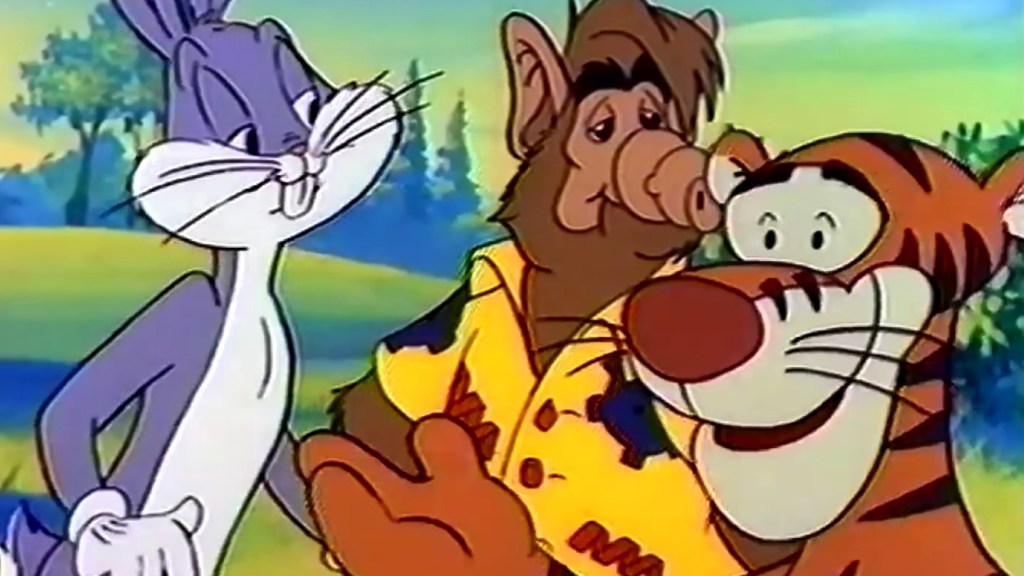
Even more distinct than the fact that the series brought in all of these cartoons, which themselves hailed from all of the major networks, but a slew of their own rights holders, is that they also brought in the voice actors from each show, so that there was no clear marker that these weren’t the “real” versions of the characters. Paul Fusco voiced ALF (albeit uncredited), Ross Bagdasarian Jr. voiced Alvin and Simon, Jim Cummings voices both Winnie the Pooh and Tigger, you get it. The cherry on top of all this is Smoke, the only original “character” in the special, who is brought to life by Academy Award-winner George C. Scott
At the time of its premiere, Cartoon All-Stars to the Rescue not only did the unlikely thing of mixing multiple unaffiliated properties together in one place, but it also brought every major network on American television together. ABC, CBS, NBC, and Fox all broadcast the special at the same time; ironically, one day after 4/20. The special even brought together members of Congress to express their support for it, a rare feat now but an equally rare one in the ’90s. An article from the Associated Press ahead of its premiere featured the iconic quote, “The most powerful weapon that we know in politics is the cartoon and we hope that the cartoon will be the most powerful tool to educate our children,” said by none other than future president Joe Biden.
The message of keeping kids off drugs was a powerful one for the George Bush Sr. administration, who actually appeared ahead of the special to personally introduce it alongside his wife, Barbara Bush, and their dog, Millie (a celebrity in her own right at the time). Even as Cartoon All-Stars to the Rescue went international, it got politicians involved, with broadcasts in various countries getting introductions by the respective leaders of those nations, including Australia, Canada, New Zealand, Mexico, and Japan. To that end, it’s difficult to note how big a deal a project like this was not only from a commercial standpoint, given the franchises involved, but also the political machinations that pulled it off. There’s a word for it, though, and it’s appropriate: propaganda.
Cartoon All-Stars to the Rescue was not aimed at scaring young pre-teens into the danger of using drugs; it was aimed at their preschool-aged siblings. You don’t include the likes of Winnie the Pooh and Baby Kermit to try and convince a 12-year-old that getting high is for squares (even worse for their case, the funniest line of the special comes from Simon Seville, said in his trademark chipmunk tenor, “I hate to suggest this but my guess would be, marijuana, an unlawful substance used to experience artificial highs.”). By bringing in both very innocent characters that appealed to young kids, plus cooler characters like Alf and Michelangelo, it could directly work on the susceptible young minds that loved these shows.
In an era where the most popular video game on the planet, Fortnite, allows its players to assemble a squad of Godzilla, Peter Griffin from Family Guy, Marty McFly from Back to the Future, and Hatsune Miku as they drop down into a map modeled after The Simpsons’ hometown of Springfield, Cartoon All-Stars to the Rescue really doesn’t feel like a big deal anymore. On top of that, YouTube has long been a place where mindless videos bring together characters like Spider-Man and Elsa for bizarre adventures, not to mention the proliferation of generative AI and the “capabilities” it has in “creating” crossovers.
Suffice to say, the modern internet is not only rampant with character crossovers, but also far more information about drugs (not only their effects, but public policy about them and even how to get them) than was remotely available in 1990. As a result, Cartoon All-Stars to the Rescue doesn’t hold up in the slightest to the modern lens, not only with its archaic messaging but even its best asset, character crossovers. Despite that, the special is hard to forget, and frankly, a perfect example of something that seems impossible to make today.
