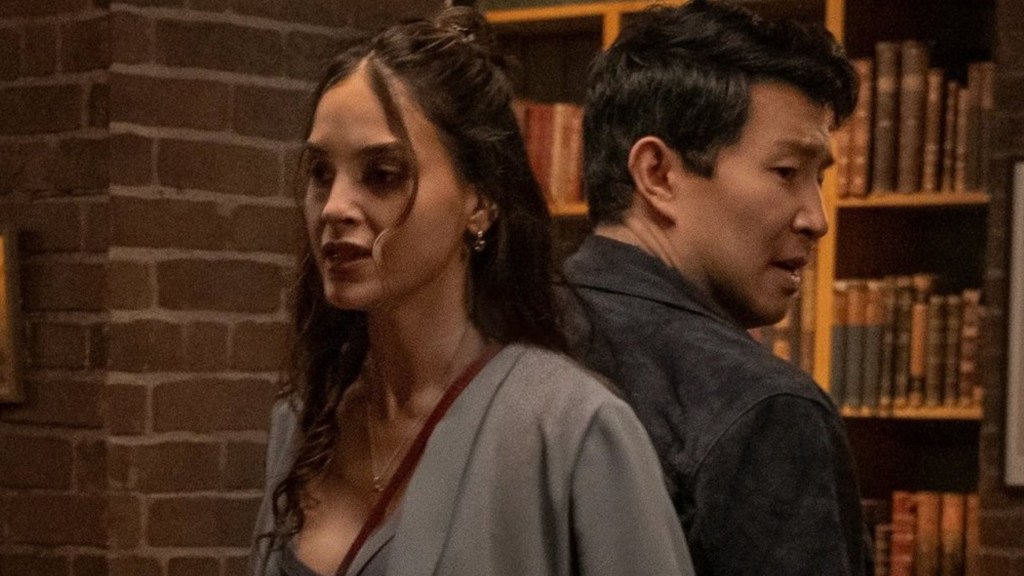
Simu Liu has been compromised. In Peacock’s new espionage thriller The Copenhagen Test, the Shang-Chi actor portrays Alexander, a low-level analyst for the clandestine government agency known as the Orphanage. Alexander’s life spirals out of control after discovering his brain has been hacked, allowing an unknown threat access to his ears, eyes, and, consequently, top-secret intel. Now an unwitting mole, Alexander must put on a show to prove his loyalty to his superiors, uncover the enemy behind this predicament, and why him.
Videos by ComicBook.com
Showrunners Thomas Brandon and Jennifer Yale spoke to ComicBook about mashing the spy and sci-fi genre together, mind games, the genius of James Wan, and second seasons.
ComicBook: The spy genre is a tough nut to crack. How did you land on this spy-fi hook that would eventually drive the narrative?
Thomas Brandon: That’s a great question. It is a tough nut to crack because it has been done a lot and a lot of it feels like the same level of cynicism. It feels like the same kind of show we have seen before. It was in the idea of stumbling across the fear of, “Ooh, what if our ideas were hacked?” Then, realizing that if you set that in the world of espionage, someone who had hacked in the world of espionage, you had the opportunity to do something that was spy-fi. It was a love of both genres and, specifically, the espionage I was most drawn towards the novels of John le Carré, like Tinker Tailor Soldier Spy. Something that had Tinker Tailor Soldier Spy and Black Mirror it its DNA, I was like, “This could be an interesting juxtaposition against each other.” It also gave us the opportunity for a Truman Show element, where this guy has to perform in this fake world and figure out what is real and what is not, and who can I trust?
Once we had all those elements in place, I started realizing it wasn’t just a spy show. It felt like something new and fresh that I hadn’t seen before. I got very excited. Also, weirdly, it took me back to something a lot more tactile. A lot of spy stuff now is typing on computers and this was more like, “OK, now we are going to be talking in Morse code and dropping notes.” It felt like old world, in a weird way, and Cold War. It felt nostalgic, like we were going back to a period I wanted to spend time in. It’s really a contradiction, but the more we spent five minutes in the future, the more access it gave me to the version of the Cold War spy I found most engaging.
Focusing on the term “spy-fi” and that this feels like it takes place “five minutes in the future,” how cynical were you about technology before going into this project?
Brandon: Interesting. I don’t think I have necessarily ever been cynical about technology. I think technology is a tool. What I am cynical about is how humans use tools. Ultimately, technology can be used for good or bad. What I think I am most cynical about technology is sometimes taking away our choices and our knowledge of ourselves, which can lead to less, fully-developed lives. There’s a temptation there when something can do something for you easily, that you stop doing it for yourself. A great Orson Welles quote, “The faster we are carried, the less time we have to spare,” is that level of contradiction.
Jennifer Yale: For technology and every generation, there is a fear that it is more advanced than we even understand or know how to control. With this, there’s the idea of your eyes and ears being hacked, and that there is actually a thing called nano dust, which is something similar to what we have in the show. It’s not nanites, exactly, but it is something that attaches itself to brain receptacles that they are able to use right now or that they are testing it on in medicine, so they are able to talk to people in a coma and to be able to see if we can communicate with people who can’t normally. Knowing that is out there ready – We always talked about this idea that technology, that is public, means that there is that same technology used in governments and clandestine agencies for years. It’s the idea of how long have they been able to see through us and hear through us… If that is something that is possible medically, is that something they are already using?
The Copenhagen Test comes across as a slow burn. Viewers become more invested, and there’s a build towards the climax. How conscious were you on pacing and the importance of littering the episodes with “oh shit” moments?
Brandon: It was a conscious effort. The arc people enjoy the most is not the wall-to-wall-action. When everything is high-stakes life and death, it loses its meaning. What we really wanted to do was infuse the series with those mundane-human moments and add the stakes to that, add the tension to that. We were conscious of the fact that we needed that ebb and flow, to really build to a moment of tension and explosion and then come back in. We talked about that in the editing process.
Yale: You want to exhilarate the audience, but you also don’t want to exhaust them. We worked hard in the writer’s room to make sure if there was a scene that was action-packed and thrilling, we would follow it with a scene that allowed the characters, as well as the audience, to take a breath before we pull them back into that spiral. That’s really the push and pull to make sure it’s a puzzle-box type of show. We wanted the audience to be part of solving it. Sometimes the audience was ahead of Alexander, and sometimes they were behind him, but most of the time they were with him. That was something we concentrated on.
Conjuring Universe creator James Wan is an executive producer on The Copenhagen Test. In what ways did he help flesh out the series?
Brandon: James and his company were fantastic. They were the first fans of the material. Without them and their support, we would not be here. They were the first ones who said, “We think we can do this.” We are an original spy show and it’s thought provoking. It’s asking a lot of the audience. It’s also asking we need money to make this thing. It took someone like James Wan saying, “This would be good and I want to do this” in order to push it along. And James was also instrumental in talking through a lot of the aspects of how this could be channelled through an Asian-American character, specifically with a Chinese-American character. And the world of that character, who feels he doesn’t fully belong here in this country and don’t fully belong with their family. So where do I belong and how far would they would go to prove they belong somewhere? How far would they go to make their own place and to prove that loyalty? He was really instrumental in helping us hone in and find that version.
Jenn: they were creatively supportive from beginning to end. They always made you feel like you were part of something special.
Is it true James suggested Simu for the lead?
Brandon: Yeah, if I remember correctly, he had just had a general meeting with him before Shang-Chi had even come out. They told me, “We are going to send this script to this guy. You should meet him.” I was like, “OK,” because I didn’t know who this guy was. Then I met Simu on Zoom while he was doing reshoots, and I was taken by what a good listener he was, which is the first thing I look for in an actor, is how they are listening. He was an exceptionally good listener. “I thought, “OK, maybe this guy can do it.” We pitched the project with hi,m and ultimately it got picked up. It was James who initially saw something in Simu that connected him to the character.
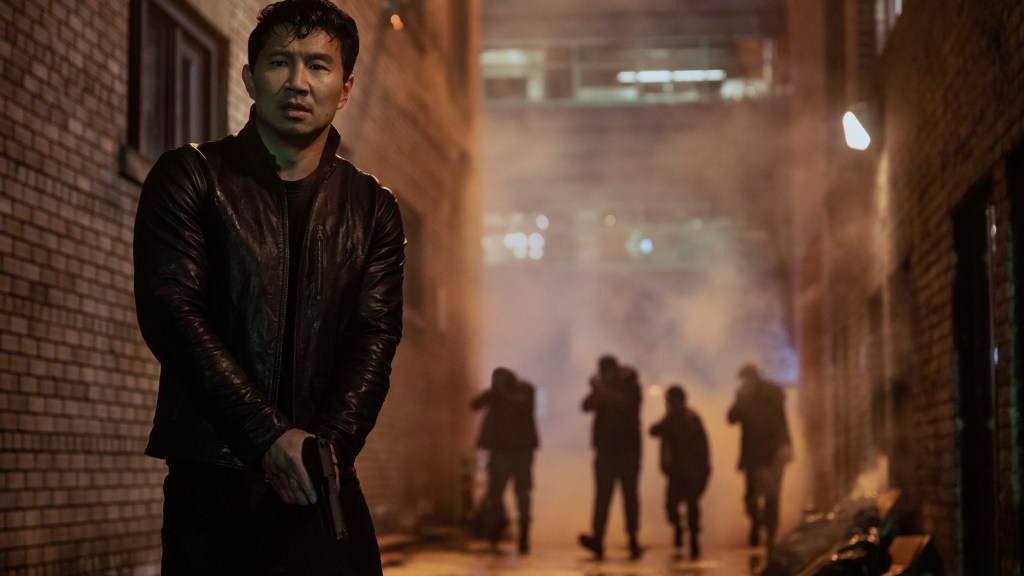
Cat-and-mouse and mind games feature prominently in The Copenhagen Test. How much did you want to play up that paranoia element?
Yale: I think that paranoia is definitely an aspect of the story. But, also, we wanted to make sure the paranoia wasn’t overshadowing the hopefulness of the world. The idea that it’s not like other spy shows and spy movies… Thomas always talks about how we are very cynical. We wanted to make sure there was motivation and momentum behind everything we were doing, the worlds that we were creating, and the organizations behind everything, and knowing the people behind the hack, that there is a reason for it. It’s not just who it is, but why? Why are they doing what they are doing? It was making sure it was an active show and not just reactive. This is happening to Alexander, so it was not only making sure he was always active and trying to figure out how to get out of the corner that he was painted in, but also trying to figure out how to get it out of his head or figure out how to get ahead of it.
How far in advance did you map out the finale and where you wanted to leave audiences?
Brandon: We knew where we wanted to end it by the time we were in the writer’s room and as we were coming in with the pitch. We knew the shape of the story we wanted to tell. We knew it was going to be about Alexander discovering that his destiny was his own choice and not necessarily following an order, but following his conscience. That was always the intention.
As far as where it goes, the wonderful thing is it can go a lot of different directions. We don’t know exactly what the future would look like, but we know the kind of track it would be on. There are kind of two tracks. One is we know that whatever is going on in the future, we are going to be following this technology. Where else is it? Who else has been hacked? And, also, can it evolve and do something else? What is it doing to Alexander? Where did it come from? What are all the ways it is being used? That is a fertile ground to explore, but ultimately, all of that comes back to him as a character. The question of how far would you go to prove your loyalty and the question of do I belong to this country at all costs or is there a line I won’t cross…That is a question that never goes away.
What do you think? Leave a comment below and join the conversation now in the ComicBook Forum!
Most Viewed
-
Image Courtesy of Netflix -

Image Courtesy of Ufotable -

Image courtesy of Warner Bros. Pictures -

Warner Bros. Pictures -
Image Courtesy of Netflix -

image courtesy of Studio Ghibli