Halo is undeniably a staple within the world of gaming and has garnered itself an impeccable legacy as an innovator and key influencer within both the wider industry and the FPS genre. Its enormous success has spawned numerous sequels, spin-off media, and a TV show (something we’ve all collectively agreed never actually existed). That’s a remarkable accomplishment for what started as a revolutionary experience in a fledgling medium few believed would take off in the way it has.
Videos by ComicBook.com
However, as revolutionary and remarkable as Halo once was, as the years have gone by, I have begun to reconsider both my relationship with it and its place in the wider gaming culture. For all its strengths, and there are many, I can’t help but wonder if nostalgia and its placement in the timeline of video game development play a large part in Halo’s astronomical success. Is Halo truly excellent, or was it merely lucky to have released at the start of a burgeoning industry? I’m not all convinced it’s the former.
Halo Has More Misses Than Hits
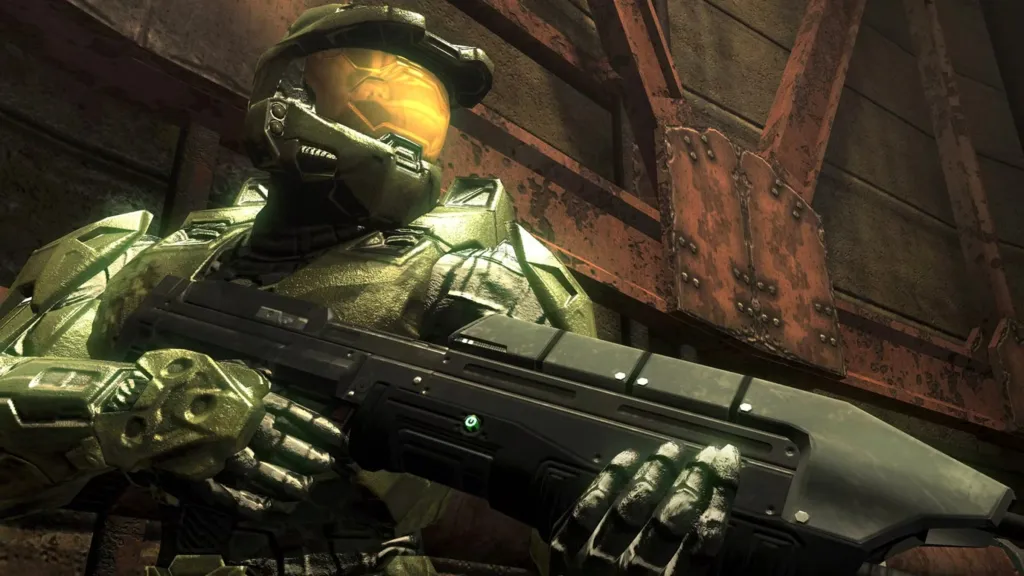
I want to make it abundantly clear that Halo was not just incredibly innovative for its time, but is also largely responsible for the birth of both the narrative first-person shooter and much of the wider FPS genre that we’ve all come to know and love today. I am not here to deny Halo its exceptional legacy, as I believe that would be dishonest. Halo, for all its flaws, achieved the remarkable when it launched back in 2001, and it’s understandable why so many were drawn to it at the time.
I myself spent a lot of my formative years playing Halo with my friends and family. My adoration of split-screen couch co-op and my lamenting of its death is almost entirely due to the many years I spent playing Halo with my sibling, blasting each other out of the sky in New Alexandria or not-so-subtly attempting to rescue Captain Keyes. However, even with some admittedly tarnished and smudged rose-tinted glasses, I find myself questioning just how good Halo is.

Halo’s narrative across the initial trilogy is messy and, at times, frankly illogical. Nuance delivered in the second game is squandered in the third; characters frequently make poor decisions unnecessarily; the wider lore is underexplored outside of the now mandatory spin-off material, and much of the narrative is delivered in a dull, conversational format, despite the rather epic, action-packed scope of the series. It isn’t until later entries that it begins to experiment more with structure and tone, but even then, the best Halo games are betrayed by their staunchly rigid structure.
Since 343 took over, Halo’s narrative has continued to take a backseat. Halo 4’s laughably bad villain and the fifth game’s incoherent decision to sideline Master Chief proved the studio lacks the narrative chops to deliver something even remotely memorable. This is baffling because one of the key features that made Halo so revolutionary to begin with was its seamless blending of narrative and gunplay. Considering how poorly Infinite’s campaign has aged, it makes me wonder whether Halo would be as well received were it to be released for the first time today, or if it was merely lucky to have launched when it did.
Halo’s Success May Be Down To Luck

Halo was released in 2001, a time when not only was gaming just starting to grow in popularity, its once-niche appeal was suddenly broadening, but the FPS genre was largely in its infancy. Of course, the likes of DOOM, Wolfenstein, and Quake had offered fans viscerally enjoyable experiences. Still, none had risen to the same level of quality and narrative potential that Halo established. When it came to what Halo was trying to achieve, it truly had no competition, with even the first Call of Duty two years away at the time it launched.
It was truly an excellent time to be a game developer and a fledgling new franchise, as there was infinite potential, a huge industry to fill, and no one to be compared to. Which is to say, Halo got lucky. That’s not to say that Halo bungled its way to success. Bungie was clearly filled with talented and ambitious developers, evidenced by Halo’s many innovative qualities, all of which furthered the medium dramatically. However, it is to say that, much like the divisive Star Wars before it, which continues to suffer a consistent decline in quality, it’s very likely that Halo’s success derived from simply being the first, and not necessarily the best.
Looking back on Halo in 2026, it’s hard not to see the cracks forming. Even in the remakes and remasters, the repetition in level design, needlessly complicated narrative beats, unfair enemy placement, punishingly accurate AI, lengthy, drawn-out sequences, and badly placed checkpoints make for a frustrating experience. There are a lot of redeeming qualities about Halo, such as its music, weapon sandbox, multiplayer modes, and visual style, but for all of its many successes, Halo can often feel like an average FPS experience.
We’ve seen the likes of the criminally underrated Battleborn, Highguard, Evolve, Homefront: The Revolution, Splitgate, or even Bungie’s own Destiny release with a handful of innovative features and be so quickly forgotten, pushed to the wayside, or endlessly criticized. Halo’s failings would absolutely have seen it follow in the footsteps of those aforementioned titles were it to release now instead of an era when it had no comparable experience through which to judge it. Destiny is frankly proof of this, as it features the same strengths and failings as Halo, is developed by the same studio, and yet often garners mixed to terrible reviews.
Halo Needs To Do Better To Honor Its Legacy

For all my complaining and criticizing, it is hard to deny that there’s something special about Halo. Even now, as I write, I’m listening to the Halo ODST soundtrack and remembering how its neon-soaked, jazz-infused, and sombre atmosphere is unlike anything else I’ve experienced. I think much of my feelings of frustration with the Halo franchise stem from its recent spate of missed potential.
As well-received as Infinite’s campaign was at launch, its poorly implemented structure and disappointing narrative have led to it lacking the replay value so many attribute to the original games. 343 also underdelivered on the multiplayer front and canceled the split-screen mode, robbing the series of a beloved and sacred tradition. Halo 5: Guardians is a forgettable mess, the TV show tarnished what little positive reputation the series had, and Halo 4 is better left squarely in our rearview mirrors.

With the completely unnecessary remake of a remaster of a game from 2001 looming ominously on the horizon, I can’t help but feel like even Xbox doesn’t know what to do with the Halo franchise. However, there is potential here for Halo to prove that its success was always based on more than just good timing, to show that ODST and Reach weren’t just one-off miracles. Halo can recapture that indescribable magic it once held, if only the newly formed Halo Studios can pull together not just a great game, but one that feels as special in today’s oversaturated and cynical market as Halo: Combat Evolved did back in the idyllic, competition-free year of 2001.
Do you think Halo’s success was just due to luck? Leave a comment below or join the conversation below in the ComicBook Forum!
Most Viewed
-

Image courtesy of Sony -

Image courtesy of Warner Bros. Pictures