While Highguard had a rough debut at the Game Awards, fans have been curious about what the new FPS from Wildlight Entertainment would actually entail. The hero shooter comes from a team of creatives who have worked on dozens of the biggest franchises in gaming, but it wasn’t initially clear how the new game would stand out in a crowded field. Making something unique was very much on the developer’s mind during production, leading to a game experience that takes typical deathmatch mechanics and introduces a lot of fun wrinkles.
Videos by ComicBook.com
Base management, resource farming, and mounted maneuverability turned out to be smaller ways to add more unique touches to the experience, all playing into a unique siege gameplay mechanic that quickly set itself apart from the competition. While attending a preview of Highguard in Los Angeles, ComicBook got the chance to speak with design and creative director Jason Ford and lead designer Carlos Panetta about the evolution of the game, how the development was refined over time, and the importance of turning unexpected bugs into entertaining features.
Breaking Down The Inspiration Behind Highguard
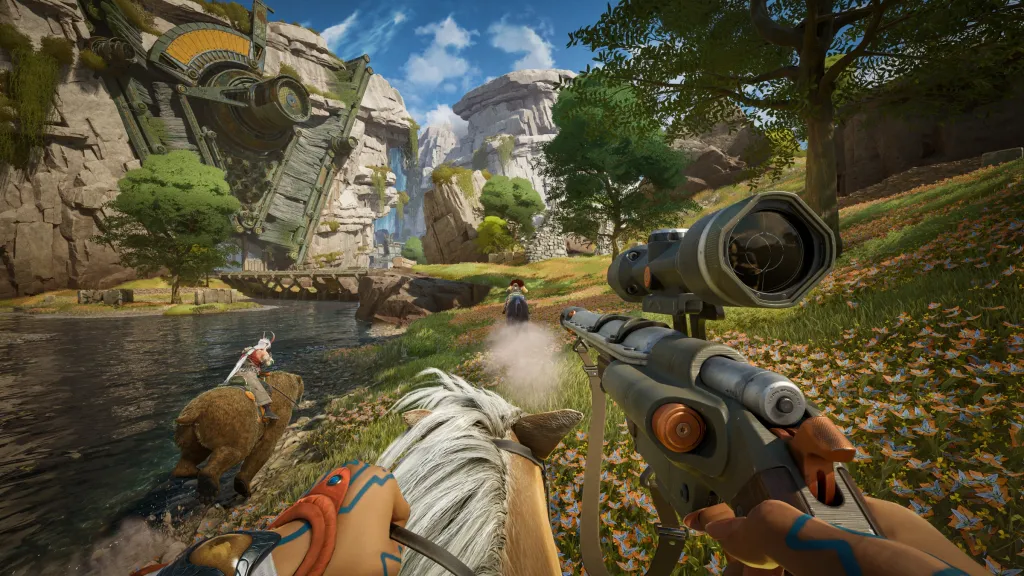
The core of Highguard‘s gameplay centers around base raids. Teams of three venture into a larger overworld and battle for possession of a special sword. This blade, known as the Shieldbreaker, is the key to lowering the defenses of the opponent’s base. Acquiring it and deploying it at the enemy base sets off a massive battle, with the attackers looking to destroy certain parts of the base while the defenders work to repel them. Games can last anywhere from 1 to 4 rounds, depending on how effective the attack is or how capable the defenders prove to be.
It’s a unique approach to the online competitive space, with a focus on both tight teamwork and direct combat. According to Panetta, the development into Highguard‘s current shape came about from experimentation and observation, all reflective of what else is available in the current gaming space. “We knew we were going to make a new game. It can’t be just like every other game, because no one’s going to care… We knew we wanted to make a multiplayer online game. We like those types of games; we’re good at making them. There’s a lot of inspiration out there, so we played a lot of games. We played Sea of Thieves, we played Rust. I asked my nephew, what are the kids playing these days? He liked playing Bed Wars.’ So that night, I loaded it up. It was always like, ‘What’s this game about?‘”
Panetta and Ford both highlighted Rust as a major influence on their work in Highguard, revealing they were fans of the game’s approach to action. However, the gradual build-up to raids was something found slow. This led to a key aspect of Highguard‘s design being centered around replicating the excitement of planning and then executing an attack, but in a reduced time frame. That emphasis on quick action was something Ford noted was intrinsic to their overall approach to gameplay, citing the speed of Apex as an example of that pacing in their other titles. It’s also something they had to reflect on, given the speed of Highguard and the desire to include slower moments that put emphasis on maneuverability and resource management. “We make pretty fast games, and we were like, ‘Can we make a game that’s slow?’ We had play tests… the team was like, ‘Can I be more athletic? Can I get my kills faster? Can I escape and outplay people?’ That was the feedback we were getting, so we kicked it up a little bit.”
This led to the game’s increased speed, which works within the larger world that has been designed by the team. On-foot combat became quicker, and mounted gunplay became a key part of the gameplay. Even transitioning from one to the other reflected the increased pacing, with a sliding dismount serving as a kinetic form of movement that was very useful during gameplay. According to Ford, that was something the team discovered along the way. “It was a bug, because you would dismount and it goes straight into a slide, completely by accident. But we were like, ‘We’re keeping that, right?’ It’s cool! Playing into that as we started to get better at transitioning between mounted movement and being on foot — getting on your mount and then running across an open space into cover, sliding into cover to be in a new position, that’s really cool. We should lean into that.”
The Development Process Is Key To Game Design (And Helped Make Highguard Something Special)
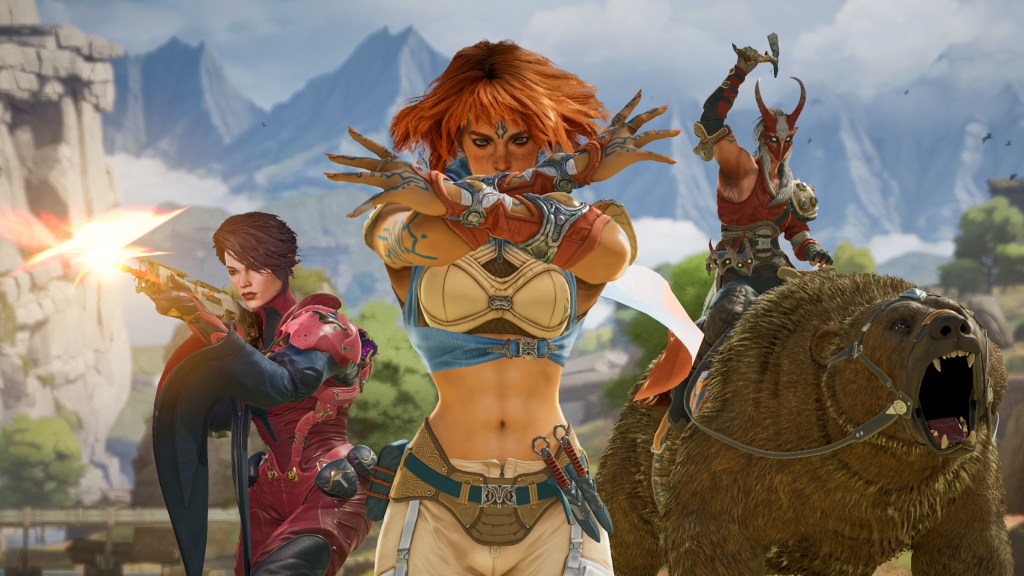
Finding happy accidents like that is crucial to any game development cycle, and it’s one that Ford and the entire team doubled down on. “You learn to trust the process,” Ford noted, reflecting on the lessons previous games like Apex had imparted on them. “We prototype a lot, and we just kind of accidentally find stuff, and we just identify the things that are really good. We find the fun, we chase the fun. We’ve accidentally bumped into something fun. Our response becomes, ‘this is really cool, we have to include it.’”
That approach to development was crucial to refining Highguard’s standard gameplay. According to the pair, even showcasing the damage taken by the base was something that was developed over time. Doing damage with each action also came as a result of playtesting, as earlier conceptions of just blowing up the enemy base resulted in hours-long matches where neither team could truly move the needle. Instead, the bases received specific points that could be targeted for damage, while breaking base shields or repelling enemy attacks could also be a key to victory.
According to the pair, the guiding light that made Highguard what it is was a desire to simplify the gameplay, streamlining the different mechanics enough that players can learn the gameplay quickly while still taking time to master it. “We started with something that was more complicated, and then we would just shave it down,” Panetta explained. “I mean, a small example, we used to have a healing mechanic, as you would have in Apex. You know, where you have to push a button, and you manage your heels. It kind of worked. But there was a point where we were just feeling exhausted while playing, which slowed things down. We wanted to simplify it even more, so we decided to take out the healing. We already had the mechanics, the animations, and the voice-overs. But we took it all out, and everybody appreciated that it was one less thing to think about. Simplification was the driving force, even when it led to difficult conversations.”
That approach benefits Highguard, which has a lot going on in any given match. There could be too many elements, but the game’s emphasis on speedy attacks and structured defense ultimately benefited the gameplay on several levels. Battles became quicker, matches became more competitive, and the game became more engrossing. It was very easy during the preview event to feel the tightness of the design. It was exciting to find new ways to use the mechanics to your advantage. During the event, my teammates who were better at strategy would be forced to adjust on the fly. Players more accustomed to defense would hold up in the base and make themselves unpassable. I became an asset to the team thanks to my quick adjustment to the mounted movement and combat, quickly snagging the Shieldbreaker and racing through labyrinth-like mines to deliver a killing blow to the enemy base. Highguard is a fun game, especially once your team is moving in synch.
There’s a lot of depth to Highguard, even as the base gameplay is quick to learn. Finding the right balance among all those elements was the key to development. “I can’t describe to you how many times during development this game did not work,” Ford admitted. “We were playing a version that had unbalanced things. We hadn’t figured out how maps are actually supposed to be laid out. It wasn’t fun, and those moments can be pits, especially when you’re trying to make a style of game that doesn’t exist. You don’t have something you can look at and go play on the weekends and be like, so that’s how they solved that. But because the people on this team have made enough games, I just told myself to trust the process. We know how to make games. We needed to get people playing the prototype, giving us feedback, and then talking about the problems, coming up with creative solutions, prototyping them, picking the best ones, and moving forward. If you do that, you will get a good game in the end. This was the hardest version of that that I probably ever had to do, but it got us there. We learned from our prototypes, and we made it into something special and fun. You just have to trust the process.”
Highguard is now available for Xbox Series S/X, PlayStation 5, and on PC
Most Viewed
-

Official art by Bastien Lecouffe-Deharme -

Image Courtesy of MAPPA -
Image Courtesy of DC Comics