The horror subgenre goes through ebbs and flows in Hollywood. In the 1980s, spurred by the success of Halloween in 1978, the slasher subgenre took over the genre completely and not only dominated the box office but disgusted critics like Roger Ebert. That success led to major expansion, which naturally gave way to contraction, with mainstream horror going dark in the 1990s until the release of Scream. Arguably, in the time since then, we’ve seldom had a dark period, with studios making sure to line their pockets with horror movie dollars while also satisfying audiences, and in truth, you can trace it back to one movie that arrived on this day over five decades ago.
Videos by ComicBook.com
52 years ago today, Warner Bros. Pictures released The Exorcist. At the time of its release, extended nationwide premieres weren’t yet a thing (Jaws would change that two years later), with The Exorcist instead rolling out in just 20 markets initially. Despite the disturbing content of the film, audiences lined up to see it, forcing Warner Bros. to quickly expand its release and turn this horror film into a pop culture phenomenon. The world hadn’t yet seen anything quite like this movie at the time (The Texas Chain Saw Massacre wouldn’t arrive for another year, while movies like Hellraiser and The Fly were over a decade away), which makes its success all the more impressive.

The Exorcist Created an Entire Subgenre (And Still Hasn’t Been Beaten)

Prior to the release of The Exorcist, the demonic possession subgenre had so few movies to its name that it was pretty imperceptible in the same way that giant monsters or ghost stories were so well defined from the 1940s to the 1960s. Around that time, some notable movies that predate The Exorcist were released that would clearly fall under this subgenre, though neither was able to make the find of splash that Friedkin’s movie developed. The first is 1961’s The Innocents from director Jack Clayton, about a woman watching over children in a house she believes is haunted, only to realize the children are becoming possessed by the ghosts. The other is 1963’s Il Demonio by Brunello Rondi, a supernatural film that has a demonic possession subplot.
The Exorcist movie, based on William Peter Blatty’s novel of the same name, took the concept and not only treated it with complete realism but, like other notable horror movies of the 1970s, created a complete blueprint for the rest of the genre to follow. Weird happenings give way to an innocent character behaving badly, which evolves to the reveal of a demon possessing their body, a problem that only the church or a very resilient parent can fix. The beats didn’t exist before The Exorcist, and now they’re well-tread territory. Without The Exorcist, a slew of genre movies don’t exist, including the billion-dollar The Conjuring franchise or any of the Amityville movies, and that’s without mentioning specific films like The Exorcism of Emily Rose or even classics like Evil Dead.
The Exorcist Helped Make Horror Mainstream
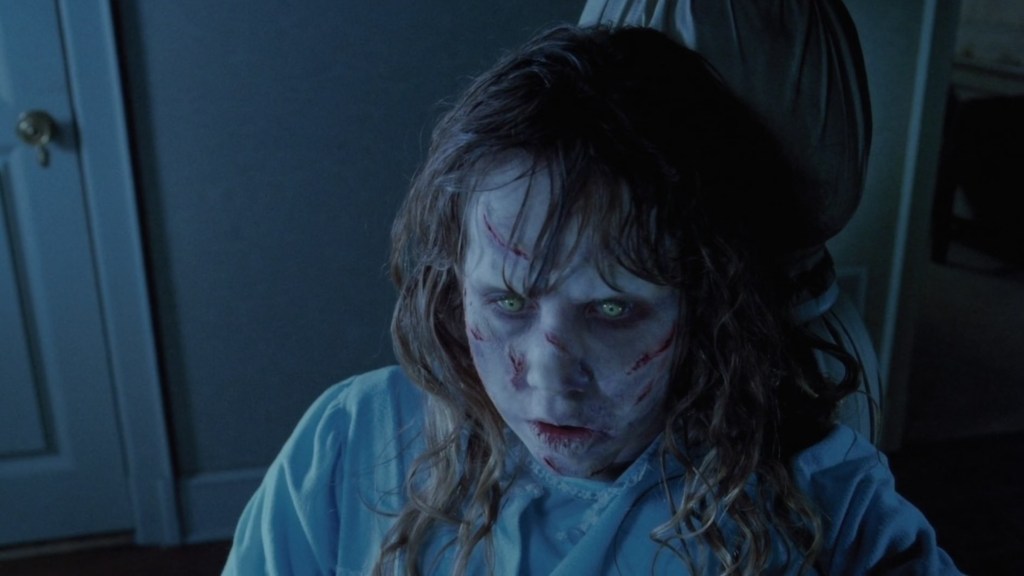
The Exorcist proved that horror wasn’t just for kids; it was something audiences craved. Prior to the release of The Exorcist, the success of horror movies at the box office was defined by the fact that they were largely produced for a cheap sum and then made major returns, but never enough to really crack the charts in a major way. Examples that bucked that trend, however, were studio horror movies that preceded The Exorcist, like Rosemary’s Baby in 1968, which was the #7 highest-grossing movie of that year, and Alfred Hitchcock’s Psycho in 1960, which was the #2 highest-grossing movie of the year it was released.
The success of these movies paints studio horror movies as an anomaly, something that worked every once in a while but was mostly cast aside. Then, The Exorcist was released. Warner Bros. courted controversy with the release of Friedkin’s film, exploiting the troubles of the production by claiming the film may have been cursed (several cast members died ahead of the release of the movie, while a fire on set reportedly burned down the MacNeil house set, except for the room where Regan was to be possessed). By combining this with reports of audience members fainting and throwing up from watching the movie, plus releasing it so close to the Christian holiday of Christmas, a perfect storm was created.
In its initial release, The Exorcist brought in over $193 million at the global box office, making it the #1 movie for 1973. Considering the film only played in 1973 for a week, it’s also worth noting that The Exorcist brought in more than any other movie in 1974, and any other movie in 1975 except for one, Steven Spielberg’s Jaws. Though the film had a mixed reception critically upon its debut, the tide quickly turned in its favor as The Exorcist would go on to be nominated for ten Academy Awards (including Best Picture and Best Director), winning two (Best Sound and Best Adapted Screenplay).
The Exorcist’s Success Convinced Studios to Bank on Horror

The Exorcist wasn’t the first studio-produced horror movie, but by and large, it was not a genre that they typically operated in. Exceptions exist, of course, like the aforementioned Rosemary’s Baby and Psycho, plus Universal Pictures’ extended history of monster movies in the 1930s, but more often than not, horror movies were relegated to drive-ins and as the “B” movie in a double bill. Major names in the genre at the time were independent filmmakers too, like William Castle, Roger Corman, and George A. Romero, fresh off the debut of Night of the Living Dead, but after The Exorcist, that changed completely.
After it became the highest-grossing movie of the year and went on to Oscar glory, horror was clearly something that could not only fill the coffers but could draw a more sophisticated crowd. That’s not to say that the independent circuit didn’t continue to define the horror genre for the most part, but it resulted in the studios taking a keener look at what they could in that space than they had before. 20th Century Fox immediately jumped on the hype left behind by The Exorcist with two of their biggest horror movies of the decade, Race with the Devil and The Omen, while United Artists would skyrocket Stephen King’s career to new heights with the release of Carrie.
Naturally, the passage of over fifty years of time will lead to clear insight into how things have changed for anything over that period of time. For horror fans though, the arrival of The Exorcist should be seen as a key demarcation line for the entire genre in more ways than one. Film fans who may be tired of Christmas by this point should consider giving it another spin, as Friedkin’s movie remains as powerful now as it was when it was released.
Most Viewed
-

Official art by Bastien Lecouffe-Deharme -

A photo of the Retrovolt Arcade taken in 2017, showing several classic arcade cabinets and stools.