The progression of science fiction cinema is rarely a linear path of gradual improvement. Instead, the genre advances through sudden shifts that force the entire industry to reconsider the possibilities of the medium. These pivotal moments occur when a single production manages to synthesize cutting-edge technology with profound philosophical inquiries regarding the human condition. Modern audiences experienced this transformation with the digital world-building of The Matrix or the immersive environments of Avatar. Similarly, the intellectual rigor found in 2001: A Space Odyssey or the grounded physics of Interstellar raised the standard for narrative depth in big-budget filmmaking when they first reached theaters. Yet, the most significant shift in the history of science fiction occurred nearly a century ago. Long before the digital revolution, a single silent film provided the blueprint for every futuristic dystopia produced in the modern era.
Videos by ComicBook.com
Directed by Fritz Lang, Metropolis premiered in Berlin on January 10, 1927, marking the definitive peak of German Expressionism. The film depicts a starkly divided society where the elite live in the Garden of Sons while the laboring class toils in subterranean machine rooms. This narrative serves as a blistering critique of the industrial age, focusing on the tension between those who conceive of great works and those who physically build them.

When Metropolis eventually reached the United States, Paramount Pictures ordered a drastic re-edit that removed nearly a quarter of the original footage to simplify the complex plot for American viewers. Despite this early censorship, the sheer power of the visual language allowed the film to achieve massive popularity and critical acclaim. Metropolis became a global sensation that proved speculative fiction could handle sophisticated social commentary regarding corporate greed and class warfare. As a result, the film effectively transitioned science fiction from pulp curiosity to a legitimate vessel for high art.
Why Is Metropolis So Important for Sci-Fi History?
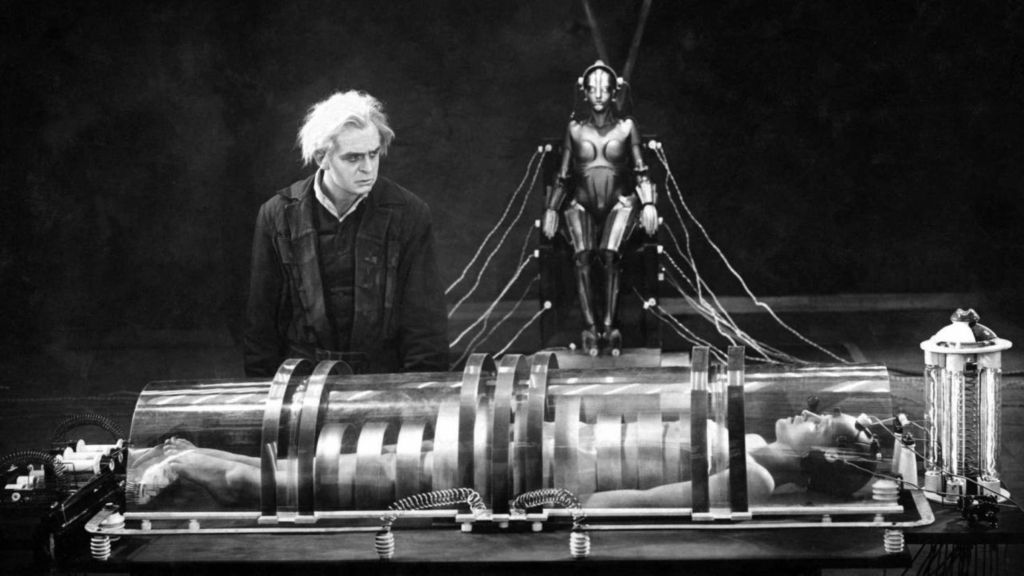
Metropolis‘ technical innovations remained the industry standard for over half a century. Fritz Lang and cinematographer Karl Freund utilized the Schüfftan process, a technique involving mirrors that allowed live actors to appear inside miniature sets. This allowed the production to visualize a multi-tiered urban environment that felt physically present and massive in scale. Consequently, the film established the visual template for the “megacity,” a concept that would later be refined by Ridley Scott for the rain-soaked streets of Blade Runner and influence Luc Besson’s The Fifth Element. By treating the urban environment as an vertical structure, Lang ensured that the setting functioned as a physical manifestation of social hierarchy. Because of that, the architectural design of the New Tower of Babel continues to influence the way modern filmmakers visualize the intersection of power and infrastructure.
Beyond the architecture, Metropolis introduced the most iconic artificial being in cinematic history. The Maschinenmensch, a mechanical double of Maria (Brigitte Helm), provided the direct inspiration for the aesthetic of C-3PO in the Star Wars franchise. The film also codified the idea of the robot as a tool of political manipulation and social unrest. Furthermore, the character of Rotwang (Rudolf Klein-Rogge) established the definitive archetype of the mad scientist. His laboratory, filled with electrical equipment and bubbling chemical vats, set the standard for how futuristic technology is portrayed as a site of chaotic creation.
Metropolis also pioneered the use of thousands of extras and massive practical sets to create a sense of realism that digital effects still struggle to replicate. Finally, by merging these technical firsts with a deeply cynical view of technological progress, Lang created a cinematic language that remains the primary dialect for the entire dystopian subgenre. That’s why, almost a century later, we can still see the ripples of Metropolis echoing in contemporary sci-fi productions.
Metropolis is currently available to stream on various platforms, including Plex and the Roku Channel.
Which movie do you think gets near to being as influential as Metropolis for sci-fi cinema? Leave a comment below and join the conversation now in the ComicBook Forum!
Most Viewed
-

Official art by Bastien Lecouffe-Deharme -

Image courtesy of Tor Books/Macmillan -

A photo of the Retrovolt Arcade taken in 2017, showing several classic arcade cabinets and stools.