Soon after it hit Netflix, KPop Demon Hunters shattered every expectation. The movie follows the journey of a K-pop girl group known as HUNTR/X, whose members Rumi (voiced by Arden Cho), Mira (voiced by May Hong), and Zoey (voiced by Ji-young Yoo) navigate the pressures of international fame while secretly working as mystical warriors. Within months of its debut, the film officially became Netflix’s biggest IP, surpassing the viewership records previously held by the live-action hit Red Notice and even the TV show Squid Game. This cultural dominance was further fueled by a revolutionary original soundtrack featuring the chart-topping lead single “Golden,” which dominated the Billboard charts for weeks. Finally, the dynamic animation style—mixing music video aesthetics and modern anime—delivered a visual experience unlike anything else. While KPop Demon Hunters deserves all the attention it gets, another underwatched Netflix animated movie should have been bigger.
Videos by ComicBook.com
Released in 2023, Nimona is a sprawling science-fantasy adventure that faced a notoriously difficult road to the screen. Based on the celebrated graphic novel by ND Stevenson, the project was originally developed at Blue Sky Studios before being unceremoniously canceled during the Disney acquisition of 20th Century Fox. Fortunately, Annapurna Pictures and Netflix intervened to save the production, allowing directors Nick Bruno and Troy Quane to complete their vision for a techno-medieval world. The narrative follows a shapeshifting teen named Nimona (voiced by Chloë Grace Moretz) who becomes the sidekick to Ballister Boldheart (voiced by Riz Ahmed), a knight framed for a crime he did not commit. However, despite receiving critical acclaim and an Academy Award nomination, Nimona never reached the commercial heights of KPop Demon Hunters, even though these movies have much in common.
Nimoma Is About Accepting the Differences
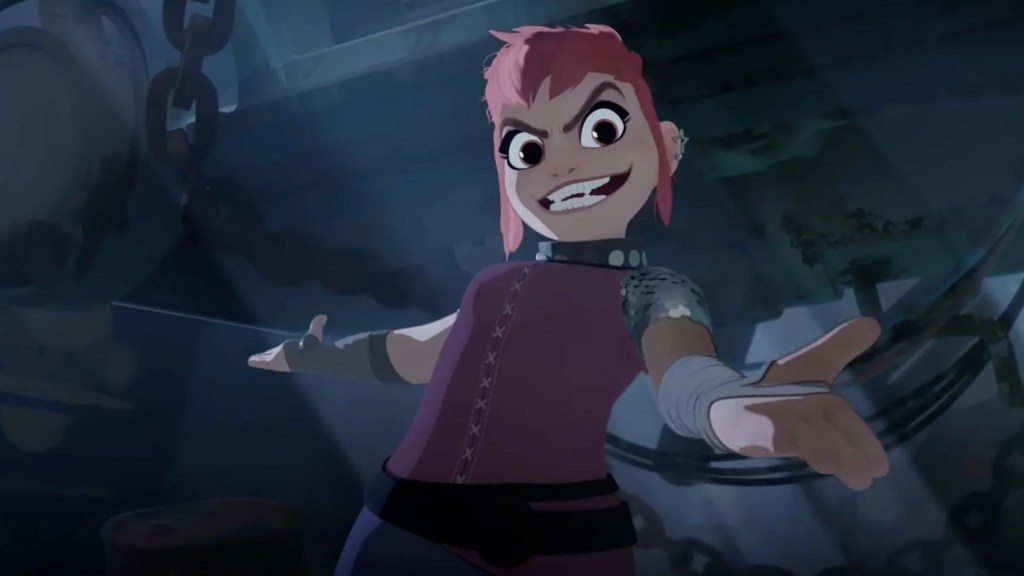
Nimona is centered on the violent friction between institutional tradition and individual identity. Set in a kingdom that has spent a thousand years fortifying its walls against perceived external monsters, the film uses Nimona’s shapeshifting abilities as a metaphor for nonconformity and the queer experience. While the Institution of Law Enforcement and Heroics, led by the Director (voiced by Frances Conroy), teaches its knights that anything outside the norm is a threat to the status quo, the narrative reframes this “monstrosity” as an act of liberating self-expression. That’s because Nimona’s refusal to be “cured” or “fixed” transforms her from a traditional sidekick into a radical force of nature that exposes the fragility of a society built on manufactured fear.
Nimona‘s investigation into the psychological toll of social exclusion creates a striking parallel with the internal conflicts found in KPop Demon Hunters. While the members of HUNTR/X are celebrated as icons of perfection, the narrative focuses heavily on the crushing weight of public expectation through Rumi, who harbors a debilitating secret regarding her half-demon heritage. Rumi experiences a fundamental disconnect between her authentic self and the polished idol persona mandated by her mentor, Celine (voiced by Yunjin Kim), and both she and Nimona inhabit worlds where their otherness is viewed as a defect that must be purged rather than an essential part of their identities.
Furthermore, both films examine how authority figures utilize propaganda to maintain control over these unique individuals. In Nimona, the Director weaponizes the legacy of Gloreth to justify the extermination of anything she cannot classify. Similarly, in KPop Demon Hunters, Celine’s prejudice leads Rumi to hate her differences. Ultimately, both narratives culminate in a rejection of normalization. Nimona’s survival and the success of HUNTR/X depend entirely on their ability to stop apologizing for their nature and reclaim their place in the world.
Nimona‘s Top-Notch Animation Is Amazing

Beyond its thematic resonance, Nimona represents a significant technical achievement in the field of digital animation, utilizing a visual shorthand that remains distinct from the house styles of major legacy studios. Developed by DNEG Animation, the film employs a unique rendering process that prioritizes a painterly look, blending illustrative backgrounds with 3D character models that possess a hand-drawn quality. This aesthetic choice ensures that the setting feels like a living extension of the original graphic novel rather than a generic CGI world. The animation team also focused on expressive character movements that emphasize personality over physical realism, a choice that is particularly effective during Nimona’s rapid-fire transformations.
Nimona‘s commitment to a stylized aesthetic aligns with the visual language used to bring KPop Demon Hunters to life. Sony Pictures Animation utilized the pipeline established by its Spider-Verse franchise to create a high-contrast world that mirrors the explosive energy of a live K-pop concert. Both productions reject hyper-realistic textures in favor of a graphic sensibility that uses light and color to signal emotional shifts. By prioritizing artistic intent over technical perfection, Nimonaproves that animated films can be both technologically advanced and deeply rooted in a specific tradition. The fact that KPop Demon Hunters follows a similar philosophy underlines the fact that both movies deserve to be record-breaking successes.
Nimona is currently available to stream on Netflix.
Do you think Nimona is as good as KPop Demon Hunters? Leave a comment below and join the conversation now in the ComicBook Forum!
Most Viewed
-
Image Courtesy of Ufotable -

Image courtesy of Wizards of the Coast