
Star Wars: Episode VI – The Empire Strikes Back was, by any measure, the defining movie of 1980. Irvin Kershner’s sequel opened on May 21 and became the year’s highest-grossing release, pulling in roughly $401.5 million worldwide during its initial run and eventually climbing past $538 million across its multiple theatrical reissues. That’s a hit even dismissing inflation, which would push the sequel beyond the $1.5 billion mark. Apart from commercial gains, the Darth Vader paternity reveal alone shook the franchise, deepening the Star Wars mythology while darkening its tone considerably from the original film. Decades later, the movie remains enshrined in the National Film Registry and is still widely regarded as the strongest entry in the entire Skywalker Saga, a benchmark that few blockbusters of any era have matched.
Videos by ComicBook.com
With The Empire Strikes Back dominating the cultural discussion, every other movie had to fight for a sliver of attention. The situation was even worse for sci-fi movies, which got immediately compared to the galaxy that George Lucas had built. Still, several genuinely ambitious science fiction films opened in Empire’s shadow in 1980, some of which would become part of every 1980s teenager’s life.
3) Battle Beyond the Stars
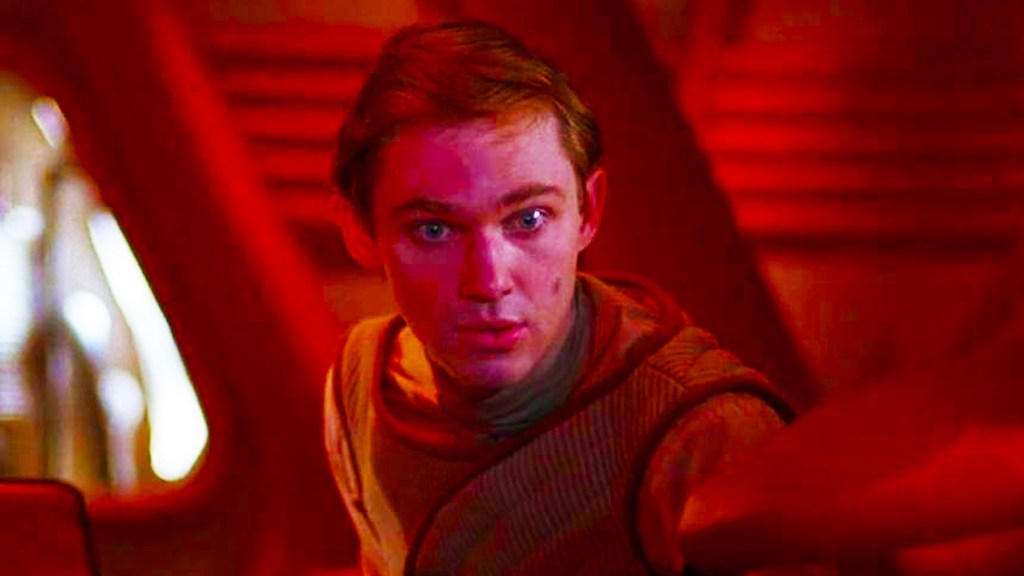
Roger Corman built his legendary career by producing exploitation films on microscopic budgets, but the monumental success of the science fiction genre in the late 1970s convinced him to invest a record-breaking $2 million into a new space opera. Directed by Jimmy T. Murakami with a screenplay by John Sayles, Battle Beyond the Stars translated Akira Kurosawa’s Seven Samurai into an intergalactic setting, something Scott Snyder would attempt again with the failed Rebel Moon for Netflix.
Battle Beyond the Stars follows a young farm boy named Shad (Richard Thomas), who recruits a ragtag group of mercenaries to defend his pacifist home world from the ruthless warlord Sador (John Saxon). The unprecedented financial investment allowed Corman to hire an incredible roster of emerging talent, assigning special effects duties to a young James Cameron and commissioning a sweeping orchestral score from James Horner. Cameron’s innovative model work maximized the budget, creating intricate alien spacecraft out of everyday materials and repurposed model kits. Battle Beyond the Stars ultimately grossed $11 million at the box office, proving that independent studios could deliver thrilling adventures capable of entertaining teenagers without relying on massive studio backing. The movie also got a profitable licensing deal with HBO, which is exactly how so many 1980s teens ended up catching it on cable.
2) Altered States
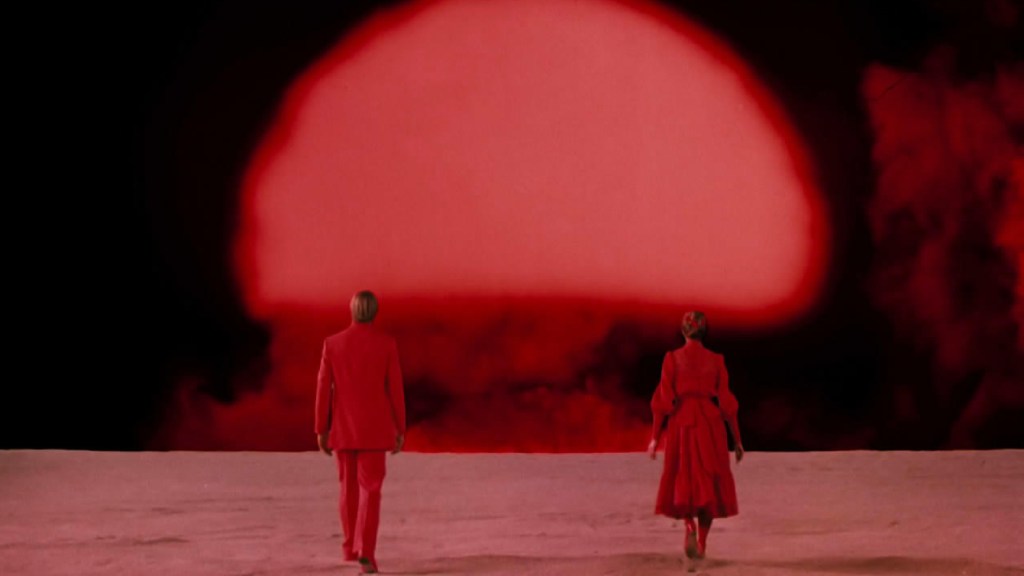
Ken Russell’s Altered States completely rejected the traditional space exploration tropes that had become dominant in late 1970s sci-fi, turning its focus inward to deliver a deeply unsettling psychological horror experience. Based on the novel by Paddy Chayefsky, who also penned the screenplay under the pseudonym Sidney Aaron, the film follows psychopathologist Edward Jessup (William Hurt) as he experiments with sensory deprivation tanks and powerful hallucinogens. His obsession with unlocking primitive human consciousness eventually triggers terrifying physical and genetic regressions that helped make the movie famous.
Armed with a $15 million budget, Russell brought Altered States‘ intense mental trips to life through groundbreaking visual effects, blending body horror with surreal, rapid-fire imagery. Surprisingly, the resulting psychedelic sequences predicted the hyper-kinetic music video aesthetic that would dominate MTV and youth culture throughout the decade. Although the cerebral narrative only pulled in $19.9 million at the box office, Altered States quickly became a late-night cable television staple, embedding its vision of unchecked scientific curiosity into the minds of an entire generation.
1) Flash Gordon

While George Lucas was deepening the Star Wars mythology, producer Dino De Laurentiis spent over $20 million to bring comic-strip exuberance back to the genre with Flash Gordon. Directed by Mike Hodges, the adaptation wholly embraced its pulp origins, following star quarterback Flash Gordon (Sam J. Jones) as he attempts to save Earth from the tyrannical Ming the Merciless (Max von Sydow).
Instead of aiming for realism, the production team of Flash Gordon leaned into deliberate camp, building a staggeringly colorful vision of the planet Mongo filled with gold-winged Hawkmen and glittering costumes. Plus, the massive visual spectacle was perfectly complemented by a bombastic rock soundtrack composed by Queen, an unconventional creative choice that became one of the defining moments of 1980s cinema. As a result, Flash Gordon proudly functioned as the self-aware antithesis to the era’s serious space operas, celebrating a brand of maximalism that continues to influence modern blockbusters. That’s why, despite earning a modest $27 million domestically, the film achieved cult status, being rewatched by the 1980s teenagers through physical media.
Which sci-fi movie from 1980 do you remember most, aside from The Empire Strikes Back? Leave a comment below and join the conversation now in the ComicBook Forum!
More Movies
-

Image Courtesy of Lionsgate -

Image Courtesy of De Laurentiis Entertainment Group



![By Any Means Director Reveals John Woo and Quentin Tarantino’s Influence on New Movie [EXCLUSIVE]](https://comicbook.com/wp-content/uploads/sites/4/2026/09/by-any-means-movie.jpg?w=300)

![Resident Evil Director Teases Ideas for Sequel, and Austin Abrams Confirms the Hardest Part of Filming [EXCLUSIVE]](https://comicbook.com/wp-content/uploads/sites/4/2026/09/Resdient-Evil-Interview-Zach-Cregger-and-Austin-Abrams-Exclusive.jpg?w=300)
