Time travel is a favorite subgenre among sci-fi fans, but to do it well, a movie usually needs to avoid cheesy tropes, over-explanation, and hand-holding. However, that means walking a fine line between over-explaining and not explaining enough, and sometimes travel plots even land on the side of being too confusing. So where exactly is that line? One 2000’s cult film still has people asking.
Videos by ComicBook.com
Shane Carruth’s debut time-travel feature Primer came out in 2004. Made on an ultra-micro budget, the sci-fi experiment has since become a cult favorite, with audiences still trying to decipher its dense plot to this day. While continued fan discourse two decades later is a marker of something great, Primer’s aggressively precise, layered story hardly makes sense on a first or even second watch.
Is Shane Carruth’s Primer the Most Confusing Time Travel Film of All Time?
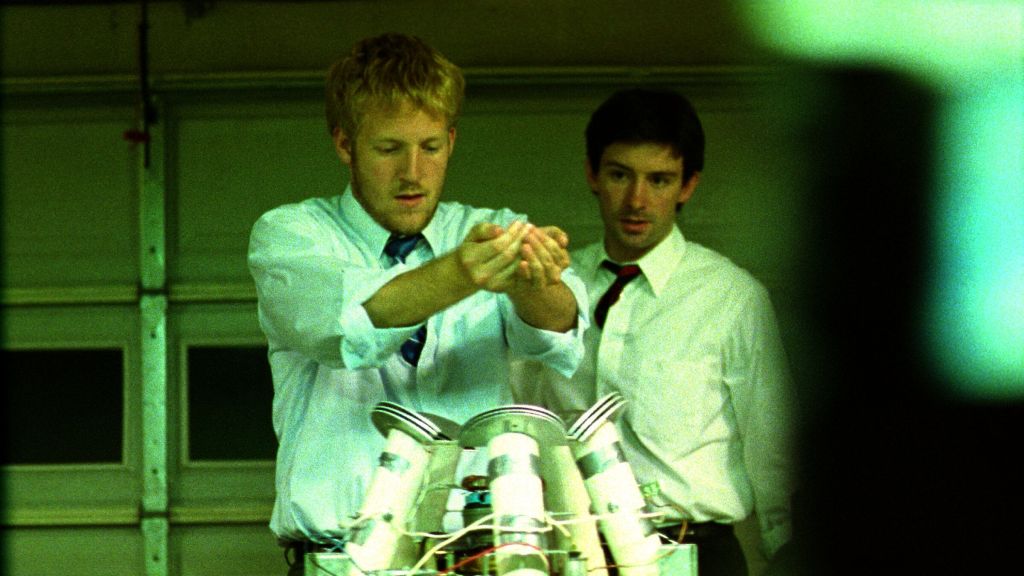
Released after its Sundance premiere, Primer was written, directed, produced, edited, and scored by filmmaker Shane Carruth, who also stars in the film. Made for an estimated $7,000 on consumer-grade film stock, the movie follows two engineers, Aaron (Carruth) and Abe (David Sullivan), who accidentally invent a form of time travel while working on side projects in a suburban garage. It’s a simple setup, but from there things spiral out quickly.
As the story unfolds, Primer explains very little to the audience about what is happening. The dialogue is heavy with overlapping technical jargon. Many key events occur off-screen, all while timelines split, loop back on themselves, and overlap before the unsuspecting audience has time to catch their breath. It’s clear the film knows the audience is falling behind, but it puts its faith in them, believing they are at least curious enough to try and keep up.

Carruth masterminds this winding structure using his engineering background. Not visually flashy or mystical, the time travel in Primer is treated seriously, as grounded or hard sci-fi, and depicted like any other scientific system that can be optimized and/or exploited. It’s never simplified or dumbed down for the sake of the viewer, but the internal logic does exist for anyone willing to unpack it.
The logic and structure are precisely why Primer is still a cut favorite today. If the movie led curious fans on a wild goose chase that amounted to nothing, it would have likely faded away with time. But the fact that the film does have a solid foundation is why it endures. In the decades since its release, fans have watched and rewatched the film, even crafting elaborate visual aids to map the multiple timelines, character doubles, and divergence points. Entire forum threads, essays, and videos have also been dedicated to decoding which version of Aaron or Abe is on screen in a given scene. Some charts are so complex that they look like blueprints for the machine itself.
While Carruth would later follow Primer with Upstream Color in 2013, another challenging, nonlinear film that leans more toward experimental arthouse, Primer remains his most popular outing. Over 20 years later, the film is still a rite of passage for smart sci-fi fans seeking a challenge.
Are you a Primer fan, or is it too dense? Leave a comment below and join the conversation now in the ComicBook Forum!
Most Viewed
-

Official art by Bastien Lecouffe-Deharme -

Image courtesy of Tor Books/Macmillan -

A photo of the Retrovolt Arcade taken in 2017, showing several classic arcade cabinets and stools. -

Courtesy of TOHO Animation