Unless you somehow live under a rock, there’s no avoiding artificial intelligence. A.I. has, for better or for worse, become highly integrated in our everyday lives. In what feels like a very short time, it’s gone from the simplicity of virtual assistants like Siri or Alexa and has now infiltrated some of our most mundane tasks, such as email or even basic searches for information thanks to ChatGPT and Gemini. For some, A.I. companionship is even a thing and now, what once was the stuff of science fiction is now reality, bringing with it some serious questions about the lines between humanity and machine and the larger implications of it all — and they aren’t questions that are new.
Videos by ComicBook.com
When it was released in 2001, Steven Spielberg’s A.I. Artificial Intelligence still felt very much like a far-fetched story. The film, which stars Haley Joel Osment, Jude Law, Frances O’Connor, Brendan Gleeson, and William Hurt, is centered around a child android with programming that makes him extremely human-like with the ability to love. At the time, the film was perhaps more talked about for having been a project that the legendary Stanley Kubrick had been developing for years before handing it off to Spielberg and its story and themes left to go largely misunderstood, but now in a world where A.I. is everywhere, it’s a movie that hits different and it’s available to stream for free now on Tubi.

A.I. Asks Difficult Questions About Our Relationship With Machines
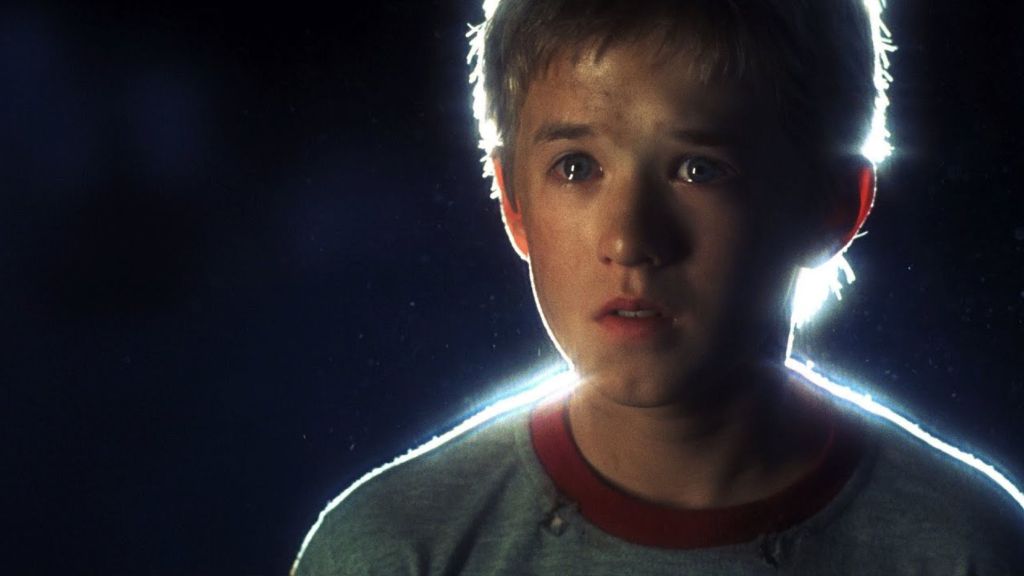
A.I. is set in the 22nd century where climate change has dramatically changed the climate and the landscape and put humanity on the decline, humanoid robots — aka mechas — have become a major part of society, designed to fulfill various roles. One is David, an 11-year-old prototype mecha child who is highly realistic and is designed to be capable of experiencing love. He’s given to a family whose son is ill and while David bonds with Monica, the mother, when the sick son is cured, things deteriorate for David and he’s meant to be destroyed, but Monica abandons him to spare him instead. David ends up on a journey, along with a prostitute mecha, Gigolo Joe, trying to seek out the Blue Fairy from Pinocchio in the hopes she can make him into a real boy.
A.I. is a very bleak movie. Viewers know from the outset that there is no way for David to ever become “real” but his programming that makes him feel and seek love, specifically Monica’s maternal love, creates some uncomfortable feelings and questions, specifically the idea of how “real” something artificial really is when it so can so closely mimic the human experience and what that approximation of reality means to how we treat and interreact with such creations. At the time, it was easy to write off the film’s story and moral questions as part of this odd sci-fi fairy tale — one that has a sort of gray resolution and not exactly a happily ever after — but 25 years later, A.I. companionship that closely mimics humanity in some respects is much more of a reality. It’s brought the world of science fiction into reality and it makes watching Spielberg’s underrated film a very different experience today.
What do you think? Leave a comment below and join the conversation now in the ComicBook Forum!
Most Viewed
-

Official art by Bastien Lecouffe-Deharme -

A photo of the Retrovolt Arcade taken in 2017, showing several classic arcade cabinets and stools. -

Image courtesy of Tor Books/Macmillan