Last summer came a surprising addition to the horror canon, some twenty-plus years in the making, when 28 Years Later brought Danny Boyle and Alex Garland back to the zombie franchise that revitalized the subgenre in the early 2000s. Even more surprising than the fact that the movie got made at all was perhaps that it was actually great. With their new film, they not only charted a fresh course in their series but proved that their collaboration is a winning one. Despite Boyle having left the horror genre behind since the original film, he proved to have not missed a beat, incorporating his frenetic style and distinctly British POV into a horror movie blockbuster.
Videos by ComicBook.com
28 Years Later didn’t arrive in a vacuum, though, as the sequel was pitched from the beginning as a trilogy of movies. The first two films were even shot back-to-back since some of the same characters and sets would be used, and now, just 28 weeks after the last film (get it?), we’ve come to the second film in the series, 28 Years Later: The Bone Temple. Though Boyle isn’t in the director’s chair this time, filmmaker Nia DaCosta steps in for the sequel, bringing with her a distinctly different energy and interest from the previous installment. As a result, she’s given us one of the most interesting horror movie sequels of the decade, one largely memorable because it defies expectations.
Rating: 4.5 out of 5
| PROS | CONS |
|---|---|
| Remarkable performances | A distinctly different visual style from the first film |
| Surprising story developments | |
| An awesome ending |
28 Years Later: The Bone Temple Takes the Narrative Deeper
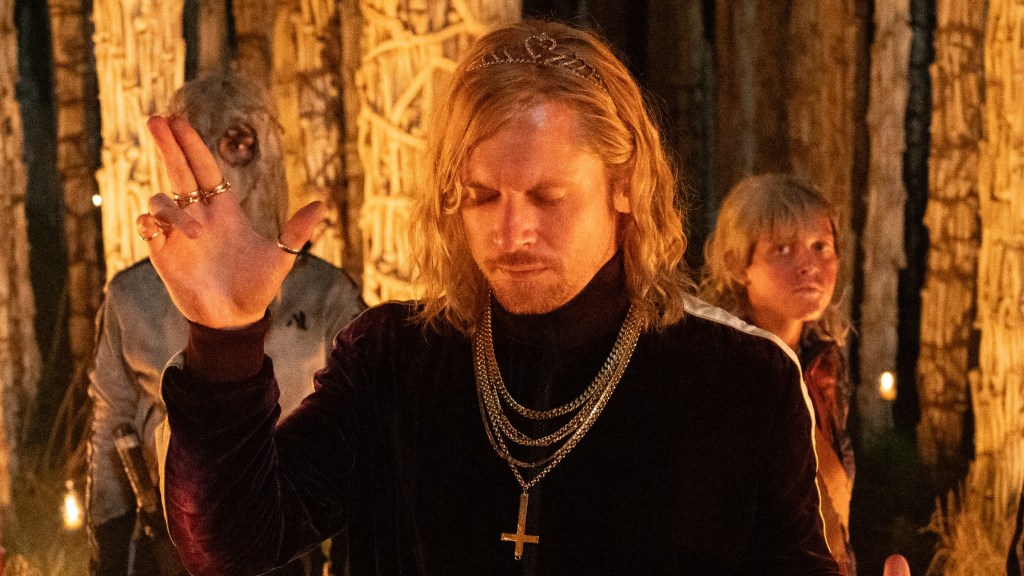
Picking up not too long after the events of the first 28 Years Later, The Bone Temple carries over two major threads from that film as the backdrop for its narrative. The first is Spike, Alfie Williams’ young character, who had his world rocked upon his first real trek outside of his village. At the end of the first film, he encountered the enigmatic Sir Lord Jimmy Crystal (Jack O’Connell) and his bizarre cult of followers who all wear the same track suits and blonde wigs, a la Jimmy Savile. Captured by these creeps and forced to fight for a spot in their ranks, Spike is learning the hard way that life outside of his home isn’t as freeing as he thought.
On the flipside, The Bone Temple returns to its titular location to offer more of Ralph Fiennes as Ian Kelson, the eccentric doctor who has built a monument to the dead and remains eager to study those still infected by the Rage virus. For now, he’s specifically driven to learn more about Samson (Chi Lewis-Parry), the gigantic Alpha who has claimed the neighboring forest as his territory.
What’s most interesting about these two storylines, which feel completely alien to each other in many respects, is how they come together. As noted, to spoil both the plot and the iconic poster for the film would stir disbelief; it must truly be seen to be believed. This is where Alex Garland’s screenplay reveals itself to be remarking on the modern era in a distinct way that only horror movies can, as it details these rival viewpoints of the world, rooted in both violence, a misunderstanding of science & belief, but also what is even real. These two plots, when combined, build to a crescendo that ties them together perfectly and makes the film a truly compelling experience.
The Bone Temple Is More Interested in Meditative Moments (But Still Has Stomach Churning Gore)
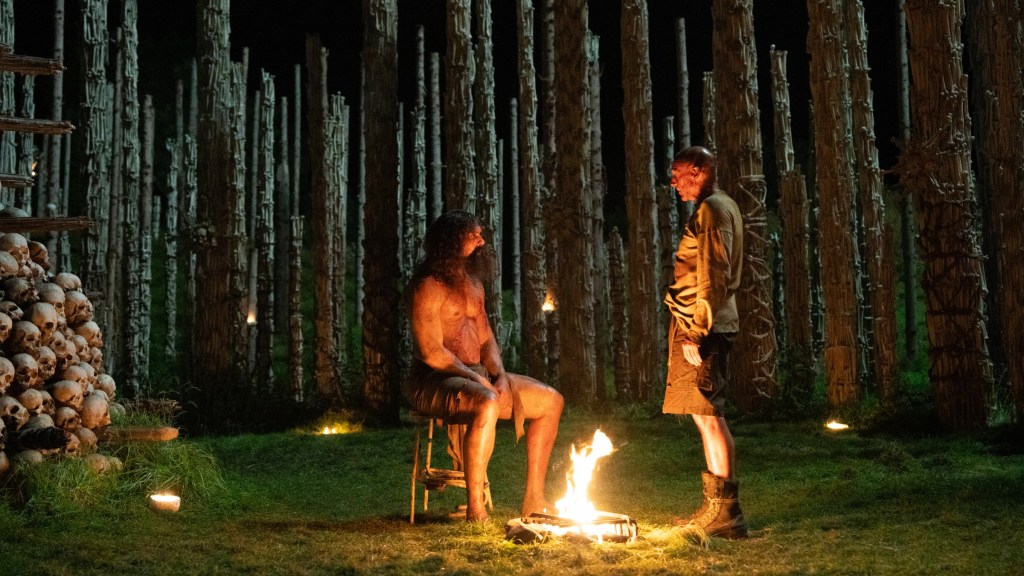
The most surprising thing about 28 Years Later: The Bone Temple is how it juxtaposes the two stories at its core. On one end are the Jimmys with their clear Clockwork Orange influence, roaming the countryside to terrorize people trying to live as normal a life as possible while satisfying only the ego of their leader and his chaotic whims; on the other is the quiet, reflective Dr. Kelson and his interest in how the Rage virus has evolved and what it’s really doing to the people it infects. Across the scenes with the Jimmys, the violence is explicit and disturbing, with skin-flaying torture, burning bodies, and spurting arterial blood spray. When Kelson is on screen, however, there’s more than one instance of him dancing to classic rock music while also pondering existential questions about the infected.
This might seem anathema to what horror fans are expecting from a sequel to a major zombie movie, but it shows a really impressive capability from DaCosta, who naturally finds the balance between living in the grotesque violence of a moment and lingering on a deeply emotional line reading, letting the audience stew in the revelation of dialogue. These things are not so different in terms of the filmmaker’s toolbox; although their aesthetic distinctions dictate one is boisterous and the other soft, they work together to show the many different ways people inhabit and view the world. That said, watching the film directly after revisiting Boyle’s work does reveal a distinct difference in visual style. It’s not inherently a bad thing, and DaCosta trying to imitate Boyle’s pace would be a disservice, but it makes the fidelity between films somewhat jarring.
At the end of the day, 28 Years Later: The Bone Temple is a horror movie where zombies rip people’s heads and spines from their bodies, where brains get eaten like candy, and where blood spatters across the screen, but it’s also about how distinct views are grounded in the world, how characters try to justify them in the face of challenges, and how they play a part in maintaining the status quo.
28 Years Later: The Bone Temple Is Grounded By Its Incredible Cast

Given that The Bone Temple is operating from a distinctly reflective viewpoint, there are two elements of the movie that have to work well. The first is DaCosta’s direction, which exercises patience across the narrative and creates a tempo that allows this story to really cook for the entire runtime. The second, and the one that really makes this film so memorable, is the performances.
Fiennes’ Dr. Ian Kelson was revealed as a misunderstood and eccentric character in the first film, with The Bone Temple adding further nuance to all of those levels. Not only do we continue to see the depth of curiosity at play behind every decision that Kelson makes, but Fiennes plays him with an unfathomable level of interest in understanding everything around him while also making sure to show off his playful side. There are multiple instances of jokes made by Kelson seemingly for the amusement of only himself, but Fiennes gives a performance that’s captivating in its sensitivity.
On the flipside, Jack O’Connell is, as expected, terrifying as Sir Lord Jimmy Crystal. Though his performance in Sinners as the sinister Remmick was one of a master manipulator, whose supernatural powers made him a god walking among men, his character in 28 Years Later: The Bone Temple is a different kind of malevolence. Jimmy Crystal is defined by his arrested development and the childlike naivety that dictates every decision he makes. Having cultivated a loyal following over the years, all based around the aesthetics of a known sex pest who utilized his position of power to carry out heinous acts, Sir Lord Jimmy Crystal is making it up as he goes along. One moment, he’s waxing poetic about an episode of the Teletubbies, and the next, he’s prepping his cult to carry out a violent atrocity. Though clearly a sociopath with a keen interest in inflicting violence and taking anything he wants, O’Connell’s ability to manifest a childlike uncertainty behind Jimmy Crystal’s gaze is proof of the distinct subtleties that he brings to every character.
There are two more heavy hitters in The Bone Temple worth highlighting, with Alfie Williams bringing more layers to his character as Spike experiences the gut punch of understanding his fellow man isn’t always so nice. He works as an interesting inverse to O’Connell’s Jimmy and how their lives have been shaped by the outbreak of the Rage virus and the fall of the UK. Erin Kellyman plays one of Crystal’s followers, Jimmy Ink, with a rebellious streak and an uncertainty about the messages she’s being told. She’s fun to watch and carries herself well in a movie full of testosterone.
It would be heinous to spend all this time talking about the performances in The Bone Temple and not shout out Chi Lewis-Parry’s work as Samson, the Alpha infected, whose terrifying sequences in the first film earned him the distinction of one of cinema’s most unique zombie characters. There’s an evolution to Samson in the sequel that makes sense after the previous film, one that peels back layers and allows him to perform with emotion in his eyes, revealing a tenderness and fragility that is quite cathartic to witness. This may be tough to imagine, as this is a character we also watch peel layers off of a ripped-open brain and eat, but it’s true. With The Bone Temple, Lewis-Parry has cemented Samson as one of the most interesting movie monsters of the 2020s, and maybe the millennium.
28 Years Later: The Bone Temple is a deep, metaphorical movie that challenges the audience while also entertaining them. It’s tough to say if it’s really better or worse than the first movie because they’re so distinctly different, but what’s noteworthy is how well both of them achieve what they’re aiming for. It’s a fantastic sequel that defies expectations while also satisfying them, and boasts one of the greatest endings from a horror movie in a franchise in years. It’s unclear how the third film in the series will play out, or when it will even arrive, but The Bone Temple has it primed to be killer.
Most Viewed
-

Official art by Bastien Lecouffe-Deharme -

A photo of the Retrovolt Arcade taken in 2017, showing several classic arcade cabinets and stools. -
Image courtesy of Tor Books/Macmillan -

Courtesy of Saber Interactive -

Courtesy of TOHO Animation