Nobody could have predicted how important Buffy the Vampire Slayer would become. “I thought it would make a good show,” Joss Whedon told Entertainment Tonight back in 1997. “I thought, I’ll make a show about high school that’s a horror movie just as my high school was, and that’s something that I really wanted to talk about. I knew there would be a lot of fun there.” But even he was left reeling by the show’s success, because Buffy became one of the defining shows of the ’90s.
Videos by ComicBook.com
It’s true that Buffy‘s legacy is a lot more complicated now, with Sarah Michelle Gellar herself admitting the show had “an extremely toxic male set.” Many of the young cast were new to Hollywood, meaning they simply didn’t know something was wrong. But the stars insist they hope Buffy‘s legacy still remains, and there’s a revival in the works under Disney that many hope will be as iconic as the original show – but without the toxicity. Today is a day to take a moment and look back at that legacy… because it’s Buffy‘s birthday.
Today Was the Day Buffy the Vampire Slayer Began
Buffy the Vampire Slayer began as a 1992 movie that pretty much flopped in the box office, but Whedon turned into a successful TV show that launched March 10, 1997. Looking back, all the core elements are there in the pilot; Gellar as the kick-ass heroine who subverts the trope of the blonde cheerleader hunted by monsters, David Boreanaz as the brooding Angel, and of course the Scoobies. That first season blends action worthy of any superhero series with teen drama and heartache, as Buffy Summers navigates both a Hellmouth and high school.
There’s a sense in which that Hellmouth serves as the perfect symbol of Buffy‘s greatness. It’s not a coincidence that the Hellmouth lies beneath Sunnydale High, because Buffy uses the supernatural as parables of real-world experiences every teenager could understand. There are first dates, awkward school plays, unrequited crushes, and ambitious students who ride roughshod over everybody else. The characters start out a little rough around the edges, but the show is anchored by incredible performances, and the potential is visible right from the start.
It’s Impossible to Exaggerate Buffy’s Influence on Pop Culture
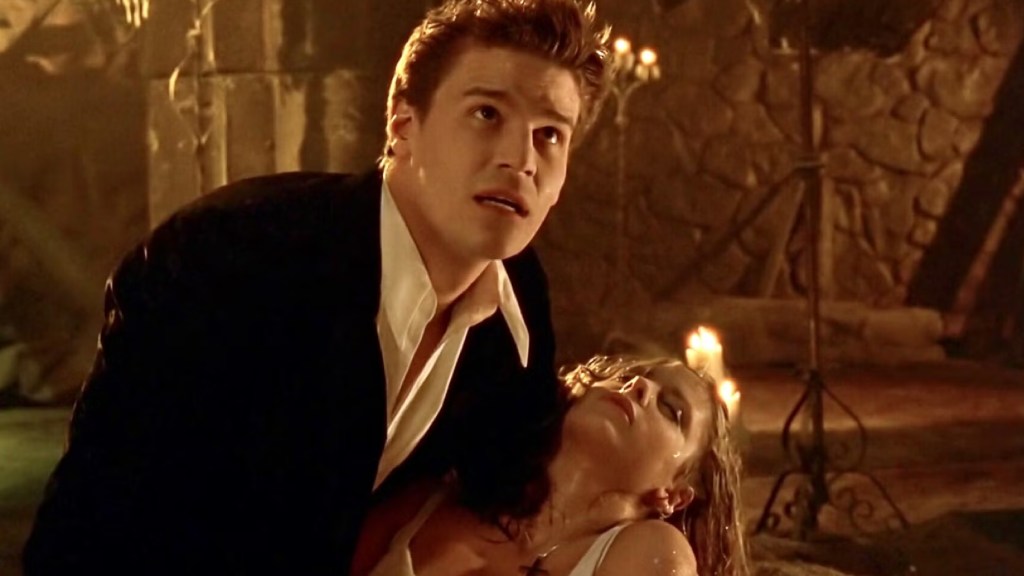
Modern viewers are used to kick-ass heroines – think Shadowhunters, Jessica Jones, or Orphan Black. It’s true there had been action heroines before Buffy – many of whom inspired Whedon’s own creation – but this was the show that really made them the norm. The episodic format was perfect for this kind of story, while progression through high school (and, later, college) meant every season naturally aged up. It was the same kind of approach J.K. Rowling attempted to use with Harry Potter, but frankly a little better-done.
But Buffy had other effects, too. Horror fans had always known vampires should be played as sexy (Anne Rice’s Vampire Chronicles were particularly influential), but Buffy turned the idea mainstream. Angel and James Marsters’ Spike became popular heartthrobs, Angel even getting his own spinoff, and the process was trope built to a head in the 2000s courtesy of Stephanie Meyers’ Twilight. Whatever your opinions on Twilight may be, Buffy occupied a similar “sexy vampire” space, and prepared the way for the stories we now take for granted.
The Scooby gang became influential, too, setting the pattern for heroes to exist in a “group” context where the secondary characters had their own journeys as well; there were major character deaths, resurrections, retcons, and expanding casts. Looking back, the push-and-pull between the lonely Slayer and the Scoobies around her was the inspiration for every CW superhero show. Buffy dared to tell LGBTQ+ stories too, making Willow gay and showcasing her story (albeit with some unfortunate arcs that are now heavily criticized, such as the overused “Bury Your Gays” trope).
It’s impossible to overestimate the importance of Buffy the Vampire Slayer. Without Buffy, television would never have embraced the idea of season-long arcs, meaning you can pretty much write off every important TV show of the 2000s. What’s more, the show’s style and storytelling approach informed everything from the Arrowverse to Doctor Who. It’s true that Buffy‘s legacy is much more complicated now, but this is a show that is thankfully far greater than Joss Whedon. So we can only echo Sarah Michelle Gellar herself, trusting that Buffy‘s influence still endures, and hoping that the future will be kind to this franchise as it resurrects itself.
What do you think? Leave a comment below and join the conversation now in the ComicBook Forum!
More TV Shows
-

Image Courtesy of Universal