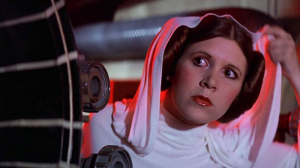
Imagine learning you had a son after more than 20 years, bursting with pride at seeing the talented young person he’d become, excited at the prospect of finally getting to know him, only to lose him after just a matter of weeks. Few moments in Star Trek history have hit as hard as witnessing the usually calm and collected Captain Kirk’s emotion at losing his son, and with him, all that could have been between them. 1984’s Star Trek III: The Search for Spock, saw Kirk powerless to help, as his son David Marcus is murdered in cold blood by a Klingon in an attempt to save his friends. It was an unexpected but brutal reminder of the dangers of the lives our characters lead and that even Starfleet legends aren’t immune to personal tragedy. Plot armour can only get you so far.
Videos by ComicBook.com
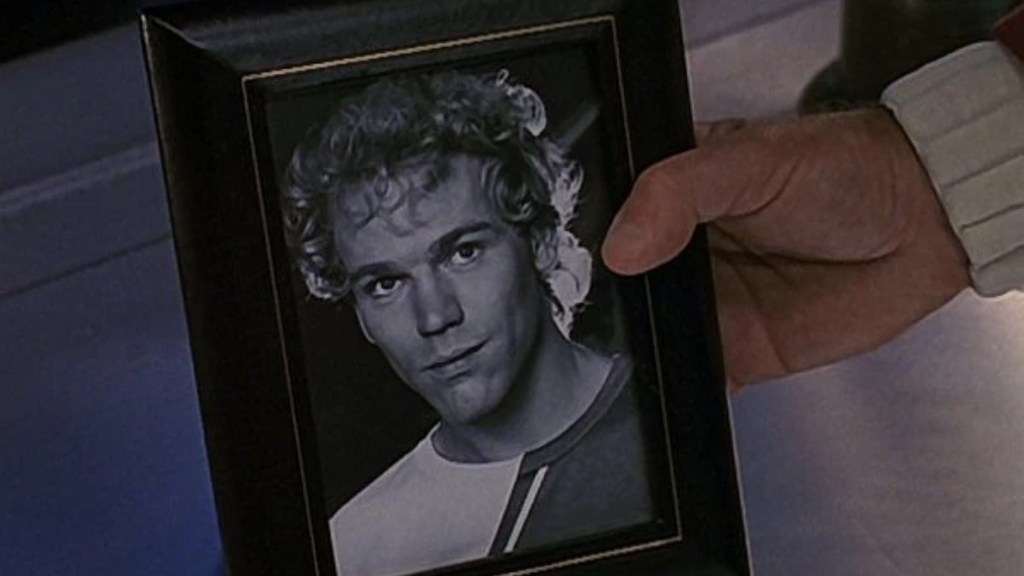
Given David Marcus was only introduced just 2 years prior in 1982’s Star Trek: The Wrath of Khan, fans were understandably shocked when he was killed so suddenly in the very next film, cutting short what could have been a father/ son relationship for the ages. Born as a result of one of Kirk’s early flings, David’s existence was kept a secret from his father by his mother Carol Marcus for over two decades. His reveal as Kirk’s son all these years later, represented what seemed to be the potential beginning of a whole new chapter in Kirk’s life, as he embraced a new side to himself as a father. For more than four decades, David’s premature death has stood as perhaps one of the franchise’s more unexpected and tragic twists.
Now, Star Trek: Starfleet Academy’s latest adventure has delivered something even more devastating. Through the story of Captain Nahla Ake, the series has reimagined the loss of a child in a way that feels colder, crueller, and more psychologically haunting than any grief Kirk endured.
Kirk’s Loss and the Measure of Personal Tragedy
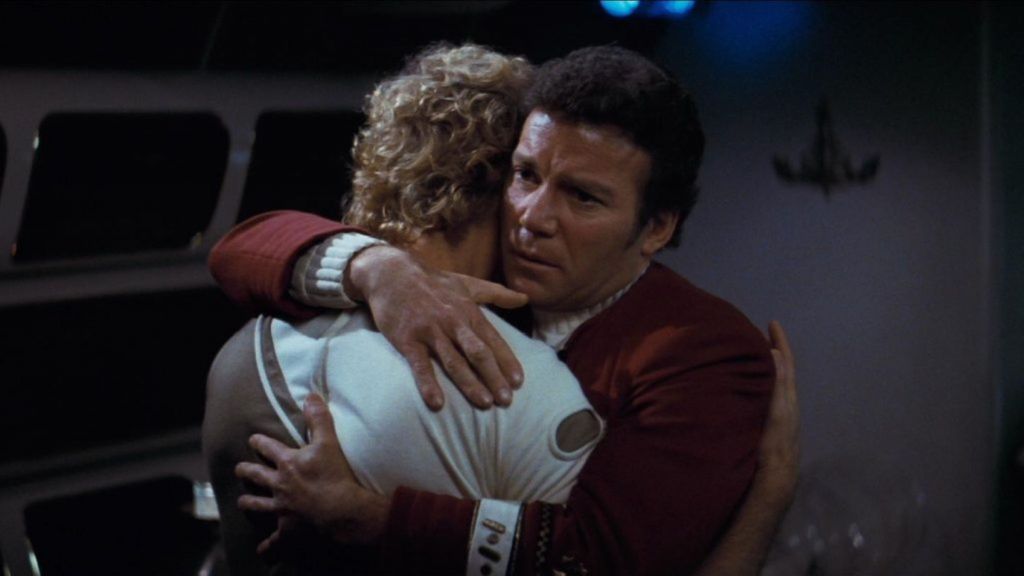
When Kirk loses his son, it’s sudden and violent. The Klingons kill David during a kind of hostage situation gone wrong, when he bravely (or foolishly) confronts them to prevent them from killing Spock or Savvik, essentially taking their place. The power of the moment lies in its sudden finality. Kirk is robbed of any chance to intervene. His son is gone in an instant, the Klingons killing him just to make a point before Kirk even has a chance to negotiate.
However, while the loss is heartbreaking, the real tragedy (as much as the loss of a young life in and of itself is tragic) is the sense of what could have been, and all that David left behind. We were certainly deprived of a potentially fantastic bit of character development for Kirk.
If we’re being brutally honest, as Kirk has only been aware of David’s existence for a matter of weeks, he didn’t truly know his son when he was so tragically taken. Not that it wouldn’t still be devastating to lose a child, whatever the situation, but in many ways, Kirk is grieving the relationship he never had. It’s more the ‘what if’ that’s the kicker here, with David being so cruelly ripped away before Kirk truly had the chance to know him. The death is shocking and devastating, but it is also mercifully brief. David is gone almost before Kirk has a chance to process what’s happening. Ake’s story on the other hand, offers no such release.
Starfleet Academy Introduces A Choice No Parent Should Have To Make

In Starfleet Academy’s latest episode, “Come, Let’s Away” we learn from a bitter Nus Braka (the Venari Ral pirate and reoccurring villain of the series) determined to shake up the usually unflappable Lanthanite, that Ake’s son once served on a vessel caught in a catastrophic singularity drive disaster similar to that of the U.S.S. Miyazaki (the focus point of the episode).
Like the U.S.S. Miyazaki, (which is now being used as a training ground for cadets for exercises on crisis response) the malfunction began tearing Ake’s son’s ship apart as systems failed one by one. Like Kirk, Ake witnessed her son’s imminent demise from a distance, but unlike Kirk, Ake wasn’t simply a powerless bystander looking on from afar. She was forced to choose.
Ake received the distress call from her son’s ship and could have gone to help, but it would have required her to abandon her own crew. Faced with the impossible choice of leaving her post in the hope of saving her son, or following protocol and prioritising her own crew, Ake made the impossible call to abandon her own son in his time of need, and sealed his fate in the process.
What’s worse is that it wasn’t a split-second decision made in the heat of the moment. Her son’s vessel didn’t explode instantly, but slowly, systems collapsing and crew dying painfully one by one.
By the sounds of it, both Ake and her son had plenty of time to realize what was happening, plenty of time to hope and pray, plenty of time for her to decide to try to save her child after all. He had time to be afraid. And Ake had moment after moment to watch as her son suffered – and yet do nothing. It was clearly a decision made in the name of duty. Ake did what Starfleet officers are trained to do — prioritise the many over the few — but she paid for it with her child’s life.
A Darker Kind of Star Trek Tragedy
What makes Ake’s loss even more unbearable is her species’ relationship with time. They say time heals, but, as Nus Braka so helpfully points out, her people do not experience time the way humans do. Being immortal, Lanthanites don’t really experience the passage of time, so pain doesn’t fade into abstraction. For Ake, her son’s final moments are ever-present, something that will be with her forever. Kirk mourns David, yes, but he is allowed to move on from his grief. Ake is trapped with hers forever, in many ways it’s a loss without end, the guilt her own personal form of torture.
As if that were not enough, Starfleet Academy compounds Ake’s suffering through Braka’s betrayal. In a not-so-shocking turn of events, a training mission gone awry leaves a group of cadets stranded on the U.S.S Miyazaki after it is attacked by a new and fearsome adversary – alien human hybrids known as the Furies. Among the cadets is Ake’s surrogate son of sorts, Caleb.
The parallels are clear, and in her desperation not to repeat history and to protect her cadets, Ake reluctantly agrees to work with Nus Braka (who just so happens to be the only person with prior experience of defeating the furies). It’s a fragile truce that, of course, ends with the pirate double-crossing them.
Braka, being Braka, plays the Starfleet gang like a fiddle. After supposedly helping by revealing that the Furies can be defeated using a specialized sonic weapon, it turns out that his real goal was ransacking the nearby highly classified J-19 Alpha Station when its usual guard dog the USS Sargasso was sent to help the Athena blast the Furies to hell.
Ake places her trust in Braka, a trust that is soon brutally exploited. Her actions led to his ransacking of a space station and the deaths of countless Starfleet personnel, including the Vulcan cadet B’Avi and Commander Tomov. Indirectly, Ake becomes the unwilling participant in yet another tragedy. This time she saves her kids, but at the cost of many other lives. Only this time, she didn’t just sit by and do nothing, she must live with the knowledge that her choices helped enable the destruction.
While Kirk’s loss remains shocking because it shattered the illusion that heroes are untouchable, Ake’s story goes further. It suggests that sometimes, loss and grief is something you bring upon yourself. Where Kirk was a victim of an unfortunate series of events, Ake is a victim of responsibility. Her trauma is not imposed on her by anyone other than herself. She chose this, all out of necessity and morals, and now she has to live with herself.
That distinction makes the grief harder to live with, harder to process. By turning loss into a moral burden that never truly fades, Starfleet Academy delivers one of the darkest emotional arcs the franchise has ever attempted for a character. Kirk lost his son. Ake sacrificed hers. And that distinction makes all the difference.
What do you think? Leave a comment below and join the conversation now in the ComicBook Forum!
Most Viewed
-

Official art by Bastien Lecouffe-Deharme -

A photo of the Retrovolt Arcade taken in 2017, showing several classic arcade cabinets and stools. -
Image courtesy of Tor Books/Macmillan -

Courtesy of Saber Interactive