X-Men ’97 introduces us to a world without the X-Men, and it’s not pretty. The end of X-Men ’97 Season 1 saw the X-Men scattered across time and space, with Bishop and Forge forged to navigate the timeline to rescue them. But that leaves 1997 without its greatest mutant defenders, and it’s down to the remaining heroes to fill the gap. Step forward not one, but two superhero teams.
Videos by ComicBook.com
On the one hand, we have X-Factor. Introduced in the classic X-Men: The Animated Series episode “Cold Comfort,” this group work with the US government. On the other hand, we have X-Force; a black ops team created by Cable, dedicated to hunting down Apocalypse and his agents. In the comics, these two teams became rivals – and it turns out the same is true here, too. Now, the X-Men are getting their own superhero civil war.
X-Factor & X-Force Are Fighting For the Same Reason the Avengers Split

X-Men ’97 Season 2, episode 2 wastes no time pitting X-Factor and X-Force against one another. To be fair, it’s something of a tradition in the superhero genre; whenever two superheroes (or teams) meet, their first interaction must be a fight. This time round, though, there’s a logical ideological reason: the question of accountability. X-Factor believe in democratic oversight and accountability, and it’s key to their attempt to restore mutant-human relations; they want to prove the two can work together. Cable is a man on a mission, and he believes that comes first.
X-Men ’97 (mostly) sides with X-Force on this occasion. They get the title credits, while the prison cells run by X-Factor look pretty barbaric (mutant teenagers are imprisoned there, for unknown reasons, with Genosha-style inhibitor collars around their necks). Jubilee sees through X-Factor in a heartbeat, talking Polaris round and leading a jailbreak, and the overall arc is clearly supposed to be one in which Polaris questions X-Factor and even turns on them. But, that said, there are also hints Cable’s philosophy is flawed too; he’s willing to kill without remorse, and he certainly has a messiah complex.
What’s particularly interesting, though, is that the methods used by X-Factor are deliberately reminiscent of the Avengers during Civil War. They have their own prisons, albeit on a SHIELD helicarrier rather than the Raft. What’s more, they are able to offer political amnesty to mutants who help them. Given X-Force’s extreme methods, it’s easy to see why they consider Cable and his team something of a priority.
X-Men Comics Made X-Factor Versus X-Force Even More Brutal
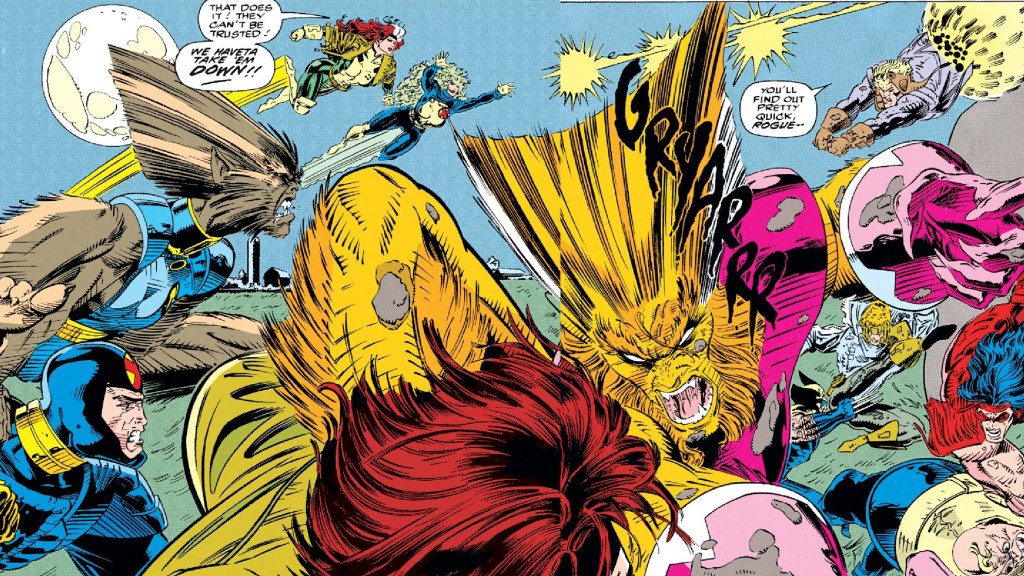
The X-Factor and X-Force rivalry is lifted straight from the comics, where the two teams had the same kind of ideological difference. It all culminated in the 1992 X-Men crossover event “X-Cutioner’s Song,” in which Cable’s insane clone Stryfe shot Professor X. Believing Cable responsible, the X-Men and X-Factor teamed up to take X-Force down, leading to a series of brutal fights. Ironically, then, X-Men ’97‘s little scrap is a far smaller-scale brawl than anything we’ve seen in the comics.
That’s partly because these were the ’90s, a time when darker, grittier storylines were in vogue, complete with certain superhero archetypes. This was the age of the antihero, with X-Force on the front line of this evolution. The X-Force team included a wildcat mutant named Feral, making for fun battles with the equally animalistic Wolfsbane; that dynamic doesn’t exist in X-Men ’97, meaning we’re spared the more bloodlusted versus matches.
X-Men ’97 parallels Jubilee and Polaris, two former X-Men who are facing the same question: how to honor the X-Men now they’ve gone. Polaris represents the X-Men’s desire to establish peace between man and mutant by working with the authorities, but pushed to the logical extreme. In contrast, Jubilee is part of an unaccountable strike team – and the lines are more blurred than ever before under Cable’s leadership, because he has no qualms with killing or conducting telepathic assaults. The X-Men themselves trod a careful balance, but neither Polaris nor Jubilee have quite managed to pull this off.
Marvel Will Never Be Able to Answer the Civil War Question

There’s a reason this particular debate will always be topical; it lies at the heart of the superhero genre itself. Superhero stories are really power fantasies, and the X-Men most of all, because they imagine a scenario where literally anybody could spontaneously develop super-powers. But how do you live in a real world where power fantasies are played out on a super-powered scale? That’s where the tension of registration acts and Sokovia Accords comes in. By making the tension explicit, Marvel establish the drama as a central part of their shared universe. X-Men ’97 is simply considering that trend, taking it to its logical extremes as the mutant community schism.
The first three episodes of X-Men ’97 are streaming now on Disney+, and new episodes will be released weekly. Leave a comment below and join the conversation now in the ComicBook Forum!
More TV Shows
-

Image Courtesy of DC Comics -

Image Courtesy of 20th Television Animation -
Courtesy of 20th Television Animation