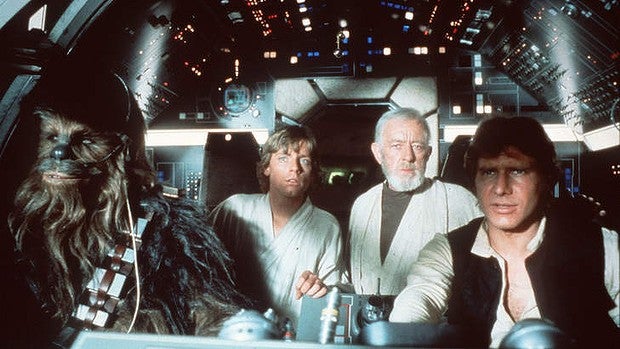
Even though it’s been repeatedly pointed out that one of Star Wars‘s key “errors” is the fact that sound can’t travel in the void of space, it doesn’t change the fact that the franchise is a masterpiece of sound design.
Videos by ComicBook.com
The iconic noises created for the film are instantly recognizable, even decades after the first film’s release, and one of the lessons of the newer Star Wars movies is that thare are elements of the originals — including the sound — which have proven difficult to improve upon.
So…how did some of the most memorable sound design elements in the history of cinema come to be? Popular Mechanics did the legwork for us, finding recollections from sound designer Ben Burtt to get some clarity…
Star Wars: The Force Awakens, directed by J.J. Abrams from a screenplay by Lawrence Kasdan & Abrams, features a cast including actors John Boyega, Daisy Ridley, Adam Driver, Oscar Isaac, Andy Serkis, Academy Award winner Lupita Nyong’o, Gwendoline Christie, Crystal Clarke, Pip Andersen, Domhnall Gleeson, and Max von Sydow. They will join the original stars of the saga, Harrison Ford, Carrie Fisher, Mark Hamill, Anthony Daniels, Peter Mayhew, and Kenny Baker.
Star Wars: The Force Awakens hit theaters December 18, 2015, kicking off a new trilogy of Saga films as Episodes VIII and IX are already scheduled. The film garnered a record $247 million at the domestic box office and $529 million globally in its opening weekend.
BLASTERS

On a family vacation, Burtt’s father once said in an interview that his son — who carried a recorder with him to capture interesting sounds — discovered the noise they wanted for Star Wars blasters when he struck a rock against support cables for a radio tower.
Apparently, the inspiration was immediate, with Burtt saying then and there that it sounded like a laser gun.
WOOKIEES
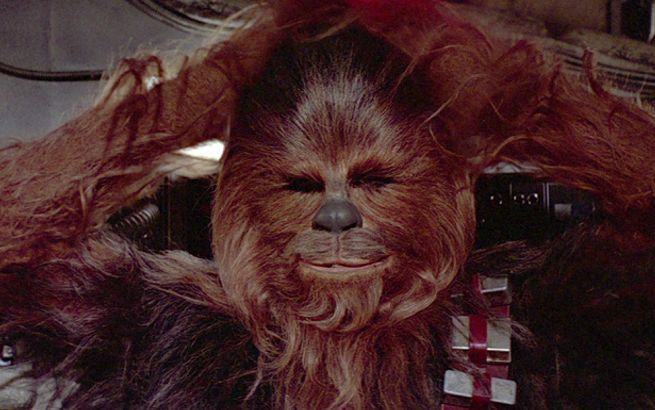
One of the most difficult-to-imitate and elaborate pieces of sound design in cinematic history, the cry of the Wookiee Chewbacca was just as animal in its composition as it is in the final product.
Popular Mechanics reports that Burtt says the composition came down to “mostly bears, with a dash of walrus, dog, and lion thrown in,” with the walrus being a key missing ingredient, discovered when he heard one howling in frustration as its tank had been emptied for cleaning.
VADER’S VOICE

More or less every Star Wars fan knows not only that James Earl Jones was dubbed in over David Prowse to create a more intimidating sound, but that Prowse’s voice has made it onto deleted scenes online that make for some pretty jarring listening.
Once they had Jones, with one of the most recognizable voices in Hollywood history, they modified him using a microphone inside a SCUBA regulator, which gave them a slightly mechanical sound, and amplified the breathing and some echo effect, without being too obviously robotic.
TIE FIGHTERS
Inspired by the telltale wail of World War II bombers, the TIE Fighter is the vehicle with the most distinctive sonic signature in the Star Wars universe.
According to the article, Burtt made the sound by slowing elephant noises way down, and then blending them with the sound of tires on wet pavement.
The elephants in particular came from a 1958 film called The Roots of Heaven, according to the PM story.
ARTOO
Thinking that most of the sounds they were coming up with sounded too automated and lacked personality, Burtt reportedly decided to inject a little of himself into the project.
“Our experiments led to the combination of using my voice doing baby talk, beeps and boops, with the electronic synthesizer,” Burtt said. “So Artoo is 50 percent machine and 50 percent organic, coming out of the performance of a person.”
LIGHTSABERS
Probably the most iconic sound in all of the Star Wars universe is that of a lightsaber powering up and then going to town in a duel.
So…what was it? Just a bug zapper, or something more?
Well, it was pretty elaborate. Burtt recorded the hum of a film projector, and then combined that with a fuzzy crackle that came from a short in the back of his old television’s picture tube, creating the basis for the lightsaber.
To get the impression of the weapon moving around, Burtt literally played the sound over a speaker and then moved the microphone around near it, swinging the microphone closer to and further from the noise to give the impression that if you play that output in a static location, it’s the noise that’s moving around.
Most Viewed
-

Courtesy of Lionhead Studios -

Image via Prime Video -

Courtesy of Toei Animation