For over a decade, ARPGs have been obsessed with perfecting the build, but what if the real evolution of the genre has nothing to do with your skill tree at all? If you love the depth of Path of Exile and you are keeping a close watch on Path of Exile 2 as it develops, you already know how satisfying it can be to craft the perfect building with its infamously large skill tree.
Videos by ComicBook.com
But every so often, a new contender shows up that is not trying to out-complex the giants. Instead, it tries to rethink what an ARPG world can actually be. That is where Darkhaven enters the conversation. This upcoming ARPG is targeting something the genre rarely meaningfully touches, because it is building a connected, persistent world that reacts directly to player behavior. If it delivers, Darkhaven could shift the focus away from pure build mastery and toward actual world impact, which would be interesting, to say the least.
Darkhaven is Building A World That Directly Reacts to You
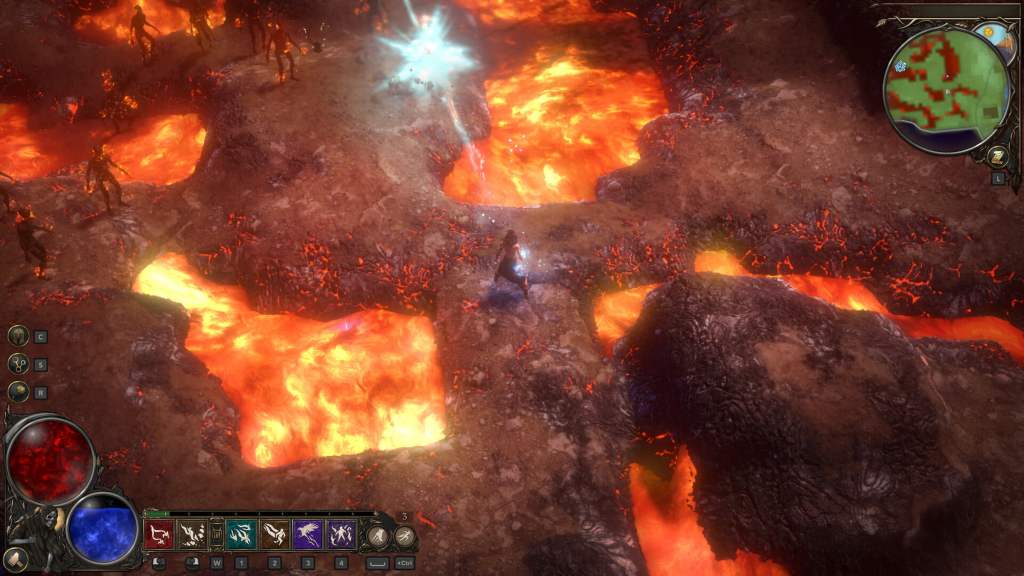
One of the biggest pain points in the ARPG space is how static the world can feel once you step back and look at it. Path of Exile offers staggering mechanical depth, and Path of Exile 2 refines that even further. But the environments themselves are mostly stages on a large grid you can’t really see. You clear them. They reset. You run them again with different modifiers. Your expression lives in your character sheet, not in the world around you.
That structure has worked for years, but it also creates a strange disconnect. You can become a screen-clearing powerhouse capable of erasing entire armies, yet the world barely acknowledges your presence. Zones reset endlessly. Nothing truly persists. For many players, that loop is addictive. For others, it has started to feel limiting, especially when the fantasy is about becoming something powerful enough to reshape reality.
Darkhaven is butting heads against that limitation with its focus on connected realms and persistence. Instead of isolated instances that vanish when you log off, its world is meant to continue evolving. Add in destructible environments that go beyond simple cosmetic breakables, and you suddenly have an ARPG that treats your actions as permanent. If your character grows in power, the world will reflect it, should you use that power. That addresses a long-standing genre frustration by tying player expression to environmental consequence, not just damage numbers.
Freedom and Creativity in Combat and Exploration
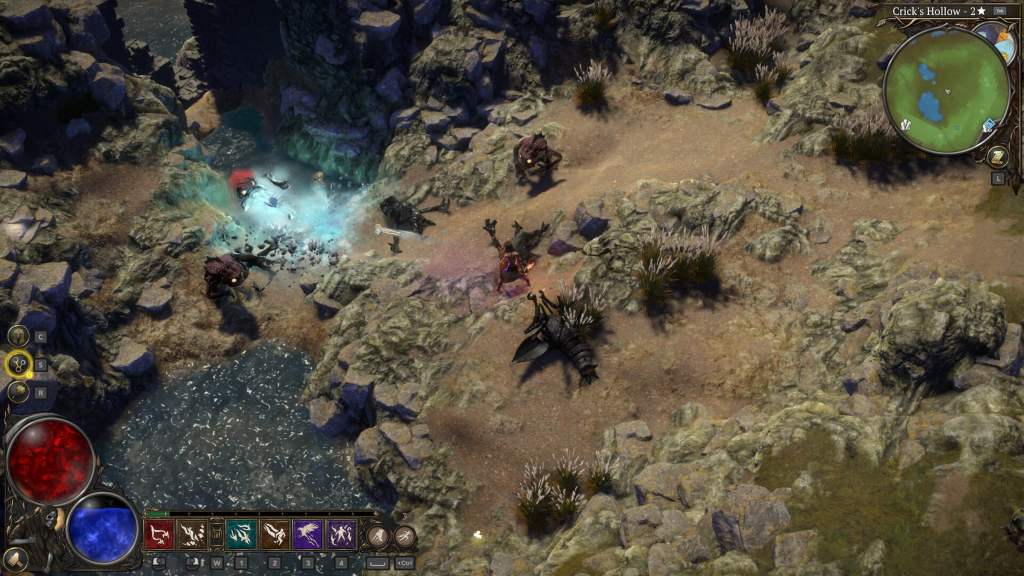
If Path of Exile excels anywhere, it is in buildcraft. The passive tree is iconic for a reason, and Path of Exile 2 has doubled down on meaningful skill identity and synergy. If you enjoy theorycrafting, there is nothing more satisfying than assembling a build that feels uniquely yours.
But most of that freedom exists in calculations and interactions. Combat encounters typically happen within structured arenas and predictable systems designed for infinite replayability. You optimize within a framework. You master the math. It is a brilliant design that is adored by many, but it is also undeniably static and controlled.
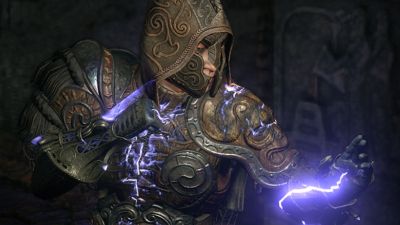
Darkhaven appears to be targeting this aspect as a focus, expanding freedom into the physical layer of the experience instead of just on spreadshoots. When environments are procedural and fully destructible, leading to hidden persistent realms not that unlike something you’d find by digging downward in Minecraft, combat becomes spatial rather than purely statistical, and that is a dramatic change of the tried and true formula.
The battlefield itself can become part of your strategy, while exploration stops being a simple loop of clear and reset. It starts feeling like participation in a shared, evolving space. That shift introduces a different kind of creativity, one rooted in how you act and where you act, not just how you scale your damage.

None of this means Darkhaven is trying to dethrone the complexity crown. While the game seeks to seriously tackle the common minimizing itemization issues that often plague games in the genre, Darkhaven also feels like it respects what Path of Exile does so well while deliberately carving its own lane. Instead of asking how to make the next passive tree bigger, it is asking how to make the world and loot matter more. It’s an experiment worth paying attention to.
The game is still in early development, and ambition alone does not guarantee execution. But the fact that Darkhaven already has an available demo you can try alongside an ongoing Kickstarter makes it completely worth noting down to keep an eye on. In a genre that often evolves through iteration, this feels like a genuine swing in a different direction. And if you are someone who loves the layered brilliance of Path of Exile and its beloved sequel, while craving something structurally different, Darkhaven is absolutely worth keeping on your radar.
What do you think? Leave a comment below and join the conversation now in the ComicBook Forum!