The Wizard of Oz was a cinematic achievement in many ways, but it’s particularly remarkable because of how it utilized color. The opening’s purposely dull sepia tone allowed for an explosive contrast of color when Dorothy opened the door to Oz, and it is still an impressive spectacle today. Even though it wasn’t the first Technicolor movie (a common misconception), it was a technical achievement for the budding medium at large that also specifically aided the film’s storytelling.
Videos by ComicBook.com
While not even close to that level of importance now, Halberd Studios’ debut game, 9 Years of Shadows, pulls a similar stunt to great effect. The grayscale intro level gives way to a staggering color reveal with vivid pixels and a beautifully presented user interface awash in magenta and sky blue. It’s breathtaking and just about the only great thing about this bad game.

RELATED: 6 Best Metroidvania Games to Play in 2025
Shadows fails fundamentally as a search action platformer because of its underwhelming abilities and hobbled progression. Most unlockable powers feel more or less like keys for different kinds of doors because they’re not used cleverly. The traversal moves are never put through their paces or supported by more involved level design. The twisty eyesores that players can sloppily dive kick into for more height demonstrate this wonderfully since they never grow in complexity or add anything to the game.
The offensive upgrades are too situational and not much use against enemies. For example, the move that makes bullets crawl across the floor is not useful during combat and is mostly relegated to triggering specific switches. None of the discoverable armor sets change how melee works in the slightest and only make it more tedious. Having to switch armor sets to damage certain arbitrarily colored enemies does not make combat deeper or more varied since the halberd swing, regardless of color, is basically the same. Even the purchasable upgrades — bought with coins that are laughably hard to save up — do little more than dryly buff attack stats.
With a complete lack of meaningful melee upgrades, fighting is a shallow and outsized part of the game that never grows. Players can only do the most basic slash with a special move that’s too slow to be effective. There are no combos or ways to spice things up. It is as boring as it sounds.

Being basic isn’t a death knell, though; its abysmal controls are. Shadows is generally sluggish, but this is most keenly felt during combat. The rigid, backwards-lurching dodge ripped straight from Castlevania: Symphony of the Night is woefully inadequate and lacks the vital invulnerability frames to keep protagonist Europa out of danger. It’s functionally useless. Having no aerial evasive maneuver is also frustrating, but perhaps for the better since it would probably be as vestigial as its grounded counterpart. When this is all coupled with the noticeable recovery frames tacked on to Europa’s attacks, it’s always abundantly clear how unresponsive Shadows feels at every moment.
Nothing highlights this more clearly than the horribly designed health system. Europa has a couple of health pips that are protected by a manually rechargeable shield. Ranged blasts pull from shield, which is suspect from the start because it seems like a punishment for using one of the game’s mechanics. But the bigger issue is how it recharges. Players can either recharge the bar by standing still and holding the fire button or using a Gears of War-like active reload system to regain meter after it empties. However, both options are terrible in their own fascinating ways.
Staying immobile to recharge is an inactive way to reup and encourages overly safe and boring play. There’s no active skill-based parry that refills the meter. Instead, players are pushed to retreat during and after combat and sit still after it fully drains. Hitting enemies builds some shield, but the amount it yields is paltry enough to not matter.
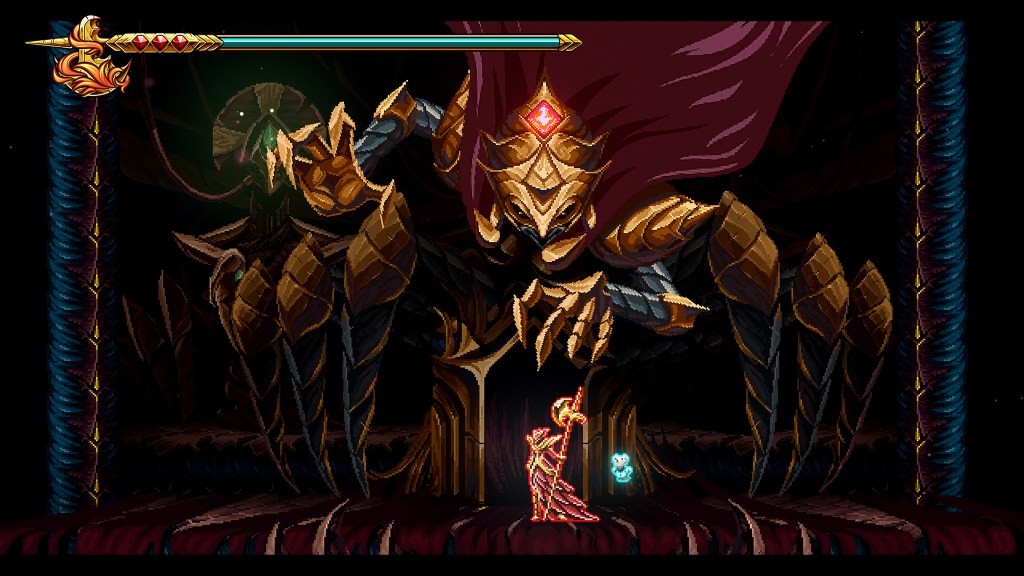
Its repetitive bosses demonstrate how bad this mechanic is at its core. All 22 or so of them spam the same two attacks and rarely let up enough to get a full charge in. Not only do its awful controls (and sweeping, poorly telegraphed attacks) make getting hit an inevitability, but regaining health is also a pain because of how it forces players to stay passive within the throes of an aggressive battle.
It seems like this antagonistic system would push players to use its active reload meter, but it is similarly plagued with unneeded cruft. The meter itself is laggy, and the sweet spot then gets smaller and yields less health after each successive reload. This is overly punitive and calls into question why the game even has a bad active recovery system if it wants to desperately reprimand players for using it.

9 Years of Shadows is thoroughly a pain to play, but almost always a joy to look at. The shock of the aforementioned color reveal sets a high bar, yet the environments that follow are still impressive. The character portraits and stylish Sailor Moon-esque animated intro are the true stars, though, and give these faces a level of vibrancy and detail that pixels, even ones this lovely, aren’t equipped to display. And while there are plenty of games with eye-catching pixel art like The Messenger and Blasphemous, 9 Years of Shadows‘ striking menus and portraits are the extra touches that ensure that no part of its visual presentation is lacking.
Its music is similarly notable with its soothing piano-rich and jazz-heavy soundtrack. It’s directly evocative of Symphony of the Night, an inevitability given how composer Michiru Yamane created music for both games.


Halberd Studio’s next title, Mariachi Legends, already looks similarly stunning with its pixelated depiction of Mexican culture. The character portrait of the well-dressed hero alone is worth fawning over, not to mention the key art featuring a seductive, yet imposing, version of Death. It’s likely Halberd’s artists will once again construct a visually astonishing world.
But Mariachi Legends has to learn from 9 Years of Shadows in order to not be another disappointing mess. Visual splendor can’t unilaterally distract from gameplay that oscillates between dull and dreadful. A glut of repetitive boss fights, an appalling health system, infuriating controls, and an underwhelming batch of upgrades betray the level of quality its intro cutscene and opening 15 minutes demonstrate. The search action platformer genre is already crowded enough as it is, with more than its share of all-time classics like Hollow Knight and Prince of Persia: The Lost Crown. There isn’t room for games like 9 Years of Shadows that dramatically underperform in so many areas, even when they have art this dazzling.
More Gaming
-
Courtesy of Arc System Works -

Image Courtesy of Sony Interactive Entertainment