It takes a lot to kill a horror movie franchise. More often than not, these long-running narratives about death at a summer camp or a boogeyman in a small town can be produced quickly and cheaply, meaning that even in the face of critical revulsion, a paltry box office sum can mean success and a sequel. Even the death of the main antagonist can’t end some of them, with the fourth Friday the 13th film proudly calling itself “The Final Chapter,” only for seven more sequels and a crossover movie to keep the train going. Continuity is also no hindrance, as the Halloween franchise has managed to rewrite its own timeline and exclude its own follow-ups multiple times.
Videos by ComicBook.com
Suffice to say, when a horror franchise really does give up the ghost, it’s something worth noticing, and that very thing happened on this day over thirty years ago. On February 19, 1993, Army of Darkness, the third film in Sam Raimi’s Evil Dead series, was released, and though the movie technically made money and was well-liked by the people who saw it, for decades it became the final entry in a beloved horror franchise. Why that happened is crystal clear now, but at the time, the shift that the series made was one that was daring (and has never been tried again).
Army of Darkness Moved The Evil Dead Into a Totally Different Genre
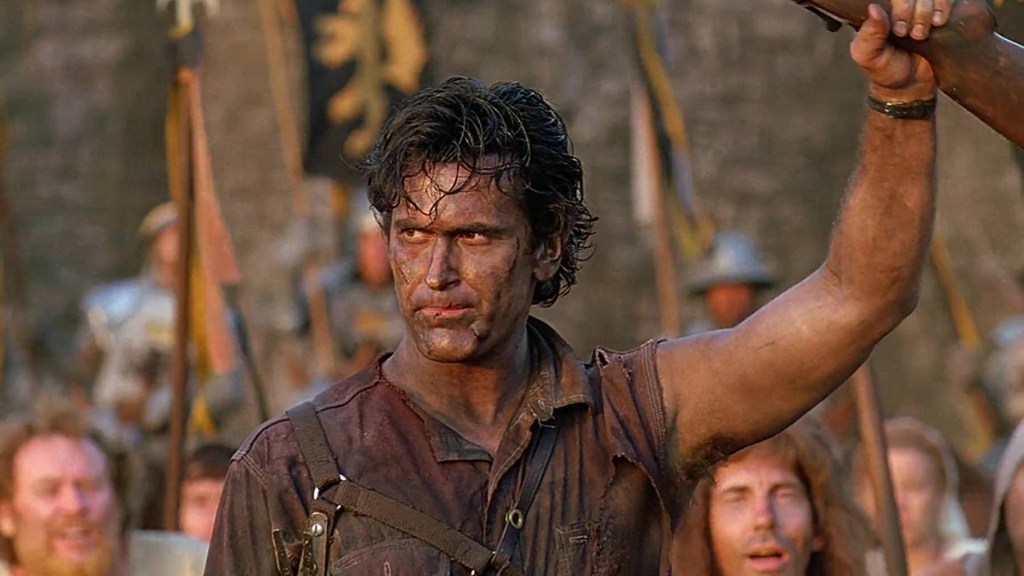
Following the runaway success of The Evil Dead in 1981, grossing almost $30 million on a budget of just $350k, it was clear a new horror franchise was on the horizon when those were arguably at their most popular. 1987’s Evil Dead II not only continued the gross and hilarious adventures of Ash Williams, but set him up in a bizarre way, ending on a cliffhanger where he’s trapped in the Middle Ages. With 1993’s Army of Darkness, Sam Raimi, Bruce Campbell, and Bob Tapert picked up the baton that they previously put down and ran with it in a big way, pushing the limits of what an Evil Dead movie could be from a pure horror film to a slapstick horror comedy, and now into the realm of epic fantasy adventure.
The real trick about Army of Darkness is that even though it technically has these shades of other genres, and is itself playing by the expected structure of those films while also taking the shape of a horror parody of Jason and the Argonauts, it is still very much an Evil Dead movie. Sam Raimi’s trademark frenetic camera shakes are there from the jump, and there’s an endless amount of new monsters who all suffer disgusting and bloody fates. On top of that, Campbell’s performance as Ash in this movie is the one that would actually define his personality for decades, influencing all of the comic books and video games that would be released, even more so than the previous two Evil Dead movies. The majority of catchphrases associated with Campbell’s character hail from this film rather than the first two (save for the iconic “Groovy”).
What’s so distinct about Army of Darkness is how it pushes the film to be even sillier than what came before it, but also even gorier, and, on the whole, bigger. It fits the exact mold of what is expected from a movie series that has gone from a homegrown independent feature to a staple of the studio system. Army of Darkness was produced and distributed by Universal Pictures, which is the exact reason that the movie ended up becoming the nail in the coffin for the series, as their demands for change and expansion put the series in the ground.
Army of Darkness Ended The Evil Dead Series for Decades (But Not Why You Think)

Trouble with Army of Darkness began on the set, with money problems making themselves apparent almost immediately. The film not only required more special effects shots than the previous movies, but also took almost 100 days to shoot. As a result, the budget ballooned, reportedly reaching $12 million at the time. Filming continued to be a problem with Bruce Campbell admitting in an interview with Post Mortem with Mick Garris back in 2023 that, “It was a never-ending nightmare of a shoot.”
The expanded budget and inflated expectations from their studio partners put Army of Darkness at a disadvantage. Given the money spent to make it, and hoping for a hit, Universal wanted to distance the title from The Evil Dead films that preceded it, meaning that when it premiered, there were at least some audiences that had no idea this was a follow-up to two other movies. On top of that, the studio hoped to cut the film down to a PG-13 rating for a wider audience, a detail that film fans know seldom actually works out.
When the film was released, it grossed $11.5 million domestically, putting it in the black. In truth, the fact that Army of Darkness was unable to make its money back or even become a blockbuster had nothing to do with the genre shift or the tonal changes, and everything to do with meddling behind the scenes that put it down the wrong path entirely. In the same 2023 interview, Campbell noted, “We kind of killed the franchise. We killed it for 25 years. It was dead.”
Though Campbell is right, and the series was put down in the face of Army of Darkness‘ flopping, like all good evil, it would never really die. The series was kept alive not only by the many home media releases that came about for every film in the series, but also by the fact that Sam Raimi would become a high-profile director on the success of the Spider-Man movies. Evil Dead also saw countless comic books and video games made based on the property after Army of Darkness was released.
Now, Evil Dead is one of the best places it’s been for some time. Though the drought of movies in the series was finally broken in 2013 with Fede Alvarez’s Evil Dead, Campbell would return to the series for the three-season Ash vs. Evil Dead TV show. 2023 saw the release of Evil Dead Rise, taking the series out of the countryside and bringing it to a high-rise building. Later this year, we’ll see Evil Dead Burn debut, though there’s not much known about it at this point.
Suffice to say, there’s a lesson to be learned from Army of Darkness all these years later. Change can be good for the soul, and even though at the time its failure stemmed from decisions entirely out of the hands of the creatives, the decisions that gave us the iconic sequel have proven to be fruitful. The Evil Dead endures because of its malleability to both form, function, and genre, and it wouldn’t have gotten there without Army of Darkness.
Most Viewed
-

Official art by Bastien Lecouffe-Deharme -
Image courtesy of Tor Books/Macmillan -

A photo of the Retrovolt Arcade taken in 2017, showing several classic arcade cabinets and stools.