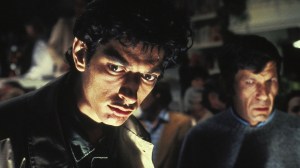
Certain cinematic ambitions are so grand that they demand the invention of new technology to even be possible. James Cameron’s Avatar franchise effectively willed new motion-capture and 3D filming techniques into existence, pushing the boundaries of visual effects by decades. Christopher Nolan has become a modern champion for the large-format IMAX camera, utilizing it in increasingly innovative ways to create unparalleled theatrical spectacle. These are well-known instances where a director’s vision directly spurred technological advancement that changed the industry. However, one of the most revolutionary developments in filmmaking history came from a critically acclaimed but commercially modest film that many audiences have never seen.
Videos by ComicBook.com
Premiering on December 5, 1976, Bound for Glory is a biographical drama directed by Hal Ashby. The film stars David Carradine as the influential American folk singer Woody Guthrie and follows his journey from the Dust Bowl of Texas to California during the Great Depression. Upon its release, the movie was a critical success, earning praise for its performances and Haskell Wexler’s cinematography, which won an Academy Award. Despite its positive reception and cultural significance, the film has largely faded from mainstream memory. Yet, its legacy is cemented by a monumental technological contribution that immediately changed how movies were made: Bound for Glory was the first feature film ever to use the Steadicam.
What Is a Steadicam, and Why Is It so Important for Cinema?

Before 1976, a director who wanted a moving camera shot had two primary options, each with severe limitations. The first was a dolly, a wheeled platform that runs on tracks, which provides a perfectly smooth shot but is cumbersome and restricted to where the tracks can be laid. The second was to shoot handheld, which offered freedom of movement but resulted in shaky footage that was often distracting to the viewer. This technological gap was bridged by inventor and camera operator Garrett Brown, who in 1975 developed a body-mounted camera stabilization system that he initially called the “Brown Stabilizer.” The device uses a harness, an iso-elastic arm, and a counter-weighted sled to isolate the camera from the operator’s movements, allowing the camera to glide through a scene with the smoothness of a dolly but with the freedom of a handheld camera.

In Bound for Glory, director Ashby and cinematographer Wexler needed to capture the chaotic reality of a 1930s migrant worker camp filled with hundreds of extras. Laying dolly tracks across the uneven terrain would have been a logistical nightmare, while traditional handheld cameras would have failed to produce the immersive quality they wanted. Brown’s invention was the answer. For the film’s most groundbreaking shot, Brown, operating his own device, began the take on a 30-foot-tall platform crane. As the crane descended, he simply stepped off and walked the camera directly into the bustling camp, following Carradine through the crowd in a seamless two-minute take. It was a shot unlike anything audiences had seen before, and it demonstrated the narrative potential of the new tool.
The invention of the Steadicam was a fundamental shift in cinematic language. It gave filmmakers the ability to create long, uninterrupted tracking shots that could immerse the audience directly into the world of the film in a way that was previously impossible. Shortly after its debut in Bound for Glory, the Steadicam was used to create some of cinema’s most iconic moments. Sylvester Stallone’s triumphant run up the Philadelphia Museum of Art steps in 1976’s Rocky was captured with a Steadicam, giving the scene its energetic feel. Stanley Kubrick famously utilized the device in 1980’s The Shining to follow Danny Torrance’s (Danny Lloyd) tricycle through the menacingly empty halls of the Overlook Hotel, creating a sense of dread and unease that a traditional dolly shot could never achieve. From horror films to action blockbusters, the Steadicam opened up a new world of creative possibilities that filmmakers are still exploring today.
Bound for Glory is only available in physical media, both on DVD and Blu-ray.
What is the most memorable Steadicam shot you’ve ever seen in a movie? Leave a comment below and join the conversation now in the ComicBook Forum!
Most Viewed
-

Sony Animation -
Troll 2. (L to R) Ine Marie Wilmann as Nora Tidemann, Anne Krigsvoll as Ester J. Tiller, Mads Sjøgård Pettersen as Kaptein Kristoffer Holm, Sara Khorami as Marion Rhadani and Kim Falck as Andreas Isaksen in Troll 2. Cr. Courtesy of Netflix © 2024 -

A Sega Genesis console over a collage of box art from the system's game library. -

Image courtesy of Lucasfilm